
- Accueil

- Reproduction de peinture à l'huile
- Georges Braque
- The Yellow Tablecloth

 Aperçu en situation
 Envoyer
 Partager
 Détails de l'œuvre

 Télécharger
 Articles similaires
 Radiographie
 Diaporama
The Yellow Tablecloth

 Lire la suite
Reproduction à l'huile faite à la main
Huile sur toile peinte à la main, avec cadre et dimensions personnalisés, réalisée sur commande par nos artistes. ( Passer au tirage Passer à l'image)




P118B $10

P118H $10

P118W $10

P438Z $10

P508JH $12

P508YH $12

P805H $10

P805Z $10

P919BZ $10

P919G $10

P919XJ $10

P959ZH $10

P968JZ $12

W106C $8

W218G $10

W218JH $8

W218Y $10

W307PJ $10

W316G $10

W316PJ $8

W316Y $10

W398PJ $8

W4111J $10

W500HY $15

W500JH $15

W692G $12

W849H $8

W940BG $15

W953PJ $8




Choisissez parmi nos formats prédéfinis qui respectent les proportions originales de l’œuvre.

Vous pouvez saisir vos propres dimensions pour l'adapter à un cadre ou à un espace spécifique. Si la taille sélectionnée ne correspond pas aux proportions de l'image d'origine, nous recadrerons l'œuvre ou prolongerons la peinture avec des éléments peints à la main supplémentaires. Une maquette numérique vous sera envoyée pour approbation avant le début de la production.
Veuillez noter que l'aperçu à l'écran ne reflète pas le recadrage ou l'extension réels. Seule la maquette montrera fidèlement la composition finale.
Bien que des tailles personnalisées soient disponibles, nous vous recommandons de sélectionner une dimension dans la liste prédéfinie afin de préserver les proportions d'origine.
Après la commande, l’équipe ArtsDot.com contactera le client par e-mail pour recueillir ses instructions et lui fournira une maquette d’aperçu
Livraison dans le monde entier () en 3 à 4 semaines au lieu des 5 semaines habituelles. (3 août). Aucun compromis sur la qualité.

Livraison express gratuite dans le monde entier

Toile de lin de qualité supérieure

Assurance transport complète

Garantie de remboursement des droits de douane

Garantie de fidélité des couleurs

Politique de retour de 60 jours (uniquement en cas de défaut)

Garantie de remboursement à 100%

Offre de tarifs dégressifs
 L'option verre n'est disponible que pour les dimensions inférieures à 110 cm.

The Yellow Tablecloth
Technique de reproduction
Format de la reproduction
-


Prix total
$ 263
Description de l'œuvre
Georges Braque’s “The Yellow Tablecloth”: A Study in Simplicity and Cubist Revelation
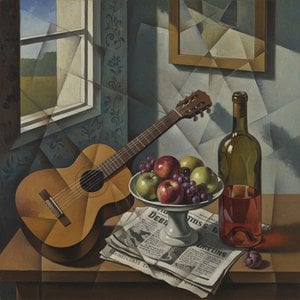
Georges Braque's "The Yellow Tablecloth," painted around 1956, isn’t merely a still life; it’s a distilled essence of form, color, and the burgeoning revolutionary spirit of Cubism. This deceptively simple composition – an arrangement of ripe fruit against a vibrant yellow backdrop – belies a profound exploration of perception and representation, firmly rooted in Braque's pivotal role alongside Pablo Picasso in dismantling traditional artistic conventions. The painting’s power lies not in dramatic subject matter or elaborate detail, but in its carefully constructed geometry and the deliberate flattening of space, hallmarks of the Cubist movement that was reshaping the very language of art at the time. Notice how the table itself seems to dissolve into a series of interlocking planes, mirroring the fragmentation of objects as seen from multiple viewpoints – a core principle of Braque’s approach. The yellow cloth isn't just a background; it actively participates in the composition, creating a warm, almost luminous atmosphere that subtly alters our perception of the fruits within.The Language of Cubism and its Roots in Everyday Life
Braque’s exploration of geometric abstraction began with his early work alongside Picasso, particularly during their “Blue Period” and subsequent “Rose Period.” However, it was in the 1920s that he truly embraced the tenets of Cubism, developing a distinct style characterized by fractured forms, multiple perspectives, and an emphasis on the underlying structure of objects. "The Yellow Tablecloth" exemplifies this evolution. Unlike the more overtly analytical Cubism of Picasso, Braque’s approach is often described as “synthetic,” favoring a more muted palette and a greater integration of collage elements – though not present in this particular work, the influence is undeniable. The painting reflects a shift towards a more internalized exploration of form, moving away from direct imitation of reality and instead focusing on capturing the *essence* of an object through its constituent shapes and planes. The choice of everyday objects—apples, oranges, bananas – elevates the mundane to the level of artistic contemplation, mirroring a broader trend in modern art that sought to find beauty and significance in the ordinary.Color as a Defining Element: The Significance of Yellow
The dominant presence of yellow is not accidental; it’s a deliberate and carefully considered element within the composition. Yellow, historically associated with optimism, warmth, and even madness, carries a complex symbolic weight. In Braque's work, it acts as both a visual anchor and a subtle emotional cue. It creates a sense of intimacy and comfort, drawing the viewer into the scene while simultaneously suggesting an underlying tension or instability – perhaps reflecting the inherent ambiguity of Cubist representation. The intensity of the yellow also contrasts sharply with the muted tones of the fruit, further emphasizing their fragmented forms and highlighting Braque’s focus on shape over color. Interestingly, this particular use of yellow echoes elements found in earlier works by Braque, suggesting a consistent exploration of its expressive potential.A Legacy of Innovation: Braque's Enduring Influence
Georges Braque’s "The Yellow Tablecloth" stands as a testament to his groundbreaking contributions to modern art. It’s a deceptively simple painting that encapsulates the revolutionary spirit of Cubism and demonstrates Braque’s ability to transform ordinary subjects into profound explorations of form, space, and perception. His work paved the way for subsequent movements like Surrealism and Abstract Expressionism, leaving an indelible mark on the history of art. Reproductions of this piece offer a unique opportunity to experience firsthand the intellectual rigor and artistic vision of one of the 20th century’s most influential figures. Consider how the painting's clarity and geometric precision translate into interior design – its clean lines and bold color scheme can be incorporated into contemporary spaces to create a sense of sophisticated minimalism and understated elegance.Œuvres similaires


Biographie de l'artiste
**Jeunesse et formation**
Georges Braque, peintre français renommé, collagiste, dessinateur, graveur et sculpteur, est né le 13 mai 1882 à Argenteuil, dans les Val-d'Oise. Il a grandi à Le Havre et a initialement été formé pour devenir peigneur et décorateur comme son père et son grand-père. Cependant, les inclinations artistiques de Braque l’ont conduit à étudier la peinture à l’École des Beaux-Arts de Le Havre de 1897 à 1899.**Évolution artistique et fauvisme**
En 1902, après avoir terminé son apprentissage auprès d'un décorateur à Paris, Braque a fréquenté l’Académie Humbert jusqu’en 1904. Cette période a marqué son introduction au fauvisme, un style caractérisé par des couleurs vives et des réponses émotionnelles. Influencé par les œuvres de Henri Matisse et André Derain, Braque a adopté une approche fauviste, comme en témoigne son tableau La Patience (fauvisme, huile sur toile).**Contribution au cubisme**
La collaboration de Braque avec Pablo Picasso de 1908 à 1912 a conduit au développement du cubisme. Leurs œuvres cubistes analytiques, telles que Georges Braque: La Patience et Pablo Picasso: Le Clarinette(cubisme analytique, huile sur toile), sont aujourd’hui considérées comme des jalons de l'histoire de l'art.**Héritage et œuvres notables**
* Maisons à l’Estaque : Témoignage de l'utilisation innovante de la géométrie et de la perspective simultanée par Braque. * La Patience(fauvisme, huile sur toile) : démontre le style fauve de Braque. * Le Clarinette(cubisme analytique, huile sur toile) : œuvre cubiste collaborative avec Picasso.**Musées et collections**
* Musée d'Orsay : présente une vaste collection d'art impressionniste et post-impressionniste, incluant des œuvres de Braque. * Musée de l'Orangerie : expose une large gamme d'œuvres d'art, incluant celles de Braque et d'autres artistes notables.- Découvrez-en davantage sur la vie et l’œuvre de Georges Braque sur ArtsDot.com
- Explorez la collection du Musée d'Orsay, présentant des œuvres de Braque et d'autres artistes, sur Musée d'Orsay - Wikipédia
- Apprenez-en davantage sur le fauvisme et son influence sur le développement du cubisme avec le mouvement artistique fauviste sur ArtsDot.com

Georges Braque
1882 - 1963 , France
L'essentiel de l'artiste
- Artistes Influents:
- Henri Matisse
- André Derain
- Paul Cézanne
- Date De Décès: 1963
- Date De Naissance: 13 mai 1882
- Influence Sur Les Artistes: ['Pablo Picasso']
- Lieu De Naissance: Argenteuil, France
- Mouvement Artistique: Cubisme, Fauvisme
- Nationalité: Française
- Nom Complet: Georges Braque
- Oeuvres Notables:
- Maisons à L'Estaque
- La Patience
- Le Clarinette
- Nature morte avec cruets
Articles connexes
Deconstructing Reality: A Comprehensive Exploration of Cubist Still Life
Explore the revolutionary world of Cubist Still Life with ArtsDot. Discover Picasso & Braque's groundbreaking techniques, its philosophical roots, and lasting impact on modern art. Expert insights for collectors.

The Bountiful Still Life: Symbolism & Artistic Representation of Fruit Across Art History
Explore the rich history of still life painting & the symbolism of fruit across art movements. Discover masterpieces from Caravaggio to Cézanne with ArtsDot – expert guidance & museum-quality reproductions.
The Enduring Appeal of Still Life: A Historical & Contemporary Exploration
Explore the rich history & symbolism of still life painting with ArtsDot. Discover masterpieces from the Dutch Golden Age, learn about vanitas art, and find expert guidance for collecting timeless artworks.

Severin Roesen: Evoking National Identity Through American Still Life Painting
Explore the captivating world of Severin Roesen, a major American still life painter influenced by Dutch masters. Discover his lush compositions and the symbolism within his art – a window into 19th-century America.

De la Nature Morte Classique à l'Abstraction Contemporaine : Élever les Espaces de Réception d'une Villa par la Reproduction Artistique
Découvrez l'histoire de la nature morte et sublimez votre villa avec des reproductions d'art exceptionnelles. Conseils d'experts, personnalisation sur mesure & qualité garantie par ArtsDot.



