Aperçu en situation
 Partager
 Partager
 Détails
 Guide imprimable

 Télécharger
 Articles similaires
 Radiographie
 Voir le diaporama
 Statistiques
The Cook
 Oil On Canvas
- WallArt
- Dutch Golden Age
 1657
1657- Early Modern
 40.0 x 34.0 cm
 Musée Thyssen-Bornemisza
 Afficher la suite
Giclées et impressions d'art
Impressions giclées ou sur toile de qualité musée, avec une production rapide et des finitions au choix. ( Acheter la peinture faite à la main Passer au format image numérique)




P118B €10

P118H €10

P118W €10

P438Z €10

P508JH €12

P508YH €12

P805H €10

P805Z €10

P919BZ €10

P919G €10

P919XJ €10

P959ZH €10

P968JZ €12

W106C €8

W218G €10

W218JH €8

W218Y €10

W307PJ €10

W316G €10

W316PJ €8

W316Y €10

W398PJ €8

W4111J €10

W500HY €15

W500JH €15

W692G €12

W849H €8

W940BG €15

W953PJ €8




Choisissez parmi nos formats prédéfinis qui respectent les proportions originales de l’œuvre.

Saisissez la largeur et la hauteur souhaitées pour qu'elles s'adaptent à votre cadre ou à votre mur. Une impression ne peut être que découpée, elle ne peut jamais être agrandie au-delà de l'image originale ; ainsi, un format de forme différente entraînera la perte d'une partie de l'image. Nous vous envoyons une maquette numérique pour approbation avant toute impression. L'image présentée sur cette page ne montre pas le recadrage réel — seule la maquette le permet.
Livraison dans le monde entier () en 2 semaines au lieu des 4/5 semaines habituelles. (24 octobre)

Livraison express gratuite dans le monde entier

Toile de lin de haute qualité

Assurance transport complète

Garantie de remboursement des droits de douane

Garantie de fidélité des couleurs

Garantie de retour de 100 jours (uniquement en cas de défaut)

Garantie de remboursement à 100%

Tarifs dégressifs sur quantité
 L'option verre n'est disponible que pour les dimensions inférieures à 110 cm.

The Cook
Giclées et impressions d'art
Format de la reproduction
-


Prix total final
€ 54
A Moment Frozen in Time: The Quiet Majesty of Gabriel Metsu
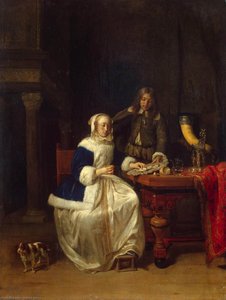
In the heart of the Dutch Golden Age, amidst a period defined by unparalleled prosperity and a burgeoning middle class, Gabriel Metsu captured something far more profound than mere domesticity. His 1657 masterpiece, "The Cook," currently held in the prestigious Museo Thtle Thyssen-Bornemisza in Madrid, serves as a breathtaking window into the seventeenth century. At first glance, the painting presents a deceptively simple tableau of everyday life, yet beneath its surface lies a masterful distillation of realism and psychological depth. The scene centers on a woman, draped in a striking blue gown that commands the viewer's attention, standing before a monumental oven. Her posture, marked by a calm and steady confidence, suggests a moment of quiet purpose as she holds aloft a tray laden with food, inviting us to witness the sacred rituals of nourishment and service.
Metsu’s technical prowess is nothing short of extraordinary, making this piece an essential inspiration for those who appreciate the fine nuances of classical oil painting. He employs chiaroscuro with surgical precision, skillfully manipulating light and shadow to sculpt the physical forms within the room. The way the light catches the subtle sheen on the food tray or illuminates the rugged texture of the oven’s brickwork creates a sense of three-dimensional reality that is almost tactile. Through the delicate use of glazing—layering thin, translucent washes of pigment over thicker underlayers—Metsu achieves a luminous, ethereal quality. This technique imbues the painting with a soft glow, as if the scene itself is breathing, making it an ideal centerpiece for any collection seeking to evoke warmth and timeless elegance.
Symbolism and the Soul of the Dutch Interior
Beyond its visual splendor, "The Cook" is a tapestry of symbolic meaning, reflecting the core values of seventeenth-century Dutch society. The oven, a dominant and rustic presence in the composition, is far more than a kitchen appliance; it stands as a powerful emblem of warmth, stability, and the hearth—the very foundation of domestic life. Even the small details, such as the bird hanging from the rafters, are heavy with intent. This poultry, likely a chicken, serves as a subtle nod to fertility and the prosperity of the household, grounding the painting in the era's preoccupation with abundance and the rewards of diligent labor.
For the discerning collector or interior designer, this work offers a unique emotional resonance. It does not shout; rather, it whispers stories of peace, sustenance, and the beauty found in the mundane. The dark, atmospheric background provides a dramatic contrast that pushes the central figures forward, creating a focal point that can anchor a room with its quiet intensity. Whether viewed as a historical document or a triumph of Baroque technique, "The Cook" remains a captivating testament to Metsu's ability to elevate the ordinary into the extraordinary, offering a sense of enduring grace to any space it inhabits.
Questions et réponses
Comment le style de « The Cook » s'inscrit-il dans l'époque de son créateur ?
«The Cook» de Gabriel Metsu s'inscrit dans le mouvement Dutch Golden Age, au sein de l'époque L'époque moderne de son créateur.
Dans quelle pièce de la maison une reproduction de « The Cook » s'intégrerait-elle bien ?
L'espace recommandé pour «The Cook» de Gabriel Metsu est un Living Room. Cette suggestion peut bien entendu être adaptée à votre intérieur.
Qui a créé « The Cook », et en quelle année ?
Gabriel Metsu a réalisé « The Cook » en 1657.
Œuvres similaires


Biographie de l'artiste
Une Vie D'Exploration Artistique : Gabriël Metsu
- Né : Leiden, Pays-Bas (1629)
- Décédé : 1667
Jeunesse et Influences
Gabriël Metsu a vécu une vie marquée par l'exploration artistique et l'innovation. Né en 1629, il était le fils de Jacques Metsu, travailleur du métier de tapissier et peintre originaire d’Hainault. Cet héritage diversifié a probablement influencé son intérêt précoce pour diverses techniques artistiques. Le déménagement de la famille à Leyde l'a exposé à de nombreuses influences culturelles.
Carrière Artistique : Un Style Éclectique
La carrière de Metsu s’est caractérisée par une absence d’adhésion à un style ou une technique unique, ce qui lui a valu le titre d'"artiste hautement éclectique". Son œuvre comprenait des peintures historiques, des natures mortes, des portraits et des œuvres de genre. Notamment, seulement 14 de ses 133 œuvres sont datées, laissant beaucoup à découvrir sur son processus créatif.
- Influences Précoces : L'influence de Rembrandt van Rijn sur les premiers travaux de Metsu est évidente dans son utilisation de la lumière et de la couleur.
- Période Amsterdamienne (à partir de 1655) : Son déménagement à Amsterdam a marqué un tournant vers des intérieurs domestiques et des scènes de genre, avec une plus grande emphase sur le détail et le réalisme.
- Formation et Mentorat : Il a formé Michiel van Musscher et Joost van Geel, reflétant son engagement envers la communauté artistique.
Œuvres Notables et Développement Artistique
Les peintures de Metsu comportaient souvent de jeunes femmes, des scènes de marché et des personnes âgées, puisant dans les emblèmes populaires de l’époque. Son style a évolué au cours de sa carrière, démontrant une maîtrise de diverses techniques.
- L'Enfant Malade (c. 1664) : Cette œuvre reflète l'admiration de Metsu pour le détail méticuleux et l'utilisation de la lumière par Johannes Vermeer.
- Portrait de la Famille Hinlopen : Un chef-d'œuvre combinant peinture de genre et portrait, mettant en valeur sa capacité à capturer à la fois le caractère individuel et la vie domestique.
- Le Fils Prodigue (c. 1640) : Démontre une influence baroque avec sa composition dramatique et ses détails riches.
- Thèmes Récurrents : Metsu dépeignait fréquemment des scènes de la vie quotidienne, souvent empreintes de sens symbolique.
Signification Historique et Héritage
L'héritage de Gabriël Metsu réside dans sa polyvalence et sa contribution à l’âge d’or néerlandais. Son style éclectique, bien que parfois énigmatique, a influencé les générations futures d'artistes. Aujourd'hui, ses œuvres sont conservées dans des musées prestigieux du monde entier.
- Peintre de l’âge d’or néerlandais : Il est reconnu comme une figure importante au sein du paysage artistique dynamique du XVIIe siècle aux Pays-Bas.
- Collections Muséales : Ses peintures se trouvent dans divers musées, dont le Rijksmuseum à Amsterdam.
- Appréciation Continue : L’art de Metsu continue de fasciner et d'inspirer les spectateurs par son réalisme, ses détails et ses récits subtils.

Gabriel Metsu
1629 - 1667 , Pays-Bas
En bref
- Artistic Movement Or Style: Âge d'or néerlandais
- Artists Or Movements Influenced By This Artist: ['Pieter de Hooch']
- Artists Who Influenced This Artist: ['Rembrandt van Rijn']
- Date Of Birth: 1629
- Date Of Death: 1667
- Full Name: Gabriël Metsu
- Nationality: Néerlandais
- Notable Artworks:
- L’Enfant malade
- Portrait de la famille Hinlopen
- Vendeur de volaille
- Place Of Birth: Leiden, Pays-Bas
Articles connexes

L'Âge d'Or Néerlandais : 10 Chefs-d'œuvre Incontournables pour Décorer avec Art et Histoire
Plongez au cœur de l'Âge d'Or néerlandais ! Découvrez 10 chefs-d'œuvre intemporels de Rembrandt, Vermeer et autres maîtres hollandais. Explorez leur histoire, technique & trouvez l'inspiration déco sur

Dante Gabriel Rossetti : Les 25 Œuvres Maîtresses du Préraphaélisme à Redécouvrir
Plongez dans l'univers fascinant de Dante Gabriel Rossetti ! Découvrez les 25 œuvres majeures du préraphaélisme : symbolisme, poésie et beauté victorienne. Reproductions d'art exceptionnelles sur ArtsDot.com.

Les 10 Chefs-d'œuvre du Baroque Néerlandais : Artistes et Décor Intemporels
Plongez au cœur du Baroque néerlandais avec les 10 œuvres incontournables de Rembrandt, Vermeer et autres maîtres hollandais. Découvrez l'histoire, la lumière et les couleurs qui ont façonné ce mouvement artistique. Reproductions d'art de qualité muséale sur ArtsDot.com

L'Âge d'Or Néerlandais : Splendeur Baroque et Révolution Artistique
Explorez l'Âge d'Or néerlandais : découvrez les maîtres baroques (Rembrandt, Fabritius) et leur révolution artistique. Analyse approfondie, contexte historique et héritage durable. Un voyage au cœur de la peinture du XVIIe siècle.

L'Âge d'Or Néerlandais : Lumière, Réalisme et l'Émergence d'une Nouvelle Esthétique Picturale
Explorez l'Âge d'Or néerlandais : un tour d'horizon expert du réalisme révolutionnaire de Rembrandt, de Keyser et des maîtres hollandais. Découvrez l'histoire, les techniques et l'héritage durable de cette période artistique unique.