

 Aperçu en situation
 Partager
 Partager
 Détails
 Guide imprimable

 Télécharger
 Articles similaires
 Radiographie
 Voir le diaporama
 Statistiques
Florero

 Afficher la suite
Reproduction à l'huile faite à la main
Huile sur toile peinte à la main, avec cadre et dimensions personnalisés, réalisée sur commande par nos artistes. ( Passer au format impression Passer au format image numérique)




P118B $10

P118H $10

P118W $10

P438Z $10

P508JH $12

P508YH $12

P805H $10

P805Z $10

P919BZ $10

P919G $10

P919XJ $10

P959ZH $10

P968JZ $12

W106C $8

W218G $10

W218JH $8

W218Y $10

W307PJ $10

W316G $10

W316PJ $8

W316Y $10

W398PJ $8

W4111J $10

W500HY $15

W500JH $15

W692G $12

W849H $8

W940BG $15

W953PJ $8




Choisissez parmi nos formats prédéfinis qui respectent les proportions originales de l’œuvre.

Vous pouvez saisir vos propres dimensions pour l'adapter à un cadre ou à un espace spécifique. Si la taille sélectionnée ne correspond pas aux proportions de l'image d'origine, nous recadrerons l'œuvre ou prolongerons la peinture avec des éléments peints à la main supplémentaires. Une maquette numérique vous sera envoyée pour approbation avant le début de la production.
Veuillez noter que l'aperçu à l'écran ne reflète pas le recadrage ou l'extension réels. Seule la maquette montrera fidèlement la composition finale.
Bien que des tailles personnalisées soient disponibles, nous vous recommandons de sélectionner une dimension dans la liste prédéfinie afin de préserver les proportions d'origine.
Après la commande, l’équipe ArtsDot.com contactera le client par e-mail pour recueillir ses instructions et lui fournira une maquette d’aperçu
Livraison dans le monde entier () en 3 à 4 semaines au lieu des 5 semaines habituelles. (26 septembre). Aucun compromis sur la qualité.

Livraison express gratuite dans le monde entier

Toile de lin de haute qualité

Assurance transport complète

Garantie de remboursement des droits de douane

Garantie de fidélité des couleurs

Garantie de retour de 100 jours (uniquement en cas de défaut)

Garantie de remboursement à 100%

Tarifs dégressifs sur quantité
 L'option verre n'est disponible que pour les dimensions inférieures à 110 cm.

Florero
Technique de reproduction
Format de la reproduction
-


Prix total final
$ 263
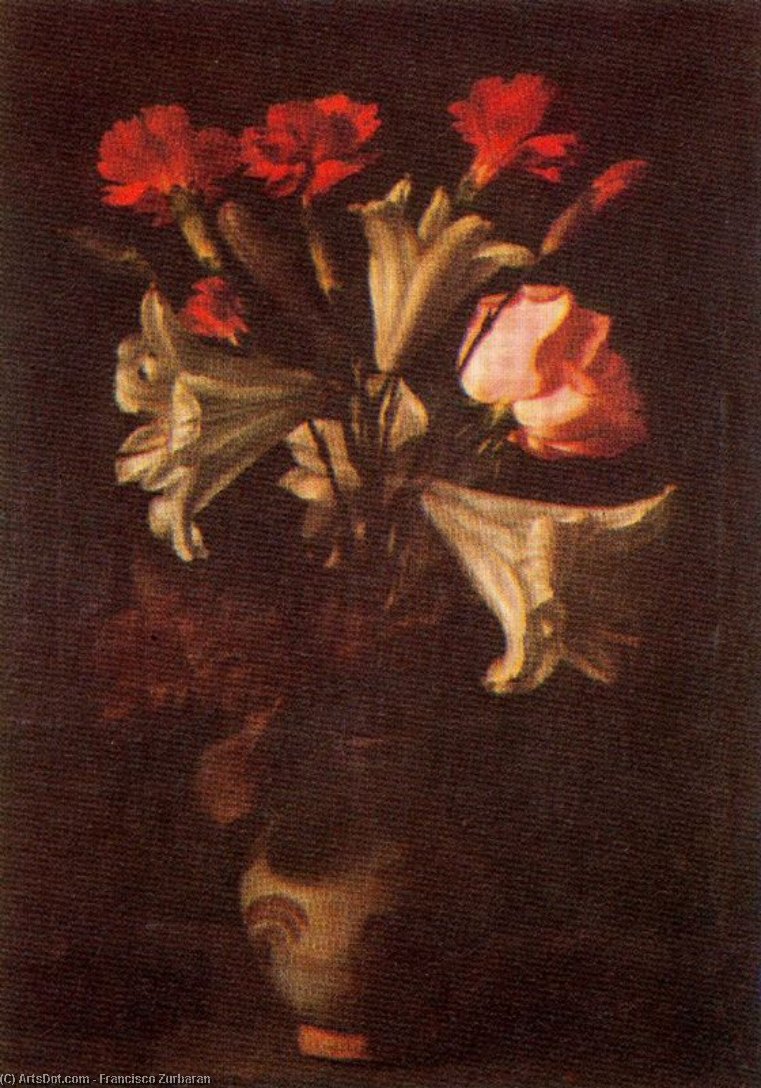
Francisco de Zurbarán’s Florero: A Study in Light and Stillness
Francisco de Zurbarán's "Florero" (Flower Vase) is more than just a depiction of flowers; it’s a profound meditation on light, simplicity, and the quiet dignity of everyday objects. Painted around 1630, this work exemplifies the artist’s signature style – a stark, almost monastic austerity that set him apart within the vibrant Baroque landscape of Spain. It's a piece that speaks volumes through its restraint, inviting contemplation rather than immediate visual gratification.
Born in Fuente de Cantos, Extremadura, Zurbarán’s early life instilled within him a deep connection to the land and a reverence for religious subjects. His training under Alonso de Najera exposed him to the burgeoning Baroque style, but he quickly forged his own path, prioritizing realism and emotional intensity over elaborate ornamentation. “Florero” is a testament to this singular vision. The composition is remarkably uncluttered; a simple wooden table provides the stage for a vase brimming with red and white blossoms. There’s no extraneous detail, no distracting background – only the essential elements arranged with meticulous precision.
The Drama of Light: Tenebrism at its Finest
Zurbarán was a master of *tenebrismo*, a dramatic technique popularized by Caravaggio that utilizes stark contrasts between light and shadow. In “Florero,” this is most evident in the way the light falls upon the vase and the flowers, creating an almost sculptural effect. The deep shadows enveloping the table and surrounding space heighten the luminosity of the blossoms, drawing the viewer’s eye directly to their vibrant colors. This interplay of light isn't merely aesthetic; it serves to imbue the scene with a sense of solemnity and spiritual weight – mirroring the religious paintings that constitute much of Zurbarán’s oeuvre.
The source of this intense illumination is subtly suggested, likely emanating from an unseen window. This creates a feeling of intimacy, as if we are witnessing a private moment of contemplation. The careful modeling of the petals and leaves reveals Zurbarán's extraordinary ability to capture the texture and form of natural objects with breathtaking accuracy. He doesn’t simply paint flowers; he renders their very essence – their delicate fragility and inherent beauty.
Symbolism and Spiritual Resonance
While seemingly a straightforward still life, “Florero” is rich in symbolic meaning. Flowers have long been associated with purity, grace, and the transience of earthly beauty. The red blossoms, particularly prominent, could represent passion or sacrifice – themes frequently explored in Zurbarán’s religious works. The white flowers offer a counterpoint, suggesting innocence and spiritual virtue.
Furthermore, the vase itself is significant. Vessels were often used to hold relics and sacred objects within religious settings, subtly connecting this still life to a broader context of faith and devotion. The overall effect is one of quiet contemplation, inviting viewers to reflect on the beauty of creation alongside its inherent vulnerability and fleeting nature. It’s a piece that transcends mere representation, becoming a poignant meditation on life, death, and the enduring power of spirituality.
A Reproduction for Your Space
ArtsDot offers meticulously crafted hand-painted reproductions of Francisco de Zurbarán's “Florero,” allowing you to bring this masterpiece into your home or office. Our skilled artisans replicate the artist’s masterful use of *tenebrismo* and his remarkable attention to detail, ensuring that your reproduction captures the full emotional impact of the original. Choose from a range of sizes and canvas materials to perfectly complement your décor. Experience the timeless beauty and profound spirituality of “Florero” – a truly exceptional addition to any art collection.
Œuvres similaires


Biographie de l'artiste
jeune vie et formation
francisco de zurbarán, un peintre espagnol renommé, est né en 1598 dans l'extrême-ouest, en Espagne. Son parcours artistique a commencé sous la direction d’alejandro de la mina, mais c'est son temps avec alonso de najera qui a véritablement façonné son style baroque.carrière artistique et œuvres notables
L'œuvre de Zurbarán est caractérisée par une utilisation dramatique de la lumière et de l'ombre, une technique connue sous le nom de tenebrisme. Cela peut être vu dans le sudarium de sainte Véranique, une peinture qui met en valeur sa maîtrise du médium. *- l'Immaculée Conception (c. 1635), un exemple de premier plan de Zurbarán, est conservé au musée des Beaux-Arts de Bilbao.
- L'Agneau de Dieu (c. 1640), un puissant symbole de dévotion religieuse, fait partie de la collection du Metropolitan Museum of Art.
- Le sujet apocryphe de l'apparition de la Vierge à saint Jean, une autre pièce notable, démontre sa capacité à équilibrer lumière et obscurité.
héritage et influence
L'influence de Zurbarán sur le baroque espagnol est indéniable. Son utilisation du clair-obscur a inspiré des générations d'artistes. Le cercle de francisco de zurbarán, un groupe d'artistes influencés par son travail, a continué à repousser les limites du tenebrisme. * points clés : * actif à Séville, en Espagne, depuis 1614. * connu pour l'éclairage dramatique et la profondeur émotionnelle intense. * a influencé de nombreux peintres baroques espagnols.conclusion
L'héritage de francisco zurbarán témoigne du pouvoir durable de l'art baroque. Son utilisation innovante de la lumière et de l'ombre a laissé une marque indélébile sur le monde de l'art, inspirant d'innombrables artistes et assurant sa place dans l'histoire. * pour en savoir plus : * [https://ArtsDot.com/@/francisco-zurbaran](https://ArtsDot.com/@/francisco-zurbaran) - explorez davantage les œuvres de zurbarán sur ArtsDot. * [https://wikipedia.org/wiki/francisco_de_zurbarán](https://wikipedia.org/wiki/francisco_de_zurbarán) - plongez dans la vie et les influences de l'artiste.
Francisco de Zurbarán
1598 - 1664 , Espagne
En bref
- Artistic Movement Or Style: Baroque
- Artists Or Movements Influenced By This Artist: Cercle de Zurbarán
- Artists Who Influenced This Artist:
- Alejandro de la Mina
- Alonso de Najera
- Date Of Birth: 1598
- Date Of Death: 1664
- Full Name: Francisco de Zurbarán
- Nationality: Espagnol
- Notable Artworks:
- Immaculée Conception (c. 1635)
- Agnus Dei (c. 1640)
- Place Of Birth: Fuente de Cantos, Espagne
Articles similaires

The Dramatic Flourish: Exploring the Baroque Movement's Enduring Legacy in Art History
Explore the dramatic world of Baroque art! Discover iconic artists like Caravaggio & Rubens, defining techniques, and its lasting impact on art history. Expert insights for collectors & enthusiasts at ArtsDot.

The Golden Age Reforged: Dramatic Realism & Religious Zeal in Spanish Baroque Art
Explore the dramatic world of Spanish Baroque art! Discover masters like Zurbarán & the powerful influence of religious zeal on painting techniques – a guide for collectors and enthusiasts.

Theatricality & Triumph: Baroque Drama in Painting & Sculpture
Explore the dramatic world of Baroque art! Discover its history, defining characteristics, & lasting influence on painting & sculpture. Expert insights into Caravaggio, Zurbarán, and Bernini – plus high-quality reproductions at ArtsDot.

The Dramatic Flourish: Exploring Themes of Power, Faith & Emotion in Baroque Artworks
Explore the dramatic world of Baroque art! Discover masters like Zurbarán & the powerful influence of religious zeal on painting techniques. Expert insights for collectors and enthusiasts.

Francisco de Zurbarán: Mysticism, Realism & the Golden Age of Spanish Painting
Explore the captivating world of Francisco de Zurbarán, a master of Spanish Baroque painting. Discover his dramatic tenebrism, religious masterpieces like 'La Porciúncula,' and lasting influence on art history.


