


 Aperçu en situation
 Partager
 Partager
 Détails
 Guide
Guide

 Télécharger
 Articles similaires
 Radiographie
 Voir le diaporama
 Statistiques
untitled (2056)

 Afficher la suite
Giclées et impressions d'art
Impressions giclées ou sur toile de qualité musée, avec une production rapide et des finitions au choix. ( Acheter la peinture faite à la main Passer au format image numérique)




































Choisissez parmi nos formats prédéfinis qui respectent les proportions originales de l’œuvre.

Vous pouvez saisir vos propres dimensions pour vous adapter à un cadre ou à un espace spécifique. Si la taille sélectionnée ne correspond pas aux proportions de l'image originale, nous recadrerons l'œuvre ou étendrons l'image avec une bordure en miroir ou une couleur unie. Une maquette numérique vous sera envoyée pour approbation avant le début de la production.
Veuillez noter que l'aperçu à l'écran ne reflète pas le recadrage ou l'extension réelle. Seule la maquette montrera avec précision la composition finale.
Bien que des tailles personnalisées soient disponibles, nous vous recommandons de choisir une dimension dans la liste prédéfinie afin de préserver les proportions originales.
Livraison dans le monde entier () en 2 semaines au lieu des 4/5 semaines habituelles. (25 septembre)

Livraison express gratuite dans le monde entier

Toile de lin de haute qualité

Assurance transport complète

Garantie de remboursement des droits de douane

Garantie de fidélité des couleurs

Garantie de retour de 100 jours (uniquement en cas de défaut)

Garantie de remboursement à 100%

Tarifs dégressifs sur quantité
 L'option verre n'est disponible que pour les dimensions inférieures à 110 cm.

untitled (2056)
Giclées et impressions d'art
Format de la reproduction
-


Prix total final
$ 62
Fernand Léger: A Pioneer of Cubist Tubism – Exploring the Machine Age Aesthetic
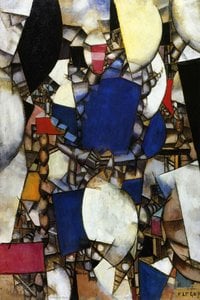
Fernand Léger’s “untitled (2056)” isn't merely a book page scan; it’s a window into the artistic soul of a pivotal moment in modern art history. Published by ArtsDot.com, this piece encapsulates the essence of Cubist Tubism – Léger’s groundbreaking approach that fused geometric abstraction with observations of industrial life and human anatomy. Examining its visual elements reveals layers of meaning beyond simple representation, offering insights into both artistic innovation and the broader cultural anxieties surrounding the burgeoning machine age.- Composition & Style: The image presents a predominantly textual layout—a large block of printed words overlaid with color plates—characteristic of book design during Léger’s era. However, these plates aren't decorative flourishes; they are meticulously crafted geometric abstractions mirroring Léger’s core stylistic principles. Lines dominate the composition, delineating text and illustrations with purposeful precision, reflecting Léger’s fascination with mechanical forms and structural clarity.
- Technique: Offset printing—a common technique of the time—contributes to a subtle tonal variation across the page, hinting at the meticulous craftsmanship involved in reproducing Léger's artwork. The color plates utilize muted palettes, prioritizing tonal harmony over vibrant hues, aligning with Léger’s desire for an art that resonated with everyday experience rather than indulging in opulent visual spectacle.
- Historical Context: Léger emerged during a period of intense industrial expansion and societal transformation—the early 20th century—a time marked by rapid urbanization and the pervasive influence of machinery. His artistic vision responded directly to these developments, rejecting traditional representational art forms in favor of exploring new visual languages that captured the dynamism and fragmentation inherent in modern life.
- Symbolism & Emotional Impact: Léger’s work transcends mere aesthetic concerns; it communicates a profound emotional response to the world around him. The simplified geometric shapes—tubes, spheres, cubes—represent not just physical forms but also concepts of movement, energy, and interconnectedness – mirroring Léger's belief that art should illuminate the human condition amidst technological progress.
- Details: A prominent watermark from ArtsDot.com / ArtsDot.com is visible in the bottom left corner, signifying the artwork’s provenance and highlighting its status as a high-quality reproduction intended for discerning collectors and interior designers.
Exploring Tubism – Léger's Geometric Revolution
Tubism, developed by Léger alongside Pablo Picasso, represents a radical departure from Impressionism and Cubism’s initial focus on capturing fleeting impressions of light and color. Instead, Tubists dissected objects into geometric components—primarily tubes and spheres—presenting them simultaneously in multiple perspectives. This technique aimed to convey not just visual appearance but also underlying structural relationships – mirroring Léger's conviction that art should reflect the fundamental principles governing the natural world. The resulting images are strikingly austere yet imbued with a palpable sense of movement and energy, embodying Léger’s fascination with industrial machinery and its transformative impact on human experience.The Influence of Industrial Aesthetics
Léger's artistic inspiration stemmed from his observations of the factories and urban landscapes of Paris during the Belle Époque—a period characterized by unprecedented industrial growth and social upheaval. He sought to translate these experiences into visual language, rejecting idealized depictions of nature in favor of confronting viewers with the realities of modern life. The geometric abstractions found in “untitled (2056)” directly reflect this preoccupation, mirroring Léger’s desire to capture the essence of the machine age—its rigid structures, its repetitive motions, and its pervasive influence on human perception.A Legacy Beyond Representation
Fernand Léger's contribution to modern art extends far beyond stylistic innovation; he fundamentally challenged conventional notions of artistic expression. By prioritizing geometric abstraction over realistic depiction, Léger paved the way for subsequent movements like Pop Art—a genre that embraced mass culture and celebrated everyday objects as sources of aesthetic inspiration. “untitled (2056)” stands as a testament to Léger’s enduring vision – an art form capable of conveying profound emotional truths while simultaneously engaging with the complexities of the modern world.




Biographie de l'artiste
jeune vie et formation
fernand léger, peintre, sculpteur et cinéaste français, est né le 4 février 1881 à Argentan, Orne, en Normandie inférieure. Son père élevait du bétail, et léger a initialement été formé à l'architecture de 1897 à 1899. Il s’est ensuite installé à Paris en 1900, se débrouillant comme dessinateur architectural.développement artistique
Le travail précoce de léger a été influencé par l'impressionnisme, comme le montrent le jardin de ma mère (mon jardin) (1905). Après avoir fréquenté l'école des beaux-arts et l’académie Julian, il a commencé à travailler sérieusement comme peintre à 25 ans. Son style s'est développé en une forme personnelle de cubisme, que les critiques ont qualifié de "tubisme" pour son accent sur les formes cylindriques.cubisme et le groupe des Puteaux
En 1910, léger a exposé au Salon d’automne aux côtés de jean metzinger et henri le fauconnier. Il a rejoint le groupe des Puteaux, également connu sous le nom de section d’or (la section dorée), avec d'autres artistes tels que francis picabia et marcel duchamp.guerre et son influence sur le travail de léger
Les expériences de léger à la Première Guerre mondiale ont eu un impact significatif sur son œuvre. Pendant son séjour au front, il a produit des croquis d'artillerie, d'avions et de soldats. Sa peinture soldier avec un tuyau (1916) reflète cette période.œuvre ultérieure et héritage
L'œuvre post-guerre de léger, caractérisée par des formes machine-like élégantes, le lia à la tradition de la peinture figurative française. Ses paysages animés de 1921 ont présenté des figures et des animaux dans des formes harmonieuses et rationalisées.- voir les œuvres de fernand léger sur ArtsDot
- en savoir plus sur fernand léger sur wikipedia
- découvrez le musée national fernand léger (france) avec ArtsDot
- la femme assise (100 x 81 cm, tubisme)
- élément de machine (cubisme)

Fernand Léger
1881 - 1955 , France
En bref
- Artistes Influents:
- Cézanne
- Impressionnisme
- Date De Décès: 1955
- Date De Naissance: 4 février 1881
- Influences Artistiques: ['Pop Art']
- Lieu De Naissance: Argentan, France
- Mouvement Artistique: Cubisme, Tubisme
- Nationalité: Française
- Nom Complet: Fernand Léger
- Oeuvres Notables:
- La Grande Parade
- Machine Élément
- Femme assise
- Paysages animés
Articles similaires

L'Âme Industrielle : 10 Chefs-d'œuvre Révélant la Beauté du Monde Moderne | ArtsDot
Plongez dans l'âme industrielle de 10 chefs-d'œuvre emblématiques ! Découvrez les histoires fascinantes de Van Gogh, Monet et d'autres artistes ayant capturé la beauté brute du monde moderne. Reproductions de qualité musée sur ArtsDot.com – Explorez la collection en ligne.

Redefining Nature: A Collector's Guide to the Geometric Beauty of Cubist Landscapes
Explore the revolutionary world of Cubist landscapes. Discover how masters like Picasso and Braque redefined nature through geometric beauty, and learn expert tips for curating these transformative masterpieces in your modern home collection.

Fernand Léger : Les 25 Œuvres Maîtresses d'un Pionnier du Modernisme | ArtsDot
Plongez dans l'univers vibrant de Fernand Léger ! Découvrez les 25 œuvres majeures du cubisme et du tubisme, explorant formes géométriques et couleurs audacieuses. Retrouvez des reproductions d'art exceptionnelles sur ArtsDot.com.

Les 10 Chefs-d'œuvre du Portrait Cubiste : Artistes & Décor Intérieur
Plongez au cœur du cubisme avec les 10 portraits emblématiques de Picasso, Braque et Gris. Découvrez l'histoire, la technique & l'impact de ces chefs-d'œuvre. Reproductions d'art de qualité musée sur ArtsDot.com !
Cubisme Expressionniste : Les 10 Chefs-d'œuvre Révolutionnaires à Redécouvrir
Plongez au cœur du Cubisme Expressionniste ! Découvrez les 10 chefs-d'œuvre de Picasso, Braque et autres artistes majeurs. Histoire, techniques & émotions : trouvez l’inspiration déco sur ArtsDot.com


