


 Aperçu en situation
 Partager
 Partager
 Détails

 Télécharger l'image
 Articles similaires
 Radiographie
 Voir le diaporama
The tree houses


 Afficher la suite
Reproduction à l'huile faite à la main
Huile sur toile peinte à la main, avec cadre et dimensions personnalisés, réalisée sur commande par nos artistes. ( Acheter l'impression Acheter l'image)




P118B $10

P118H $10

P118W $10

P438Z $10

P508JH $12

P508YH $12

P805H $10

P805Z $10

P919BZ $10

P919G $10

P919XJ $10

P959ZH $10

P968JZ $12

W106C $8

W218G $10

W218JH $8

W218Y $10

W307PJ $10

W316G $10

W316PJ $8

W316Y $10

W398PJ $8

W4111J $10

W500HY $15

W500JH $15

W692G $12

W849H $8

W940BG $15

W953PJ $8




Choisissez parmi nos formats prédéfinis qui respectent les proportions originales de l’œuvre.

Vous pouvez saisir vos propres dimensions pour l'adapter à un cadre ou à un espace spécifique. Si la taille sélectionnée ne correspond pas aux proportions de l'image d'origine, nous recadrerons l'œuvre ou prolongerons la peinture avec des éléments peints à la main supplémentaires. Une maquette numérique vous sera envoyée pour approbation avant le début de la production.
Veuillez noter que l'aperçu à l'écran ne reflète pas le recadrage ou l'extension réels. Seule la maquette montrera fidèlement la composition finale.
Bien que des tailles personnalisées soient disponibles, nous vous recommandons de sélectionner une dimension dans la liste prédéfinie afin de préserver les proportions d'origine.
Après la commande, l’équipe ArtsDot.com contactera le client par e-mail pour recueillir ses instructions et lui fournira une maquette d’aperçu
Livraison dans le monde entier () en 3 à 4 semaines au lieu des 5 semaines habituelles. (25 août). Aucun compromis sur la qualité.

Livraison express gratuite dans le monde entier

Toile de lin de haute qualité

Assurance transport complète

Garantie de remboursement des droits de douane

Garantie de fidélité des couleurs

Politique de retour de 60 jours (uniquement en cas de défaut)

Garantie de remboursement à 100%

Tarifs dégressifs sur quantité
 L'option verre n'est disponible que pour les dimensions inférieures à 110 cm.

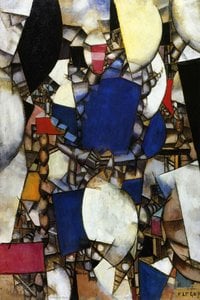
The tree houses
Technique de reproduction
Format de la reproduction
-


Prix total final
$ 263
Description de l'œuvre
A Symphony of Geometric Forms: The Vibrancy of Fernand Léger
In the heart of the early twentieth century, as the world stood on the precipice of profound industrial transformation, Fernand Léger captured a moment of pure, rhythmic energy in his 1914 masterpiece, "The Tree Houses" (often associated with his Houses in the Trees Landscape series). This work is far more than a mere arrangement of shapes; it is a breathtaking exploration of how Cubism could breathe life into the mundane. At first glance, the viewer is met with a kaleidoscope of primary and secondary colors—vibrant reds, deep blues, sunny yellows, and lush greens—that dance across the canvas in a way that defies traditional perspective. Léger does not merely paint objects; he orchestrates a visual symphony where every bottle and geometric plane contributes to a larger, pulsating movement.
The technique employed here showcases Léger’s unique departure from the more fragmented approach of his contemporaries, Picasso and Braque. While others sought to shatter reality into unrecognizable shards, Léger maintained a sense of structural integrity. He utilizes interlocking planes and overlapping surfaces to create an illusionistic depth that feels both modern and architectural. The way the colorful forms—reminiscent of glassware and everyday vessels—are stacked and layered creates a fascinating tension between two-dimensional flatness and a reconstructed three-dimensional space. For the discerning collector or interior designer, this piece offers a sophisticated balance of bold abstraction and recognizable structure, making it a commanding focal point for any contemporary setting.
The Pulse of Modernity and Industrial Spirit
To understand the soul of this painting, one must look toward the historical dawn of mechanization. Painted at the cusp of World War I, the artwork reflects the burgeoning energy of an era defined by rapid technological advancement. Léger, deeply influenced by the precision of industrial design, saw beauty in the manufactured and the utilitarian. The geometric shapes within the composition mirror the steel, glass, and rhythmic machinery of the age. There is a deliberate juxtaposition here: the organic suggestion of "trees" or landscapes is replaced by the hard-edged, disciplined forms of man-made objects. This reflects Léger’s personal mission to integrate the dynamism of the machine age into the very fabric of fine art.
The emotional impact of the piece is one of profound optimism and structured chaos. There is a sense of organized vitality, as if the viewer is witnessing the heartbeat of a new, modern world being constructed in real-time. The inclusion of subtle elements, such as the clock-like forms, serves as a poignant reminder of the relentless march of time and progress. For those looking to adorn a space with art that inspires movement and intellectual curiosity, this reproduction offers an unparalleled opportunity. It is a piece that does not merely sit upon a wall; it interacts with the light and the architecture of a room, inviting contemplation on the beauty found within the structured precision of our modern existence.
Œuvres similaires




Biographie de l'artiste
jeune vie et formation
fernand léger, peintre, sculpteur et cinéaste français, est né le 4 février 1881 à Argentan, Orne, en Normandie inférieure. Son père élevait du bétail, et léger a initialement été formé à l'architecture de 1897 à 1899. Il s’est ensuite installé à Paris en 1900, se débrouillant comme dessinateur architectural.développement artistique
Le travail précoce de léger a été influencé par l'impressionnisme, comme le montrent le jardin de ma mère (mon jardin) (1905). Après avoir fréquenté l'école des beaux-arts et l’académie Julian, il a commencé à travailler sérieusement comme peintre à 25 ans. Son style s'est développé en une forme personnelle de cubisme, que les critiques ont qualifié de "tubisme" pour son accent sur les formes cylindriques.cubisme et le groupe des Puteaux
En 1910, léger a exposé au Salon d’automne aux côtés de jean metzinger et henri le fauconnier. Il a rejoint le groupe des Puteaux, également connu sous le nom de section d’or (la section dorée), avec d'autres artistes tels que francis picabia et marcel duchamp.guerre et son influence sur le travail de léger
Les expériences de léger à la Première Guerre mondiale ont eu un impact significatif sur son œuvre. Pendant son séjour au front, il a produit des croquis d'artillerie, d'avions et de soldats. Sa peinture soldier avec un tuyau (1916) reflète cette période.œuvre ultérieure et héritage
L'œuvre post-guerre de léger, caractérisée par des formes machine-like élégantes, le lia à la tradition de la peinture figurative française. Ses paysages animés de 1921 ont présenté des figures et des animaux dans des formes harmonieuses et rationalisées.- voir les œuvres de fernand léger sur ArtsDot
- en savoir plus sur fernand léger sur wikipedia
- découvrez le musée national fernand léger (france) avec ArtsDot
- la femme assise (100 x 81 cm, tubisme)
- élément de machine (cubisme)

Fernand Léger
1881 - 1955 , France
En bref
- Artistes Influents:
- Cézanne
- Impressionnisme
- Date De Décès: 1955
- Date De Naissance: 4 février 1881
- Influences Artistiques: ['Pop Art']
- Lieu De Naissance: Argentan, France
- Mouvement Artistique: Cubisme, Tubisme
- Nationalité: Française
- Nom Complet: Fernand Léger
- Oeuvres Notables:
- La Grande Parade
- Machine Élément
- Femme assise
- Paysages animés
Articles similaires
Fernand Léger : Les 25 Œuvres Maîtresses d'un Pionnier du Modernisme | ArtsDot
Plongez dans l'univers vibrant de Fernand Léger ! Découvrez les 25 œuvres majeures du cubisme et du tubisme, explorant formes géométriques et couleurs audacieuses. Retrouvez des reproductions d'art exceptionnelles sur ArtsDot.com.

Paul Cézanne : Les 25 Œuvres Maîtresses d'un Génie Révolutionnaire | ArtsDot
Plongez dans l'univers de Paul Cézanne avec les 25 œuvres incontournables du maître post-impressionniste. Découvrez l'histoire, la technique et l'émotion derrière ses tableaux iconiques comme 'Les Baigneuses' ou 'Mont Sainte-Victoire'. Reproductions d'art haute qualité sur ArtsDot.com.

L'Âme Industrielle : 10 Chefs-d'œuvre Révélant la Beauté du Monde Moderne | ArtsDot
Plongez dans l'âme industrielle de 10 chefs-d'œuvre emblématiques ! Découvrez les histoires fascinantes de Van Gogh, Monet et d'autres artistes ayant capturé la beauté brute du monde moderne. Reproductions de qualité musée sur ArtsDot.com – Explorez la collection en ligne.

Les 10 Chefs-d'œuvre du Paysage Romantique : Artistes et Décor d'Intérieur
Plongez dans l'émotion du Romantisme avec les 10 plus beaux paysages de Friedrich, Turner & Delacroix. Découvrez leur histoire et trouvez l'inspiration déco idéale sur ArtsDot.com !

Abstraction Géométrique : Les 10 Chefs-d'œuvre qui ont Marqué l'Histoire de l'Art
Plongez au cœur de l'abstraction géométrique avec ArtsDot.com ! Découvrez les 10 œuvres majeures de Mondrian, Malevitch et Kandinsky qui ont révolutionné l'art moderne. Inspirez votre décoration intérieure avec des reproductions de tableaux exceptionnelles. Explorez la collection en ligne !



