


 Aperçu en situation
 Envoyer
 Partager
 Détails de l'œuvre

 Télécharger
 Articles similaires
 Radiographie
 Diaporama
The Staircase2

 Lire la suite
Reproduction à l'huile faite à la main
Huile sur toile peinte à la main, avec cadre et dimensions personnalisés, réalisée sur commande par nos artistes. ( Acheter l'impression Acheter l'image)




P118B $10

P118H $10

P118W $10

P438Z $10

P508JH $12

P508YH $12

P805H $10

P805Z $10

P919BZ $10

P919G $10

P919XJ $10

P959ZH $10

P968JZ $12

W106C $8

W218G $10

W218JH $8

W218Y $10

W307PJ $10

W316G $10

W316PJ $8

W316Y $10

W398PJ $8

W4111J $10

W500HY $15

W500JH $15

W692G $12

W849H $8

W940BG $15

W953PJ $8




Choisissez parmi nos formats prédéfinis qui respectent les proportions originales de l’œuvre.

Vous pouvez saisir vos propres dimensions pour l'adapter à un cadre ou à un espace spécifique. Si la taille sélectionnée ne correspond pas aux proportions de l'image d'origine, nous recadrerons l'œuvre ou prolongerons la peinture avec des éléments peints à la main supplémentaires. Une maquette numérique vous sera envoyée pour approbation avant le début de la production.
Veuillez noter que l'aperçu à l'écran ne reflète pas le recadrage ou l'extension réels. Seule la maquette montrera fidèlement la composition finale.
Bien que des tailles personnalisées soient disponibles, nous vous recommandons de sélectionner une dimension dans la liste prédéfinie afin de préserver les proportions d'origine.
Après la commande, l’équipe ArtsDot.com contactera le client par e-mail pour recueillir ses instructions et lui fournira une maquette d’aperçu
Livraison dans le monde entier () en 3 à 4 semaines au lieu des 5 semaines habituelles. (13 août). Aucun compromis sur la qualité.

Livraison express gratuite dans le monde entier

Toile de lin de qualité supérieure

Assurance transport complète

Garantie de remboursement des droits de douane

Garantie de fidélité des couleurs

Politique de retour de 60 jours (uniquement en cas de défaut)

Garantie de remboursement à 100%

Offre de tarifs dégressifs
 L'option verre n'est disponible que pour les dimensions inférieures à 110 cm.

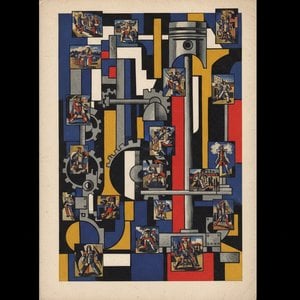
The Staircase2
Technique de reproduction
Format de la reproduction
-


Prix total
$ 263
Description de l'œuvre
A Moment Frozen in Time: Exploring Fernand Léger’s “The Staircase2”
Fernand Léger's "The Staircase2" isn’t merely a depiction of a domestic scene; it’s a carefully constructed meditation on the intersection between human presence and industrial progress. Painted sometime around 1930, this artwork encapsulates the burgeoning Surrealist movement while simultaneously retaining Léger’s signature geometric abstraction—a stylistic choice that distinguishes him from many of his peers who sought refuge in pure abstraction as an escape from realism. The painting presents two figures – a man and a child – positioned against a backdrop of a simple stairwell, yet their interaction feels profoundly significant within the broader context of the era.- Subject Matter: Léger’s focus isn't on capturing an idyllic pastoral landscape but rather on portraying everyday life infused with the influence of machinery and urban environments. The stairwell itself serves as a visual metaphor for ascent – both physically and symbolically – representing aspiration, progress, and perhaps even the challenges inherent in navigating a rapidly changing world.
- Style: Léger’s style is undeniably geometric abstraction, characterized by bold lines and simplified forms. However, unlike purely conceptual abstractions that disregard visual perception, Léger meticulously observes and translates natural shapes into angular constructions. This technique reflects the artist's fascination with the underlying structure of objects – a preoccupation evident throughout his oeuvre.
Technique and Material Considerations
Léger employed oil paint on canvas—a standard medium for artists of his time—allowing for rich color saturation and textural depth. The artist’s meticulous attention to detail is particularly noticeable in the rendering of the stairwell walls, which are depicted with a deliberate flatness that emphasizes their geometric qualities. Furthermore, the inclusion of elements like a clock and a bowl adds subtle visual cues that contribute to the overall composition's complexity without detracting from Léger’s core aesthetic principles. The artist skillfully utilizes color palettes—primarily muted tones—to convey a sense of calm amidst the dynamism suggested by the architectural setting.- Historical Context: “The Staircase2” emerged during the height of Surrealism, though Léger resisted categorization within any particular movement. Nevertheless, the painting resonates with Surrealist ideas about dreamlike imagery and subconscious exploration—particularly in its depiction of a seemingly ordinary scene imbued with an underlying tension. The period was marked by anxieties surrounding technological advancement and societal transformation, themes that find expression in Léger’s visual language.
- Symbolism: Beyond the literal representation of figures and objects, “The Staircase2” carries symbolic weight. The staircase itself symbolizes upward movement, ambition, and overcoming obstacles—a motif frequently revisited by Léger throughout his artistic career. The child figure represents innocence and vulnerability juxtaposed against the adult’s presence, prompting contemplation on themes of legacy and continuity.
Emotional Resonance and Artistic Legacy
Ultimately, “The Staircase2” transcends its formal elements to evoke a feeling of quiet contemplation. Léger's masterful use of geometric abstraction doesn’t preclude conveying emotion; rather, it compels viewers to engage with the artwork on an intellectual level. The painting invites reflection on the relationship between humanity and technology—a dialogue that remains relevant today. Fernand Léger cemented his place as one of the most distinctive voices in modern art, demonstrating that innovation could coexist with profound sensitivity to human experience. Reproductions of “The Staircase2” offer a captivating glimpse into Léger’s artistic vision and provide an opportunity to appreciate the enduring power of geometric abstraction.Œuvres similaires


Biographie de l'artiste
jeune vie et formation
fernand léger, peintre, sculpteur et cinéaste français, est né le 4 février 1881 à Argentan, Orne, en Normandie inférieure. Son père élevait du bétail, et léger a initialement été formé à l'architecture de 1897 à 1899. Il s’est ensuite installé à Paris en 1900, se débrouillant comme dessinateur architectural.développement artistique
Le travail précoce de léger a été influencé par l'impressionnisme, comme le montrent le jardin de ma mère (mon jardin) (1905). Après avoir fréquenté l'école des beaux-arts et l’académie Julian, il a commencé à travailler sérieusement comme peintre à 25 ans. Son style s'est développé en une forme personnelle de cubisme, que les critiques ont qualifié de "tubisme" pour son accent sur les formes cylindriques.cubisme et le groupe des Puteaux
En 1910, léger a exposé au Salon d’automne aux côtés de jean metzinger et henri le fauconnier. Il a rejoint le groupe des Puteaux, également connu sous le nom de section d’or (la section dorée), avec d'autres artistes tels que francis picabia et marcel duchamp.guerre et son influence sur le travail de léger
Les expériences de léger à la Première Guerre mondiale ont eu un impact significatif sur son œuvre. Pendant son séjour au front, il a produit des croquis d'artillerie, d'avions et de soldats. Sa peinture soldier avec un tuyau (1916) reflète cette période.œuvre ultérieure et héritage
L'œuvre post-guerre de léger, caractérisée par des formes machine-like élégantes, le lia à la tradition de la peinture figurative française. Ses paysages animés de 1921 ont présenté des figures et des animaux dans des formes harmonieuses et rationalisées.- voir les œuvres de fernand léger sur ArtsDot
- en savoir plus sur fernand léger sur wikipedia
- découvrez le musée national fernand léger (france) avec ArtsDot
- la femme assise (100 x 81 cm, tubisme)
- élément de machine (cubisme)

Fernand Léger
1881 - 1955 , France
L'essentiel de l'artiste
- Artistes Influents:
- Cézanne
- Impressionnisme
- Date De Décès: 1955
- Date De Naissance: 4 février 1881
- Influences Artistiques: ['Pop Art']
- Lieu De Naissance: Argentan, France
- Mouvement Artistique: Cubisme, Tubisme
- Nationalité: Française
- Nom Complet: Fernand Léger
- Oeuvres Notables:
- La Grande Parade
- Machine Élément
- Femme assise
- Paysages animés
Articles connexes
Fernand Léger : Les 25 Œuvres Maîtresses d'un Pionnier du Modernisme | ArtsDot
Plongez dans l'univers vibrant de Fernand Léger ! Découvrez les 25 œuvres majeures du cubisme et du tubisme, explorant formes géométriques et couleurs audacieuses. Retrouvez des reproductions d'art exceptionnelles sur ArtsDot.com.

Abstraction Géométrique : Les 10 Chefs-d'œuvre qui ont Marqué l'Histoire de l'Art
Plongez au cœur de l'abstraction géométrique avec ArtsDot.com ! Découvrez les 10 œuvres majeures de Mondrian, Malevitch et Kandinsky qui ont révolutionné l'art moderne. Inspirez votre décoration intérieure avec des reproductions de tableaux exceptionnelles. Explorez la collection en ligne !

L'Âme Industrielle : 10 Chefs-d'œuvre Révélant la Beauté du Monde Moderne | ArtsDot
Plongez dans l'âme industrielle de 10 chefs-d'œuvre emblématiques ! Découvrez les histoires fascinantes de Van Gogh, Monet et d'autres artistes ayant capturé la beauté brute du monde moderne. Reproductions de qualité musée sur ArtsDot.com – Explorez la collection en ligne.

Beyond Form & Color: Geometric Abstraction's Evolution in 20th/21st Century Art
Explore the evolution of geometric abstraction from Cubism to contemporary art. Discover key artists like Malevich & Mondrian, investment insights, and expert collecting advice at ArtsDot.

Beyond Form & Color: Geometric Abstraction's Enduring Legacy in Art History
Explore the captivating world of geometric abstraction! Discover its origins, key artists like Malevich & Mondrian, and why this movement remains highly valued by art collectors today. Expert insights at ArtsDot.



