


 Aperçu en situation
 Partager
 Partager
 Détails

 Télécharger l'image
 Articles similaires
 Radiographie
 Voir le diaporama
The great stop on a red background

 Afficher la suite
Giclées et impressions d'art
Impressions giclées ou sur toile de qualité musée, avec une production rapide et des finitions au choix. ( Acheter la peinture faite à la main Acheter l'image)




P118B $10

P118H $10

P118W $10

P438Z $10

P508JH $12

P508YH $12

P805H $10

P805Z $10

P919BZ $10

P919G $10

P919XJ $10

P959ZH $10

P968JZ $12

W106C $8

W218G $10

W218JH $8

W218Y $10

W307PJ $10

W316G $10

W316PJ $8

W316Y $10

W398PJ $8

W4111J $10

W500HY $15

W500JH $15

W692G $12

W849H $8

W940BG $15

W953PJ $8




Choisissez parmi nos formats prédéfinis qui respectent les proportions originales de l’œuvre.

Vous pouvez saisir vos propres dimensions pour vous adapter à un cadre ou à un espace spécifique. Si la taille sélectionnée ne correspond pas aux proportions de l'image originale, nous recadrerons l'œuvre ou étendrons l'image avec une bordure en miroir ou une couleur unie. Une maquette numérique vous sera envoyée pour approbation avant le début de la production.
Veuillez noter que l'aperçu à l'écran ne reflète pas le recadrage ou l'extension réelle. Seule la maquette montrera avec précision la composition finale.
Bien que des tailles personnalisées soient disponibles, nous vous recommandons de choisir une dimension dans la liste prédéfinie afin de préserver les proportions originales.
Livraison dans le monde entier () en 2 semaines au lieu des 4/5 semaines habituelles. (22 août)

Livraison express gratuite dans le monde entier

Toile de lin de haute qualité

Assurance transport complète

Garantie de remboursement des droits de douane

Garantie de fidélité des couleurs

Politique de retour de 60 jours (uniquement en cas de défaut)

Garantie de remboursement à 100%

Tarifs dégressifs sur quantité
 L'option verre n'est disponible que pour les dimensions inférieures à 110 cm.

The great stop on a red background
Giclées et impressions d'art
Format de la reproduction
-


Prix total final
$ 62
Description de la pièce
A Symphony of Steel and Soul: Exploring Fernand Léger’s “The Great Stop”
Fernand Léger's "The Great Stop," painted in 1931, isn’t merely a depiction of horses and musicians; it’s an audacious declaration that the anxieties and exhilarations of industrial progress could coexist with profound artistic expression. Léger, born Joseph Fernand Henri Léger in Argentan, Normandy, in 1881, arrived in Paris around 1900 armed with architectural ambitions but swiftly seduced by the burgeoning world of painting – a decision that would irrevocably alter his trajectory and solidify his place as one of the most influential artists of the early twentieth century. Unlike many of his peers who sought refuge in pure abstraction, Léger confronted the mechanized landscape head-on, determined to translate its rhythms into a visual language that retained an undeniable connection to tangible reality.- Style and Technique: Léger’s distinctive style – dubbed “Constructivist Surrealism” – fused elements of Cubism with the geometric precision of Constructivism. He employed bold, angular forms reminiscent of machine parts, juxtaposed against organic shapes mirroring natural landscapes. This paradoxical combination created a visual tension that mirrored the anxieties surrounding urbanization and technological advancement during the Weimar Republic.
- Historical Context: The painting emerged from a period marked by profound societal shifts – the rise of industrial capitalism, the burgeoning influence of psychoanalysis, and the escalating tensions leading up to World War II. Léger’s artistic response wasn't simply aesthetic; it reflected a broader preoccupation with capturing the psychological impact of modernity on the human psyche.
Decoding the Symbolism: Horses, Musicians, and Time
The imagery within “The Great Stop” is laden with symbolic significance. The horses themselves represent strength, nobility, and tradition – qualities Léger sought to preserve amidst the encroaching dominance of machinery. Simultaneously, they embody a primal connection to the earth, anchoring the composition in a grounding element. Surrounding them are musicians playing instruments like trumpets and saxophones, symbolizing creativity, communication, and the pursuit of beauty—a deliberate counterpoint to the perceived sterility of industrial society. Notably, a prominent clock dominates the background, serving as a visual reminder of time’s relentless march forward, yet its fractured face suggests an unsettling disruption of conventional notions of chronology.Emotional Resonance: Capturing the Paradox of Progress
Léger's masterful manipulation of color and form contributes significantly to the painting’s emotional impact. Dominant hues of red and yellow convey a sense of urgency and dynamism, mirroring the frenetic pace of industrial life. However, interspersed amongst these energetic tones are patches of muted blues and greens—a subtle acknowledgment of the enduring beauty and tranquility found in nature. The overall effect is one of captivating tension – an invitation to contemplate the complex interplay between tradition and innovation, fear and fascination. Léger succeeded in conveying not just what he *saw*, but also how it *felt*—a feat that continues to resonate with viewers today.A Legacy Enduring Through Reproduction
“The Great Stop” exemplifies Léger’s unwavering commitment to translating the anxieties and aspirations of his era into a uniquely expressive artistic idiom. Its enduring appeal lies in its ability to provoke contemplation about our relationship with technology, culture, and the human spirit. High-quality reproductions offer an opportunity to experience this seminal artwork firsthand—a chance to immerse oneself in Léger’s visionary synthesis of form and emotion and to appreciate the profound beauty embedded within a celebration of both steel and soul.Œuvres similaires


Biographie de l'artiste
jeune vie et formation
fernand léger, peintre, sculpteur et cinéaste français, est né le 4 février 1881 à Argentan, Orne, en Normandie inférieure. Son père élevait du bétail, et léger a initialement été formé à l'architecture de 1897 à 1899. Il s’est ensuite installé à Paris en 1900, se débrouillant comme dessinateur architectural.développement artistique
Le travail précoce de léger a été influencé par l'impressionnisme, comme le montrent le jardin de ma mère (mon jardin) (1905). Après avoir fréquenté l'école des beaux-arts et l’académie Julian, il a commencé à travailler sérieusement comme peintre à 25 ans. Son style s'est développé en une forme personnelle de cubisme, que les critiques ont qualifié de "tubisme" pour son accent sur les formes cylindriques.cubisme et le groupe des Puteaux
En 1910, léger a exposé au Salon d’automne aux côtés de jean metzinger et henri le fauconnier. Il a rejoint le groupe des Puteaux, également connu sous le nom de section d’or (la section dorée), avec d'autres artistes tels que francis picabia et marcel duchamp.guerre et son influence sur le travail de léger
Les expériences de léger à la Première Guerre mondiale ont eu un impact significatif sur son œuvre. Pendant son séjour au front, il a produit des croquis d'artillerie, d'avions et de soldats. Sa peinture soldier avec un tuyau (1916) reflète cette période.œuvre ultérieure et héritage
L'œuvre post-guerre de léger, caractérisée par des formes machine-like élégantes, le lia à la tradition de la peinture figurative française. Ses paysages animés de 1921 ont présenté des figures et des animaux dans des formes harmonieuses et rationalisées.- voir les œuvres de fernand léger sur ArtsDot
- en savoir plus sur fernand léger sur wikipedia
- découvrez le musée national fernand léger (france) avec ArtsDot
- la femme assise (100 x 81 cm, tubisme)
- élément de machine (cubisme)

Fernand Léger
1881 - 1955 , France
En bref
- Artistes Influents:
- Cézanne
- Impressionnisme
- Date De Décès: 1955
- Date De Naissance: 4 février 1881
- Influences Artistiques: ['Pop Art']
- Lieu De Naissance: Argentan, France
- Mouvement Artistique: Cubisme, Tubisme
- Nationalité: Française
- Nom Complet: Fernand Léger
- Oeuvres Notables:
- La Grande Parade
- Machine Élément
- Femme assise
- Paysages animés
Articles similaires

Fernand Léger : Les 25 Œuvres Maîtresses d'un Pionnier du Modernisme | ArtsDot
Plongez dans l'univers vibrant de Fernand Léger ! Découvrez les 25 œuvres majeures du cubisme et du tubisme, explorant formes géométriques et couleurs audacieuses. Retrouvez des reproductions d'art exceptionnelles sur ArtsDot.com.
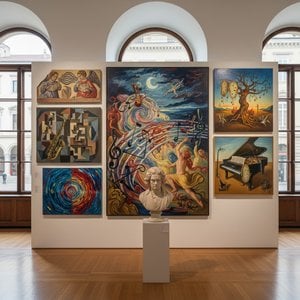
Harmonies on Canvas: Exploring the Visual Representation of Music in Art History
Explore the fascinating history of music's visual representation in art! From ancient symbolism to modern abstraction, discover how artists have captured sound and emotion on canvas. Expert insights & stunning examples.

Abstraction Géométrique : Les 10 Chefs-d'œuvre qui ont Marqué l'Histoire de l'Art
Plongez au cœur de l'abstraction géométrique avec ArtsDot.com ! Découvrez les 10 œuvres majeures de Mondrian, Malevitch et Kandinsky qui ont révolutionné l'art moderne. Inspirez votre décoration intérieure avec des reproductions de tableaux exceptionnelles. Explorez la collection en ligne !

Expressionnisme Abstrait : Les 10 Chefs-d'Œuvre Incontournables pour Décorer avec Art et Histoire
Plongez au cœur de l'Expressionnisme Abstrait avec ! Découvrez les 10 œuvres majeures de Pollock, Rothko et De Kooning. Histoire, techniques & inspiration déco. Explorez la collection complète en ligne.

Kandinsky : Les 25 Œuvres Maîtresses d'un Pionnier de l'Art Abstrait | ArtsDot
Plongez dans l'univers vibrant de Kandinsky ! Découvrez les 25 œuvres majeures du pionnier de l'art abstrait. Explorez son expressionnisme, ses couleurs audacieuses et l'histoire fascinante derrière chaque tableau. Reproductions d'exception sur ArtsDot.com.



