


 Aperçu en situation
 Partager
 Partager
 Détails
 Guide imprimable

 Télécharger
 Articles similaires
 Radiographie
 Voir le diaporama
 Statistiques
The disc


 Afficher la suite
Giclées et impressions d'art
Impressions giclées ou sur toile de qualité musée, avec une production rapide et des finitions au choix. ( Acheter la peinture faite à la main Passer au format image numérique)




P118B €10

P118H €10

P118W €10

P438Z €10

P508JH €12

P508YH €12

P805H €10

P805Z €10

P919BZ €10

P919G €10

P919XJ €10

P959ZH €10

P968JZ €12

W106C €8

W218G €10

W218JH €8

W218Y €10

W307PJ €10

W316G €10

W316PJ €8

W316Y €10

W398PJ €8

W4111J €10

W500HY €15

W500JH €15

W692G €12

W849H €8

W940BG €15

W953PJ €8




Choisissez parmi nos formats prédéfinis qui respectent les proportions originales de l’œuvre.

Saisissez la largeur et la hauteur souhaitées pour qu'elles s'adaptent à votre cadre ou à votre mur. Une impression ne peut être que découpée, elle ne peut jamais être agrandie au-delà de l'image originale ; ainsi, un format de forme différente entraînera la perte d'une partie de l'image. Nous vous envoyons une maquette numérique pour approbation avant toute impression. L'image présentée sur cette page ne montre pas le recadrage réel — seule la maquette le permet.
Livraison dans le monde entier () en 2 semaines au lieu des 4/5 semaines habituelles. (20 octobre)

Livraison express gratuite dans le monde entier

Toile de lin de haute qualité

Assurance transport complète

Garantie de remboursement des droits de douane

Garantie de fidélité des couleurs

Garantie de retour de 100 jours (uniquement en cas de défaut)

Garantie de remboursement à 100%

Tarifs dégressifs sur quantité
 L'option verre n'est disponible que pour les dimensions inférieures à 110 cm.

The disc
Giclées et impressions d'art
Format de la reproduction
-


Prix total final
€ 54
A Manifesto in Crimson: The Soul of Fernand Léger’s “The Disc”
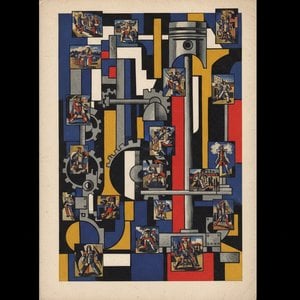
In the vibrant landscape of early twentieth-century modernism, few artists captured the rhythmic pulse of the machine age as effectively as Fernand Léger. His 1918 masterpiece, “The Disc,” stands not merely as a portrait of a human face, but as a profound manifesto of a burgeoning movement. Created during the tumultuous years following the devastation of World War I, this artwork embodies Léger's distinctive approach to capturing the transformative influence of industrialization on the human experience. It is an aesthetic philosophy that distinguishes him from many of his contemporaries who sought refuge in pure abstraction; instead, Lélyer chose to integrate modernity—its dynamism, its mechanical forms, and its very essence—into a new visual language that remains as striking today as it was a century ago.
The painting presents a simplified, almost architectural portrait of a man’s face set against a breathtakingly intense crimson backdrop. Léger deliberately eschewed the soft anatomical realism of the past, opting instead for geometric forms and fractured perspectives to convey the true essence of his subject. This compositional strategy mirrors the fragmented realities perceived through the lens of technological advancement, where individual elements are viewed in relation to larger, interconnected systems. Within this scarlet orbit, the artist employs a technique often referred to as “Tubism,” utilizing bold outlines and cylindrical, volumetric forms that lend a palpable sense of weight and solidity to the canvas. The interplay between the deep, emotive red and the bright yellows creates a visual tension that is both stimulating and harmonious, drawing the eye into a dance of primary colors.
The Geometry of Resilience and Modernity
To gaze upon “The Disc” is to witness a masterclass in Cubist principles. Léger dismantates traditional representation, presenting multiple viewpoints simultaneously within a single frame. This layering of planes and textures serves a purpose far greater than mere stylistic flourish; it communicates the inherent dynamism of a mechanized world. The man's face, depicted from various angles, creates an intriguing visual effect that suggests movement even within the stillness of the paint. For the collector or interior designer, this piece offers a commanding presence, acting as a focal point that injects energy and structural precision into any space.
Beyond its technical brilliance, the historical context of the work adds a layer of poignant symbolism. Painted in the wake of the Great War, “The Disc” speaks directly to the psychological impact of conflict on the human psyche. Yet, Léger’s response was not one of despair or mourning. Instead, he envisioned a future shaped by innovation and resilience. The painting reflects a broader cultural preoccupation with rebuilding society amidst technological upheaval, finding beauty in the strength and geometry of the new age. It is an invitation to embrace the bold, the structural, and the vibrant, making it an enduring inspiration for those who find beauty in the intersection of humanity and the industrial spirit.
Questions et réponses
Quel est l'usage recommandé pour une impression de « The disc » ?
Une reproduction de «The disc» de Fernand Léger est recommandée pour Focal. Cette suggestion découle du sujet, de l'atmosphère et des couleurs de l'œuvre.
Où puis-je acheter une reproduction peinte à la main de «The disc» de Fernand Léger ?
Vous pouvez commander une reproduction peinte à la main de «The disc» de Fernand Léger directement sur sa page Reproduction peinte à la main : une reproduction à l'huile peinte à la main sur toile de lin, réalisée sur commande.
Qu'est-ce que "The disc" partage avec le reste de l'œuvre de Fernand Léger ?
«The disc» appartient à l'œuvre Cubist Synthesis de Fernand Léger, dont les thèmes récurrents incluent futurist expressionism, industrial progress, formal experimentation, geometric abstraction, léger’s vision.
Œuvres similaires


Biographie de l'artiste
jeune vie et formation
fernand léger, peintre, sculpteur et cinéaste français, est né le 4 février 1881 à Argentan, Orne, en Normandie inférieure. Son père élevait du bétail, et léger a initialement été formé à l'architecture de 1897 à 1899. Il s’est ensuite installé à Paris en 1900, se débrouillant comme dessinateur architectural.développement artistique
Le travail précoce de léger a été influencé par l'impressionnisme, comme le montrent le jardin de ma mère (mon jardin) (1905). Après avoir fréquenté l'école des beaux-arts et l’académie Julian, il a commencé à travailler sérieusement comme peintre à 25 ans. Son style s'est développé en une forme personnelle de cubisme, que les critiques ont qualifié de "tubisme" pour son accent sur les formes cylindriques.cubisme et le groupe des Puteaux
En 1910, léger a exposé au Salon d’automne aux côtés de jean metzinger et henri le fauconnier. Il a rejoint le groupe des Puteaux, également connu sous le nom de section d’or (la section dorée), avec d'autres artistes tels que francis picabia et marcel duchamp.guerre et son influence sur le travail de léger
Les expériences de léger à la Première Guerre mondiale ont eu un impact significatif sur son œuvre. Pendant son séjour au front, il a produit des croquis d'artillerie, d'avions et de soldats. Sa peinture soldier avec un tuyau (1916) reflète cette période.œuvre ultérieure et héritage
L'œuvre post-guerre de léger, caractérisée par des formes machine-like élégantes, le lia à la tradition de la peinture figurative française. Ses paysages animés de 1921 ont présenté des figures et des animaux dans des formes harmonieuses et rationalisées.- voir les œuvres de fernand léger sur ArtsDot
- en savoir plus sur fernand léger sur wikipedia
- découvrez le musée national fernand léger (france) avec ArtsDot
- la femme assise (100 x 81 cm, tubisme)
- élément de machine (cubisme)

Fernand Léger
1881 - 1955 , France
En bref
- Artistes Influents:
- Cézanne
- Impressionnisme
- Date De Décès: 1955
- Date De Naissance: 4 février 1881
- Influences Artistiques: ['Pop Art']
- Lieu De Naissance: Argentan, France
- Mouvement Artistique: Cubisme, Tubisme
- Nationalité: Française
- Nom Complet: Fernand Léger
- Oeuvres Notables:
- La Grande Parade
- Machine Élément
- Femme assise
- Paysages animés
Articles connexes

Redefining Nature: A Collector's Guide to the Geometric Beauty of Cubist Landscapes
Explore the revolutionary world of Cubist landscapes. Discover how masters like Picasso and Braque redefined nature through geometric beauty, and learn expert tips for curating these transformative masterpieces in your modern home collection.

Abstraction Géométrique : Les 10 Chefs-d'œuvre qui ont Marqué l'Histoire de l'Art
Plongez au cœur de l'abstraction géométrique avec ArtsDot.com ! Découvrez les 10 œuvres majeures de Mondrian, Malevitch et Kandinsky qui ont révolutionné l'art moderne. Inspirez votre décoration intérieure avec des reproductions de tableaux exceptionnelles. Explorez la collection en ligne !

Crimson Threads of Narrative: Exploring Symbolism & Representation in Artworks Featuring the Red Dress
Explore the rich symbolism of the red dress in art history! From ancient power displays to iconic portraits like Cézanne’s 'Madame Cezanne', discover the cultural and artistic significance behind this captivating color. Expert analysis & insights.
Fernand Léger : Les 25 Œuvres Maîtresses d'un Pionnier du Modernisme | ArtsDot
Plongez dans l'univers vibrant de Fernand Léger ! Découvrez les 25 œuvres majeures du cubisme et du tubisme, explorant formes géométriques et couleurs audacieuses. Retrouvez des reproductions d'art exceptionnelles sur ArtsDot.com.

L'Âme Industrielle : 10 Chefs-d'œuvre Révélant la Beauté du Monde Moderne | ArtsDot
Plongez dans l'âme industrielle de 10 chefs-d'œuvre emblématiques ! Découvrez les histoires fascinantes de Van Gogh, Monet et d'autres artistes ayant capturé la beauté brute du monde moderne. Reproductions de qualité musée sur ArtsDot.com – Explorez la collection en ligne.


