


 Aperçu en situation
 Partager
 Partager
 Détails
 Guide imprimable

 Télécharger
 Articles similaires
 Radiographie
 Voir le diaporama
 Statistiques
The black tree


 Afficher la suite
Giclées et impressions d'art
Impressions giclées ou sur toile de qualité musée, avec une production rapide et des finitions au choix. ( Acheter la peinture faite à la main Passer au format image numérique)




P118B €10

P118H €10

P118W €10

P438Z €10

P508JH €12

P508YH €12

P805H €10

P805Z €10

P919BZ €10

P919G €10

P919XJ €10

P959ZH €10

P968JZ €12

W106C €8

W218G €10

W218JH €8

W218Y €10

W307PJ €10

W316G €10

W316PJ €8

W316Y €10

W398PJ €8

W4111J €10

W500HY €15

W500JH €15

W692G €12

W849H €8

W940BG €15

W953PJ €8




Choisissez parmi nos formats prédéfinis qui respectent les proportions originales de l’œuvre.

Saisissez la largeur et la hauteur souhaitées pour qu'elles s'adaptent à votre cadre ou à votre mur. Une impression ne peut être que découpée, elle ne peut jamais être agrandie au-delà de l'image originale ; ainsi, un format de forme différente entraînera la perte d'une partie de l'image. Nous vous envoyons une maquette numérique pour approbation avant toute impression. L'image présentée sur cette page ne montre pas le recadrage réel — seule la maquette le permet.
Livraison dans le monde entier () en 2 semaines au lieu des 4/5 semaines habituelles. (20 octobre)

Livraison express gratuite dans le monde entier

Toile de lin de haute qualité

Assurance transport complète

Garantie de remboursement des droits de douane

Garantie de fidélité des couleurs

Garantie de retour de 100 jours (uniquement en cas de défaut)

Garantie de remboursement à 100%

Tarifs dégressifs sur quantité
 L'option verre n'est disponible que pour les dimensions inférieures à 110 cm.

The black tree
Giclées et impressions d'art
Format de la reproduction
-


Prix total final
€ 54
A Symphony of Form: Unveiling "The Black Tree" by Fernand Léger
Fernand Léger’s “The Black Tree,” painted in 1937, is more than just a depiction of a tree; it's a powerful embodiment of the anxieties and aspirations surrounding modernity. Emerging from the fertile landscapes of Normandy – specifically Argentan, where he was born in 1881 – Léger channeled his formative experiences with rural labor into a revolutionary artistic language. This work, characteristic of his mature style, reflects his fascination with the machine age, translating its geometric precision and dynamic energy into a vibrant, almost unsettling, visual vocabulary. The painting’s stark contrast between the dark, monolithic trunk and the explosion of color in its branches immediately draws the viewer into a world where nature and industry collide.
Cubism's Embrace of the Machine
Created during a pivotal moment in art history – a period heavily influenced by Cubism – “The Black Tree” exemplifies Léger’s unique approach. While many artists were exploring purely abstract forms, Léger sought to integrate recognizable elements from the modern world, particularly the industrial landscape, into his compositions. The fractured planes and angular shapes within the tree's structure are undeniably reminiscent of Cubist principles, yet they aren’t merely stylistic choices; they represent a deliberate attempt to capture the essence of mechanized movement and form. Léger wasn't rejecting representation entirely, but rather reinterpreting it through the lens of his time – a world increasingly dominated by factories, trains, and the relentless march of progress.
Color as Emotional Language
The bold use of color in “The Black Tree” is crucial to understanding its emotional impact. The dominant black trunk, a grounding element, provides a stark counterpoint to the riotous hues of the branches – fiery reds, vibrant yellows, and verdant greens. These colors aren’t simply decorative; they evoke a sense of energy, dynamism, and perhaps even unease. Léger deliberately employed these intense tones to convey the overwhelming force of industrialization, suggesting both its beauty and its potential for disruption. The inclusion of white flowers adds a subtle layer of fragility and hope amidst this otherwise forceful composition.
Symbolism and Legacy
The title itself, “The Black Tree,” is laden with symbolic weight. Trees have long represented life, growth, and connection to the earth – concepts that were increasingly challenged by the rapid urbanization and industrialization of the early 20th century. The "black" element could signify decay, darkness, or even the shadow cast by technological advancement. Léger’s work, therefore, can be interpreted as a meditation on humanity's relationship with nature in an age of unprecedented change. As one of the most significant figures of the Machine Age aesthetic, Léger’s influence continues to resonate within contemporary art and design. A museum-quality reproduction of “The Black Tree” offers a captivating glimpse into this visionary artist’s world – a world where form and function are inextricably linked, and where the beauty of industry is celebrated with unapologetic intensity.
Questions et réponses
Existe-t-il un guide pour «The black tree» de Fernand Léger ?
Une page Guide est disponible pour «The black tree» de Fernand Léger : une fiche d'information imprimable sur l'œuvre, conçue pour les étudiants et un usage pédagogique en classe.
Quelle couleur ressort le plus dans « The black tree » ?
Walnut (#904b34) est la couleur dominante de «The black tree» de Fernand Léger.
Quelle est la teinte dominante de «The black tree» de Fernand Léger ?
«The black tree» tend vers une nuance Ochre to Sepia.
Œuvres similaires


Biographie de l'artiste
jeune vie et formation
fernand léger, peintre, sculpteur et cinéaste français, est né le 4 février 1881 à Argentan, Orne, en Normandie inférieure. Son père élevait du bétail, et léger a initialement été formé à l'architecture de 1897 à 1899. Il s’est ensuite installé à Paris en 1900, se débrouillant comme dessinateur architectural.développement artistique
Le travail précoce de léger a été influencé par l'impressionnisme, comme le montrent le jardin de ma mère (mon jardin) (1905). Après avoir fréquenté l'école des beaux-arts et l’académie Julian, il a commencé à travailler sérieusement comme peintre à 25 ans. Son style s'est développé en une forme personnelle de cubisme, que les critiques ont qualifié de "tubisme" pour son accent sur les formes cylindriques.cubisme et le groupe des Puteaux
En 1910, léger a exposé au Salon d’automne aux côtés de jean metzinger et henri le fauconnier. Il a rejoint le groupe des Puteaux, également connu sous le nom de section d’or (la section dorée), avec d'autres artistes tels que francis picabia et marcel duchamp.guerre et son influence sur le travail de léger
Les expériences de léger à la Première Guerre mondiale ont eu un impact significatif sur son œuvre. Pendant son séjour au front, il a produit des croquis d'artillerie, d'avions et de soldats. Sa peinture soldier avec un tuyau (1916) reflète cette période.œuvre ultérieure et héritage
L'œuvre post-guerre de léger, caractérisée par des formes machine-like élégantes, le lia à la tradition de la peinture figurative française. Ses paysages animés de 1921 ont présenté des figures et des animaux dans des formes harmonieuses et rationalisées.- voir les œuvres de fernand léger sur ArtsDot
- en savoir plus sur fernand léger sur wikipedia
- découvrez le musée national fernand léger (france) avec ArtsDot
- la femme assise (100 x 81 cm, tubisme)
- élément de machine (cubisme)

Fernand Léger
1881 - 1955 , France
En bref
- Artistes Influents:
- Cézanne
- Impressionnisme
- Date De Décès: 1955
- Date De Naissance: 4 février 1881
- Influences Artistiques: ['Pop Art']
- Lieu De Naissance: Argentan, France
- Mouvement Artistique: Cubisme, Tubisme
- Nationalité: Française
- Nom Complet: Fernand Léger
- Oeuvres Notables:
- La Grande Parade
- Machine Élément
- Femme assise
- Paysages animés
Articles connexes

Expressionnisme Abstrait : Les 10 Chefs-d'Œuvre Incontournables pour Décorer avec Art et Histoire
Plongez au cœur de l'Expressionnisme Abstrait avec ! Découvrez les 10 œuvres majeures de Pollock, Rothko et De Kooning. Histoire, techniques & inspiration déco. Explorez la collection complète en ligne.

Fernand Léger : Les 25 Œuvres Maîtresses d'un Pionnier du Modernisme | ArtsDot
Plongez dans l'univers vibrant de Fernand Léger ! Découvrez les 25 œuvres majeures du cubisme et du tubisme, explorant formes géométriques et couleurs audacieuses. Retrouvez des reproductions d'art exceptionnelles sur ArtsDot.com.

Kandinsky : Les 25 Œuvres Maîtresses d'un Pionnier de l'Art Abstrait | ArtsDot
Plongez dans l'univers vibrant de Kandinsky ! Découvrez les 25 œuvres majeures du pionnier de l'art abstrait. Explorez son expressionnisme, ses couleurs audacieuses et l'histoire fascinante derrière chaque tableau. Reproductions d'exception sur ArtsDot.com.
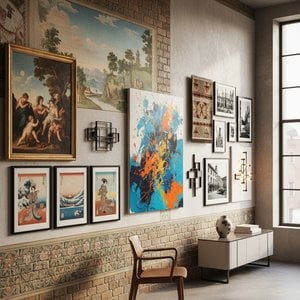
Transforming Spaces: A Comprehensive Exploration of Wall Decor Through Art History & Contemporary Practice
Explore the art of transforming spaces with our comprehensive guide to wall decor. From historical movements to contemporary trends, discover how to curate impactful interiors and commission bespoke artwork for a truly personalized aesthetic.

Abstraction Géométrique : Les 10 Chefs-d'œuvre qui ont Marqué l'Histoire de l'Art
Plongez au cœur de l'abstraction géométrique avec ArtsDot.com ! Découvrez les 10 œuvres majeures de Mondrian, Malevitch et Kandinsky qui ont révolutionné l'art moderne. Inspirez votre décoration intérieure avec des reproductions de tableaux exceptionnelles. Explorez la collection en ligne !


