


 Aperçu en situation
 Partager
 Partager
 Détails
 Guide
Guide

 Télécharger
 Articles similaires
 Radiographie
 Voir le diaporama
 Statistiques
Still Life


 Afficher la suite
Giclées et impressions d'art
Impressions giclées ou sur toile de qualité musée, avec une production rapide et des finitions au choix. ( Acheter la peinture faite à la main Passer au format image numérique)




P118B $10

P118H $10

P118W $10

P438Z $10

P508JH $12

P508YH $12

P805H $10

P805Z $10

P919BZ $10

P919G $10

P919XJ $10

P959ZH $10

P968JZ $12

W106C $8

W218G $10

W218JH $8

W218Y $10

W307PJ $10

W316G $10

W316PJ $8

W316Y $10

W398PJ $8

W4111J $10

W500HY $15

W500JH $15

W692G $12

W849H $8

W940BG $15

W953PJ $8




Choisissez parmi nos formats prédéfinis qui respectent les proportions originales de l’œuvre.

Vous pouvez saisir vos propres dimensions pour vous adapter à un cadre ou à un espace spécifique. Si la taille sélectionnée ne correspond pas aux proportions de l'image originale, nous recadrerons l'œuvre ou étendrons l'image avec une bordure en miroir ou une couleur unie. Une maquette numérique vous sera envoyée pour approbation avant le début de la production.
Veuillez noter que l'aperçu à l'écran ne reflète pas le recadrage ou l'extension réelle. Seule la maquette montrera avec précision la composition finale.
Bien que des tailles personnalisées soient disponibles, nous vous recommandons de choisir une dimension dans la liste prédéfinie afin de préserver les proportions originales.
Livraison dans le monde entier () en 2 semaines au lieu des 4/5 semaines habituelles. (24 septembre)

Livraison express gratuite dans le monde entier

Toile de lin de haute qualité

Assurance transport complète

Garantie de remboursement des droits de douane

Garantie de fidélité des couleurs

Garantie de retour de 100 jours (uniquement en cas de défaut)

Garantie de remboursement à 100%

Tarifs dégressifs sur quantité
 L'option verre n'est disponible que pour les dimensions inférieures à 110 cm.

Still Life
Giclées et impressions d'art
Format de la reproduction
-


Prix total final
$ 62
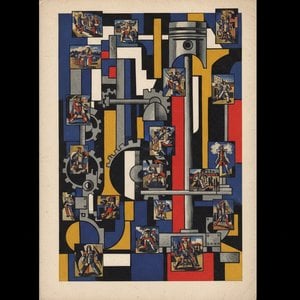
A Symphony of Form and Color: The Vibrancy of Fernand Léger’s Still Life
In the realm of modern art, few names resonate with as much mechanical energy and rhythmic vitality as Fernand Léger. His masterpiece, Still Life, serves as a profound window into an era where the boundaries between the organic world and the industrial age began to blur. While many of his contemporaries were retreating into the ethereal realms of pure abstraction, Léger remained anchored to the tangible, finding beauty in the structured essence of everyday objects. This particular work is not merely a depiction of items on a table; it is a carefully orchestrated dance of geometry, where the familiar becomes extraordinary through a lens of bold, primary colors and architectural precision.
The composition invites the viewer into a space that feels simultaneously grounded and dreamlike. At first glance, one recognizes the classic elements of a traditional still life: a wooden table, a bowl of fruit, a vase of lilies, and the humble presence of cutlery. However, Léger employs a technique that defies traditional perspective. Instead of creating an illusion of depth through soft shadows and realistic gradients, he utilizes a flattened plane where shapes overlap and intersect with startling clarity. The objects are deconstructed into their most fundamental geometric components—cylinders, spheres, and cubes—creating a visual texture that feels as much like a blueprint for modern living as it does a painting. This approach captures the very heartbeat of the machine age, celebrating the strength and clarity of defined edges.
Symbolism and the Intersection of Nature and Industry
Beyond its striking visual impact, Still Life carries a deep, underlying narrative rooted in Léger’s personal history and the shifting cultural landscape of the early 20th century. The muted browns and ochres used for the tabletop serve as a poignant nod to his formative years spent amidst the agricultural landscapes of Normandy. This connection to the earth provides a soulful counterpoint to the more vibrant, almost electric colors found in the fruit and flowers. The lilies, rendered in brilliant yellows and oranges, transcend their traditional associations with purity to become symbols of structured vitality, standing as bright beacons within the complex arrangement.
There is an inherent tension in this work between the soft, organic nature of the fruit and the hard-edged, mechanical execution of the forms. This duality reflects Léger’s unique artistic philosophy: the desire to integrate the dynamism of modern technology with the enduring beauty of the natural world. For the collector or interior designer, this piece offers a sophisticated balance. It possesses the intellectual depth of Cubism while maintaining an accessible, decorative warmth that can anchor a room with its commanding presence and rhythmic energy.
An Essential Addition to the Modern Collection
For those seeking to curate a space that inspires movement and thought, a high-quality reproduction of this work offers unparalleled value. The painting’s ability to harmonize disparate elements—the heavy weight of the objects against the lightness of the color palette—makes it a versatile centerpiece for contemporary interiors. Whether placed in a minimalist gallery-style setting or a richly textured classical room, Léger’s Still Life commands attention through its unapologetic joy and structural integrity.
Owning a piece that captures this specific moment in art history means bringing home more than just decor; it is an invitation to experience the pulse of the avant-garde. The interplay of light, the bold use of primary hues, and the masterful command of shape ensure that this artwork remains as visually stimulating today as it was when Léger first applied his brush to the canvas. It is a timeless celebration of life, reconstructed through the magnificent lens of modernism.
Œuvres similaires


Biographie de l'artiste
jeune vie et formation
fernand léger, peintre, sculpteur et cinéaste français, est né le 4 février 1881 à Argentan, Orne, en Normandie inférieure. Son père élevait du bétail, et léger a initialement été formé à l'architecture de 1897 à 1899. Il s’est ensuite installé à Paris en 1900, se débrouillant comme dessinateur architectural.développement artistique
Le travail précoce de léger a été influencé par l'impressionnisme, comme le montrent le jardin de ma mère (mon jardin) (1905). Après avoir fréquenté l'école des beaux-arts et l’académie Julian, il a commencé à travailler sérieusement comme peintre à 25 ans. Son style s'est développé en une forme personnelle de cubisme, que les critiques ont qualifié de "tubisme" pour son accent sur les formes cylindriques.cubisme et le groupe des Puteaux
En 1910, léger a exposé au Salon d’automne aux côtés de jean metzinger et henri le fauconnier. Il a rejoint le groupe des Puteaux, également connu sous le nom de section d’or (la section dorée), avec d'autres artistes tels que francis picabia et marcel duchamp.guerre et son influence sur le travail de léger
Les expériences de léger à la Première Guerre mondiale ont eu un impact significatif sur son œuvre. Pendant son séjour au front, il a produit des croquis d'artillerie, d'avions et de soldats. Sa peinture soldier avec un tuyau (1916) reflète cette période.œuvre ultérieure et héritage
L'œuvre post-guerre de léger, caractérisée par des formes machine-like élégantes, le lia à la tradition de la peinture figurative française. Ses paysages animés de 1921 ont présenté des figures et des animaux dans des formes harmonieuses et rationalisées.- voir les œuvres de fernand léger sur ArtsDot
- en savoir plus sur fernand léger sur wikipedia
- découvrez le musée national fernand léger (france) avec ArtsDot
- la femme assise (100 x 81 cm, tubisme)
- élément de machine (cubisme)

Fernand Léger
1881 - 1955 , France
En bref
- Artistes Influents:
- Cézanne
- Impressionnisme
- Date De Décès: 1955
- Date De Naissance: 4 février 1881
- Influences Artistiques: ['Pop Art']
- Lieu De Naissance: Argentan, France
- Mouvement Artistique: Cubisme, Tubisme
- Nationalité: Française
- Nom Complet: Fernand Léger
- Oeuvres Notables:
- La Grande Parade
- Machine Élément
- Femme assise
- Paysages animés
Articles similaires

Georges Braque : Les 25 Œuvres Maîtresses du Cubisme et de la Modernité | ArtsDot
Plongez dans l'univers de Georges Braque avec les 25 œuvres incontournables du cubisme. Découvrez l'histoire, les techniques et l'impact de ce maître de l'art moderne. Reproductions d'art exceptionnelles sur ArtsDot.com.

Beyond Form & Color: Geometric Abstraction's Enduring Legacy in Art History
Explore the captivating world of geometric abstraction! Discover its origins, key artists like Malevich & Mondrian, and why this movement remains highly valued by art collectors today. Expert insights at ArtsDot.

Beyond Form & Color: Geometric Abstraction's Evolution in 20th/21st Century Art
Explore the evolution of geometric abstraction from Cubism to contemporary art. Discover key artists like Malevich & Mondrian, investment insights, and expert collecting advice at ArtsDot.
Fernand Léger : Les 25 Œuvres Maîtresses d'un Pionnier du Modernisme | ArtsDot
Plongez dans l'univers vibrant de Fernand Léger ! Découvrez les 25 œuvres majeures du cubisme et du tubisme, explorant formes géométriques et couleurs audacieuses. Retrouvez des reproductions d'art exceptionnelles sur ArtsDot.com.

Abstraction Géométrique : Les 10 Chefs-d'œuvre qui ont Marqué l'Histoire de l'Art
Plongez au cœur de l'abstraction géométrique avec ArtsDot.com ! Découvrez les 10 œuvres majeures de Mondrian, Malevitch et Kandinsky qui ont révolutionné l'art moderne. Inspirez votre décoration intérieure avec des reproductions de tableaux exceptionnelles. Explorez la collection en ligne !


