


 Aperçu en situation
 Partager
 Partager
 Détails
 Guide imprimable

 Télécharger
 Articles similaires
 Radiographie
 Voir le diaporama
 Statistiques
L'album « Cirque »


 Afficher la suite
Giclées et impressions d'art
Impressions giclées ou sur toile de qualité musée, avec une production rapide et des finitions au choix. ( Acheter la peinture faite à la main Passer au format image numérique)




P118B $10

P118H $10

P118W $10

P438Z $10

P508JH $12

P508YH $12

P805H $10

P805Z $10

P919BZ $10

P919G $10

P919XJ $10

P959ZH $10

P968JZ $12

W106C $8

W218G $10

W218JH $8

W218Y $10

W307PJ $10

W316G $10

W316PJ $8

W316Y $10

W398PJ $8

W4111J $10

W500HY $15

W500JH $15

W692G $12

W849H $8

W940BG $15

W953PJ $8




Choisissez parmi nos formats prédéfinis qui respectent les proportions originales de l’œuvre.

Vous pouvez saisir vos propres dimensions pour vous adapter à un cadre ou à un espace spécifique. Si la taille sélectionnée ne correspond pas aux proportions de l'image originale, nous recadrerons l'œuvre ou étendrons l'image avec une bordure en miroir ou une couleur unie. Une maquette numérique vous sera envoyée pour approbation avant le début de la production.
Veuillez noter que l'aperçu à l'écran ne reflète pas le recadrage ou l'extension réelle. Seule la maquette montrera avec précision la composition finale.
Bien que des tailles personnalisées soient disponibles, nous vous recommandons de choisir une dimension dans la liste prédéfinie afin de préserver les proportions originales.
Livraison dans le monde entier () en 2 semaines au lieu des 4/5 semaines habituelles. (26 septembre)

Livraison express gratuite dans le monde entier

Toile de lin de haute qualité

Assurance transport complète

Garantie de remboursement des droits de douane

Garantie de fidélité des couleurs

Garantie de retour de 100 jours (uniquement en cas de défaut)

Garantie de remboursement à 100%

Tarifs dégressifs sur quantité
 L'option verre n'est disponible que pour les dimensions inférieures à 110 cm.

L'album « Cirque »
Giclées et impressions d'art
Format de la reproduction
-


Prix total final
$ 62
A Modern Allegory: Decoding Fernand Léger’s ‘The Album “Circus”’
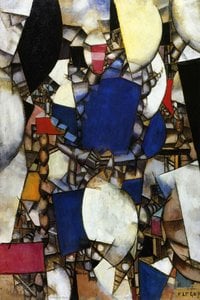
Fernand Léger's 1950 work, *“The album ''Circus''”,* is more than a simple depiction of entertainment; it’s a powerful visual statement about the burgeoning modern age and humanity’s relationship with its technological advancements. Created in the aftermath of World War II, this piece resonates with an optimistic energy, a belief in rebuilding and embracing a future shaped by industry and innovation. The artwork presents a robust figure powerfully gripping a large wheel – a motif that immediately transcends the playful connotations of a circus act. Instead, Léger imbues the image with layers of symbolism, suggesting not just dynamism but also the relentless cycle of life, the gears of progress, and even the passage of time itself. The heroic stance of the central figure isn’t merely physical strength; it embodies mastery over these forces, a confident assertion of control in an increasingly mechanized world. It's a compelling image – a modern-day Atlas shouldering not a world, but the potential of the machine age.Tubism and Beyond: Léger’s Distinctive Style
Léger was a pioneer in developing what became known as “Tubism,” a distinctive branch of Cubism characterized by its emphasis on cylindrical and geometric forms. *“The album ''Circus''”* exemplifies this approach with striking clarity. Flattened perspectives, bold outlines, and simplified shapes are hallmarks not only of Léger’s work but also of the broader Art Deco and Constructivist movements that celebrated machine aesthetics and functional design. However, Léger didn't simply depict machines; he integrated their visual language into the very structure of his art. This creates a sense of order, precision, and forward momentum, transforming the canvas into a dynamic representation of modernity. The limited palette – dominated by red, yellow, black, and white – further enhances this impact, lending graphic clarity to the composition and reinforcing its design-focused aesthetic. The technique appears to be drawing with potential color application using mediums like markers or colored pencils on paper, adding to the work’s immediate and impactful quality.Historical Echoes: A Vision Forged in a Changing World
To understand *“The album ''Circus''”* fully, it's crucial to consider Fernand Léger’s life and times. Born in 1881, he witnessed firsthand the dramatic social and technological shifts of the late 19th and early 20th centuries. Initially trained as an architect, Léger was deeply influenced by the rise of industrialization and the burgeoning machine age. His artistic evolution reflects this experience; moving from early Impressionistic influences to embrace Cubism before forging his own unique style that celebrated the beauty and power inherent in machines – not as threats to humanity, but as tools for progress. The post-war context of 1950 is also significant. *“The album ''Circus''”* can be interpreted as a hopeful declaration, an optimistic vision for rebuilding and embracing a future where technology serves human advancement. It’s a testament to the enduring spirit of innovation and resilience in the face of adversity.Emotional Resonance and Contemporary Appeal
Despite its stylized and somewhat detached aesthetic, *“The album ''Circus''”* evokes powerful emotions – strength, determination, and optimism. The figure's unwavering gaze and firm grip convey a sense of confidence and control, while the dynamic composition suggests relentless energy and forward motion. Today, this artwork continues to resonate with viewers because it speaks to universal themes of human ambition, technological innovation, and the enduring spirit of progress. Its bold aesthetic makes it a compelling statement piece for modern interiors, bringing a touch of sophisticated energy and historical significance to any space. It’s not merely an image; it's a visual embodiment of hope and possibility – a reminder that even in the face of complexity, humanity has the power to shape its own destiny.Œuvres similaires




Biographie de l'artiste
jeune vie et formation
fernand léger, peintre, sculpteur et cinéaste français, est né le 4 février 1881 à Argentan, Orne, en Normandie inférieure. Son père élevait du bétail, et léger a initialement été formé à l'architecture de 1897 à 1899. Il s’est ensuite installé à Paris en 1900, se débrouillant comme dessinateur architectural.développement artistique
Le travail précoce de léger a été influencé par l'impressionnisme, comme le montrent le jardin de ma mère (mon jardin) (1905). Après avoir fréquenté l'école des beaux-arts et l’académie Julian, il a commencé à travailler sérieusement comme peintre à 25 ans. Son style s'est développé en une forme personnelle de cubisme, que les critiques ont qualifié de "tubisme" pour son accent sur les formes cylindriques.cubisme et le groupe des Puteaux
En 1910, léger a exposé au Salon d’automne aux côtés de jean metzinger et henri le fauconnier. Il a rejoint le groupe des Puteaux, également connu sous le nom de section d’or (la section dorée), avec d'autres artistes tels que francis picabia et marcel duchamp.guerre et son influence sur le travail de léger
Les expériences de léger à la Première Guerre mondiale ont eu un impact significatif sur son œuvre. Pendant son séjour au front, il a produit des croquis d'artillerie, d'avions et de soldats. Sa peinture soldier avec un tuyau (1916) reflète cette période.œuvre ultérieure et héritage
L'œuvre post-guerre de léger, caractérisée par des formes machine-like élégantes, le lia à la tradition de la peinture figurative française. Ses paysages animés de 1921 ont présenté des figures et des animaux dans des formes harmonieuses et rationalisées.- voir les œuvres de fernand léger sur ArtsDot
- en savoir plus sur fernand léger sur wikipedia
- découvrez le musée national fernand léger (france) avec ArtsDot
- la femme assise (100 x 81 cm, tubisme)
- élément de machine (cubisme)

Fernand Léger
1881 - 1955 , France
En bref
- Artistes Influents:
- Cézanne
- Impressionnisme
- Date De Décès: 1955
- Date De Naissance: 4 février 1881
- Influences Artistiques: ['Pop Art']
- Lieu De Naissance: Argentan, France
- Mouvement Artistique: Cubisme, Tubisme
- Nationalité: Française
- Nom Complet: Fernand Léger
- Oeuvres Notables:
- La Grande Parade
- Machine Élément
- Femme assise
- Paysages animés
Articles similaires

L'Âme Industrielle : 10 Chefs-d'œuvre Révélant la Beauté du Monde Moderne | ArtsDot
Plongez dans l'âme industrielle de 10 chefs-d'œuvre emblématiques ! Découvrez les histoires fascinantes de Van Gogh, Monet et d'autres artistes ayant capturé la beauté brute du monde moderne. Reproductions de qualité musée sur ArtsDot.com – Explorez la collection en ligne.

Fernand Léger : Les 25 Œuvres Maîtresses d'un Pionnier du Modernisme | ArtsDot
Plongez dans l'univers vibrant de Fernand Léger ! Découvrez les 25 œuvres majeures du cubisme et du tubisme, explorant formes géométriques et couleurs audacieuses. Retrouvez des reproductions d'art exceptionnelles sur ArtsDot.com.

L'Âge d'Or Réinventé : Esthétique et Héritage Durable de l'Art Déco
Explorez l'histoire fascinante de l'Art Déco : influences, artistes emblématiques, matériaux luxueux et héritage durable. Découvrez comment ce style révolutionnaire continue d'inspirer le design contemporain.

Déconstruction de la réalité : L'impact révolutionnaire du cubisme sur l'art du XXe siècle
Explorez l'impact révolutionnaire du cubisme sur l'art moderne. Découvrez Picasso, Braque et les maîtres de ce mouvement clé. Guide pour collectionneurs éclairés.

Deconstructing Reality: Cubism's Evolution, Impact & Enduring Legacy
Explore the revolutionary world of Cubism with expert insights from ArtsDot. Discover Picasso & Braque's groundbreaking techniques, its philosophical roots, and lasting impact on modern art. Expert appraisal & custom reproductions available.


