

 Aperçu en situation
 Envoyer
 Partager
 Détails de l'œuvre
 Guide
Guide

 Télécharger l'image
 Articles similaires
 Radiographie
 Diaporama
 Questions et réponses
 Statistiques
Geometric standards


 Lire la suite
Obtenez un fichier prêt pour l'impression qui dépasse de loin la qualité de l'aperçu web. Chaque image numérique que nous proposons est issue d'un fichier maître haute résolution de notre base de données — mesurant généralement entre 5 000 et 15 000 pixels de large — vous permettant ainsi d'imprimer en grand format, de recadrer avec précision ou de reproduire les détails les plus fins en toute confiance.
Aucun fichier ne quitte notre studio sans être retouché. Un expert numérique vérifie la colorimétrie par rapport à l'œuvre originale et la corrige si nécessaire, puis améliore la clarté et les détails à l'aide d'outils de retouche professionnels — tout en restant toujours fidèle au coup de pinceau et au style de l'artiste. Le résultat est une image qui ressemble au tableau, et non à un simple scan filtré.
Validez avant de finaliser : notre expert vous envoie l'image par e-mail sous 72 heures pour examen. Non satisfait ? Demandez des améliorations ou des corrections, ou demandez un remboursement si la qualité ne répond pas à vos attentes.
C'est une qualité sur laquelle s'appuient éditeurs, studios de création, galeries et ateliers d'impression.
Image numérique
Téléchargez un fichier haute résolution pour votre usage personnel, l'impression et vos projets créatifs. ( Passer au format impression Commander la reproduction peinte à la main)
Inclus avec chaque commande d'image numérique
Livraison numérique experte, garantie.
En choisissant ArtsDot.com, vous n'obtenez pas seulement une simple image : vous recevez une œuvre numérique sublimée avec professionnalisme, conçue avec précision et accompagnée d'une garantie de satisfaction. Voici tout ce qui accompagne automatiquement votre commande :

Envoi rapide par e-mail
Votre fichier d'image numérique haute résolution vous sera envoyé par e-mail sous 72 heures après votre commande — prêt à un usage immédiat.

Fichier numérique optimisé par l'IA
Votre œuvre d'art bénéficie d'une optimisation professionnelle grâce à des outils d'IA avancés et une retouche manuelle, garantissant un niveau maximal de détail, de clarté et de fidélité chromatique.

Réexpédition gratuite à vie
Vous avez accidentellement supprimé ou perdu votre fichier ? Pas d'inquiétude — nous vous le renverrons gratuitement, quand vous le souhaitez.

Aucuns frais de douane — À jamais
Profitez de votre œuvre d'art instantanément sans frais de douane ni de livraison — les téléchargements numériques sont toujours exonérés de taxes.

Garantie de fidélité des couleurs
Nous garantissons que votre image numérique reproduit les couleurs de l'original aussi fidèlement que possible grâce à des outils professionnels et une gestion rigoureuse des couleurs.

Garantie de satisfaction 100 jours
Si vous n'êtes pas satisfait de votre image numérique, nous la retoucherons ou vous rembourserons 100% sous 100 jours — sans poser de questions.

Garantie de remboursement à 100%
Pas satisfait ? Obtenez un remboursement intégral dans les 100 jours suivant la réception de votre fichier numérique — sans aucune question posée.

Réductions sur les commandes groupées
Achetez 3 images, économisez 10% - Achetez 5, économisez 15% - Achetez 10+, économisez 20%. Idéal pour les projets créatifs, les galeries et les agences.
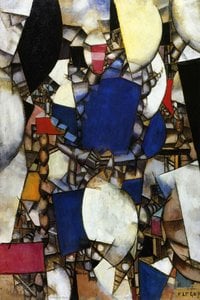
Geometric Standards: A Vision of Industrial Harmony
Fernand Léger’s “Geometric Standards,” painted in 1913, stands as an arresting declaration of Cubist principles interwoven with the burgeoning fascination for machine aesthetics—a visual manifesto that foreshadowed the stylistic upheavals of the coming decades. Executed in bold reds and creams against a stark white ground plan, this monumental canvas transcends mere representation; it strives to capture not just what is seen but how it *feels*. Léger’s meticulous attention to detail reveals an obsessive exploration of form—circles dominate the composition, interspersed with squares and triangles that engage in a dynamic interplay of spatial relationships. These geometric shapes aren't simply decorative elements; they embody the very essence of industrial progress: repetition, precision, and unwavering structural integrity.The Influence of Cubism and Tubism
Léger’s artistic trajectory was profoundly shaped by Pablo Picasso and Georges Braque’s pioneering Cubist experiments. Rejecting traditional illusionistic perspective, Cubists fragmented objects into interlocking planes—a technique Léger adopted with fervor—creating a multifaceted visual experience that challenged viewers to reconsider their perception of reality. However, Léger pushed Cubism further, developing his own distinctive style known as Tubism (short for “tubisme”). Tubism prioritized tubular forms—representing pipes and machinery—as dominant motifs, emphasizing the underlying structure of objects while simultaneously conveying a sense of movement and dynamism. This stylistic innovation perfectly mirrored the anxieties and aspirations of the era, reflecting both the dehumanizing effects of industrialization and the optimistic belief in technological advancement.A Reflection of Parisian Life in 1913
“Geometric Standards” isn’t merely an abstract exercise; it's a carefully considered portrayal of Parisian life during the tumultuous years preceding World War I. Léger sought to depict not just the physical environment but also the psychological state of his contemporaries—a population grappling with rapid social change and confronted by the looming threat of conflict. The stark white ground plan symbolizes purity and clarity, contrasting sharply with the vibrant reds that represent passion and energy—elements crucial to capturing the spirit of the time. Léger’s masterful use of color contributes significantly to the artwork's emotional impact, drawing viewers into a contemplative engagement with its complex visual vocabulary.Symbolism Beyond Form: The Machine Age Aesthetic
Beyond its formal innovations, “Geometric Standards” carries symbolic weight—a deliberate invocation of the Machine Age aesthetic that permeated artistic discourse in Europe during this period. Léger’s obsession with tubular forms speaks to a broader cultural preoccupation with technology and industrial efficiency, reflecting anxieties about societal transformation alongside hopes for progress. The geometric shapes themselves represent stability and order amidst chaos—a visual assertion of faith in reason and scientific inquiry. By distilling the complexities of modern life into simplified geometric abstractions, Léger succeeded in communicating profound ideas about humanity’s relationship to its environment and its future trajectory.A Legacy of Bold Vision
Fernand Léger's “Geometric Standards” remains an enduring testament to his artistic genius—a cornerstone of Cubist innovation and a seminal work embodying the Machine Age aesthetic. Its bold colors, meticulous geometric construction, and evocative depiction of Parisian life continue to inspire artists and collectors alike. Today, reproductions of this masterpiece offer a captivating glimpse into Léger’s visionary worldview—a celebration of form and color that transcends time and resonates powerfully with audiences seeking inspiration from one of the most influential figures in modern art history.Questions et réponses
D'où viennent les visiteurs de «Geometric standards» de Fernand Léger ?
La page Statistiques de «Geometric standards» de Fernand Léger présente les statistiques de visites publiques : le nombre de visites mensuelles de cette œuvre, une comparaison avec les œuvres les plus consultées de l'artiste, ainsi que la provenance des visiteurs.
Où puis-je voir un aperçu de « Geometric standards » ?
Un aperçu de «Geometric standards» de Fernand Léger est disponible sur la page Aperçu en situation de l'œuvre.
Les couleurs de «Geometric standards» de Fernand Léger sont-elles vives ou feutrées ?
La couleur de « Geometric standards » présente une saturation de Couleurs subtiles et une intensité de Équilibré.
Œuvres similaires




Biographie de l'artiste
La Vie de Fernand Léger
L'histoire de Fernand Léger prend racine dans le village d'Argentan, niché dans l'Orne, en Basse-Normandie. Il voit le jour le 4 février 1881, fils unique d'un foyer modeste. Ses premières années sont façonnées par la quiétude de la campagne française et la présence protectrice de sa mère, Marie-Adèle Daunou. Son père, qui tirait ses revenus du commerce de bétail, s'éteint alors que Fernand n'est qu'un jeune enfant, laissant l'enfant à l'éducation de sa mère, au sein d'un foyer marqué par la piété et une certaine humilité.
Cette éducation au cœur des paysages ruraux de Normandie offrit un contraste saisissant avec la vie qu'il allait mener plus tard dans les centres bouillonnants de la culture française. Si ses racines étaient liées à la terre et à la physicalité de la vie agricole, son esprit, lui, était irrésistiblement attiré par les complexités de l'ère moderne. Il allait progressivement étendre son influence bien au-delà des frontières d'Argentan, devenant un homme aux multiples disciplines. Il ne se contenta pas de la toile, cherchant plutôt à exprimer sa vision à travers la sculpture et le mouvement éphémère du cinéma.
Sa vie fut un mouvement perpétuel entre les textures organiques de sa jeunesse et les rythmes mécaniques et structurés de la ville. Cette dualité a défini son existence même, alors qu'il naviguait à travers les bouleversements d'un siècle en pleine mutation. Son parcours ne fut jamais linéaire, marqué par la tension constante entre le monde traditionnel de son enfance et le pouls industriel et rapide du futur qu'il allait, par son art, aider à définir.
Jeunesse, Famille et Formation
Les racines de sa vision furent plantées dans les paysages ruraux d'Argentan, dans l'Orne, en Basse-Normandie. Né dans un univers de l'élevage, ses premières années furent façonnées par la physicalité de la terre et les rythmes immuables de la vie agricole. Cet ancrage dans le monde tangible et laborieux demeurera une présence silencieuse sous la surface de ses explorations ultérieures, plus complexes. Fils unique, élevé par une mère à la fois pieuse et effacée, son destin fut d'abord orienté vers la discipline structurée de l'architecture. De 1897 à 1899, il se consacra à cet art technique, apprenant la logique de l'espace et la nécessité d'un dessin précis.
Dès 1900, l'appel de la ville devint trop puissant pour être ignoré, et il s'installa à Paris. Pour subvenir à ses besoins, il travailla comme dessinateur en architecture, un métier exigeant un œil aiguisé pour la ligne et la proportion. Si sa formation architecturale lui apporta une compréhension structurelle fondamentale, son cœur commença toutefois à dériver vers la toile. Il chercha à intégrer la prestigieuse École des Beaux-Arts, mais l'institution ne lui accorda pas le statut officiel d'étudiant inscrit. Loin de se décourager, il fréquentait l'école en tant qu'auditeur libre, absorbant les leçons des maîtres tout en évoluant en marge de l'établissement académique. Cette période d'étude, bien que parfois décrite comme une phase de quête, fut essentielle pour affiner la maîtrise technique qu'il utiliserait plus tard pour déconstruire et reconstruire le monde à son propre image.
L'influence de Cézanne et du Cubisme
Un tournant profond s'opère en 1907, lorsque l'artiste découvre la rétrospective de Cézanne au Salon d'Automne. Cette rencontre agit comme un véritable catalyseur, l'arrachant aux impressions douces de sa jeunesse pour le porter vers une vision plus structurelle du monde. Il commence alors à regarder au-delà de la surface des choses, cherchant plutôt la géométrie sous-jacente qui définit la réalité. Dès 1909, sa présence au sein des cercles créatifs de Paris s'affermit alors qu'il côtoie des figures telles qu' Alexander Archipenko, Jacques Lipchitz, Marc Chagall et Robert Delaunay. Ces rencontres ne sont pas de simples échanges sociaux ; elles constituent de véritables collisions d'idées nouvelles qui vont façonner la direction de sa vision en pleine gestation.
Au fil des années, il s'inscrit dans l'orbite du Groupe de Puteaux, ce cercle d'artistes également connu sous le nom de Section d'Or. Aux côtés de Jean Metzinger et Henri Le Fauconnier, il explore les possibilités mathématiques et structurelles de ce nouveau langage. Loin de se contenter de suivre les sentiers tracés par ses pairs, il cherche sa propre voie à travers les plans fracturés et les formes superposées qui définissent cette époque. Cette période d'expérimentation intense le mène à sa première exposition majeure au Salon des Indépendants en 1911, où il présente Nudes in the Forest.
- Nudes in the Forest (1911)
La Guerre et la Période Mécanique
Le chaos de la Grande Guerre arracha l'artiste aux ateliers parisiens pour le plonger dans les réalités brutales du front. De 1914 à 1917, il servit au sein de l'armée française, passant deux années éprouvantes dans l'Argonne. Ce conflit ne fut pas un simple décor de son existence, mais une force transformatrice qui altéra sa perception même de la forme. En 1916, une attaque au gaz moutarde faillit lui coûter la vie, le laissant en convalescence tandis que le monde autour de lui se remodelait sous la puissance pure de la destruction industrielle. Même lors d'un bref congé la même année, il se sentit poussé par une nécessité impérieuse de peindre, donnant naissance à l'œuvre Soldier with a Pipe. Cette création saisissait l'essence d'une nouvelle réalité, où la figure humaine commençait à revêtir les qualités des machines qui dominaient le champ de bataille.
Dès 1917, un basculement profond s'était emparé de son esprit créatif, marquant le début de ce que l'on appellera sa période mécanique. Il dénichait une beauté étrange et rythmée dans les outils et la technologie de la guerre moderne et de l'industrie. Les formes tubulaires épurées et la précision des pièces mécaniques devinrent son nouveau langage visuel. Loin de percevoir ces objets comme froids ou impersonnels, il embrassa leur force et leur capacité à organiser le chaos de l'existence moderne. La guerre avait balayé les contours adoucis de ses œuvres de jeunesse, les remplaçant par une clarté structurelle et tranchante, miroir de l'acier et des pistons d'une époque en pleine mutation.
Technique et Style
Son pinceau se déplaçait avec une précision rythmique, presque industrielle, cherchant à capturer le pouls d'une époque en pleine mutation. S'éloignant des ombres douces et estompées du passé, il choisit plutôt de bâtir ses compositions à travers un langage de force géométrique et robuste. Cette démarche a conduit au développement d'une forme personnelle de cubisme que la critique a baptisée le « tubisme ». Dans ce style, le monde est réimaginé à travers des formes tubulaires, coniques et cubiques, créant une sensation de volume qui semble à la fois solide et dynamique. Il ne se contentait pas de peindre des objets ; il cherchait à en extraire la logique structurelle essentielle.
Les couleurs qu'il choisissait étaient aussi affirmées que les formes qu'elles habitaient. Il privilégiait une palette dominée par les couleurs primaires, souvent ponctuée de noir et de blanc tranchants, ce qui aidait à définir les contours nets de ses sujets. Plutôt que de s'appuyer sur l'illusionnisme traditionnel, il appliquait la peinture en plans de couleurs audacieux et aplatis. Il utilisait souvent un impasto épais, une technique qui accentuait la présence physique du médium sur la toile. Cette approche texturale permettait à son œuvre de paraître ancrée et matérielle, faisant écho aux machines et aux structures urbaines qu'il admirait tant. Ses figures adoptaient souvent des formes lisses et mécaniques, brouillant la frontière entre la forme humaine organique et la précision technique de l'ère moderne.
- Nudes in the Forest (1910)
- The Woman in Blue (1912)
- Soldier with a Pipe (1916)
- The Mechanic (1920)
Les dernières années et la fin d'un voyage
Les marées changeantes des conflits mondiaux finirent par arracher l'artiste à ses cercles parisiens pour le porter par-delà l'Atlantique. Entre 1940 et 1945, il résida aux États-Unis, une période qui lui offrit un regard nouveau sur ce monde moderne qu'il s'était tant efforcé de traduire sur la toile. Ce séjour outre-Atlantique constitua une pause dans sa longue évolution, un moment de transition suspendu avant son ultime retour sur la terre de France.
À son retour dans sa patrie, sa vie personnelle connut un tournant majeur. En février 1952, il épousa Nadia Khodasevich. Cette union marqua le dernier chapitre de son existence, une période vécue au rythme de sa production artistique toujours aussi foisonnante, allant des fresques monumentales aux délicats vitraux. Même avec l'âge, sa renommée ne cessa de croître sur la scène internationale. En 1955, il reçut le Grand Prix de la Biennale de São Paulo, un honneur prestigieux qui survint l'année même de son départ. Fernand Léger s'éteignit le 17 août 1955, à Gif-sur-Yvette, en France.
Héritage et Influence
Fernand Léger a laissé une empreinte qui a largement dépassé les cercles d'avant-garde de son propre temps. En jetant un pont entre l'art abstrait et la représentation figurative, il a offert aux artistes une manière d'interagir avec le monde moderne sans pour autant abandonner totalement le sujet humain. Son approche a permis l'instauration d'un dialogue entre la logique structurelle de la géométrie et la présence reconnaissable des personnes et des objets. Cette capacité à trouver un terrain d'entente entre le purement conceptuel et le tangible a contribué à façonner la direction d'une grande partie de l'art qui a suivi.
Sa simplification audacieuse de la forme et sa fascination pour l'esthétique de la production de masse ont agi comme les précurseurs du mouvement Pop Art. Il percevait une certaine beauté dans la nature répétitive et fonctionnelle de l'ère industrielle, une perspective qui allait plus tard trouver un écho auprès d'une nouvelle génération de créateurs. Des artistes tels que Roy Lichtenstein et Andy Warhol ont tracé une ligne directe entre ses expérimentations — caractérisées par des contours affirmés et une imagerie mécanique — et leurs propres explorations de la culture populaire. Il a aidé à préparer le langage visuel d'une époque qui allait finalement célébrer ces mêmes éléments industriels et commerciaux qu'il avait autrefois cherché à traduire sur la toile.
Où contempler ses œuvres aujourd'hui
Pour faire l'expérience de la présence physique de sa vision, il faut parfois s'aventurer dans le sud de la France, et plus précisément à Biot, dans les Alpes-Maritimes. C'est là que réside le Musée national Fernand Léger, un sanctuaire entièrement dédié à l'étude et à la préservation de son héritage créatif. Le musée occupe le Mas Saint-André, une villa qui fut autrefois la demeure de l'artiste lui-même. Entre ces murs et dans la sérénité des jardins environnants, ses sculptures en céramique polychrome retrouvent leur écrin naturel, permettant au spectateur de saisir la manière dont ses formes dialoguent avec la lumière et l'espace du paysage méditerranéen.
Au-delà de ce refuge spécialisé, ses toiles et ses sculptures sont conservées au sein de diverses institutions de prestige. Le Musée d'Art et d'Histoire en France maintient une collection de ses œuvres, assurant ainsi sa place dans le grand récit de l'art français. Ces collections permettent de poursuivre l'étude de la façon dont il a su traduire l'énergie de l'ère industrielle en des formes visuelles statiques, mais pourtant vibrantes de vie. Les voyageurs en quête de son esthétique singulière peuvent retrouver ses traces dans plusieurs collections majeures, notamment :
- Le Kimbell Art Museum à Fort Worth
- Le Museum of Modern Art à New York
- Le Musée National Fernand Léger à Biot
Si son influence imprègne encore l'œuvre de nombreux autres artistes, le moyen privilégié de témoigner de sa main directe demeure ces lieux de mémoire établis. Qu'il s'agisse d'observer ses formes cylindriques audacieuses dans le cadre feutré d'un musée ou de découvrir ses sculptures dans le calme d'un jardin, le visiteur est toujours confronté à cette même clarté structurelle qui a défini l'œuvre de sa vie. Son héritage demeure ancré dans ces lieux précis, où les rythmes mécaniques et puissants de ses peintures sont préservés pour quiconque cherche à saisir la vérité de sa géométrie.

Fernand Léger
1881 - 1955 , France
En bref
- Artistes Ayant Influencé Cet Artiste: ['Paul Cézanne']
- Artistes Ou Mouvements Influencés Par Cet Artiste:
- Pop Art
- Roy Lichtenstein
- Andy Warhol
- Date De Décès: 1955
- Date De Naissance: 1881
- Lieu De Naissance: Argentan, France
- Mouvement Ou Style Artistique:
- Cubisme
- Tubisme
- Section d'Or
- Purisme
- Dadaïsme
- Constructivisme
- Nationalité: Française
- Nom Complet: Joseph Fernand Henri Léger
- Œuvres Notables:
- Nudes in the Forest
- La Ville
- Le Mécanicien
- Trois Femmes
- La Femme en bleu