


 Aperçu en situation
 Partager
 Partager
 Détails
 Guide imprimable

 Télécharger
 Articles similaires
 Radiographie
 Voir le diaporama
 Statistiques
Evening

 Afficher la suite
Reproduction à l'huile faite à la main
Huile sur toile peinte à la main, avec cadre et dimensions personnalisés, réalisée sur commande par nos artistes. ( Passer au format impression Passer au format image numérique)




P118B €10

P118H €10

P118W €10

P438Z €10

P508JH €12

P508YH €12

P805H €10

P805Z €10

P919BZ €10

P919G €10

P919XJ €10

P959ZH €10

P968JZ €12

W106C €8

W218G €10

W218JH €8

W218Y €10

W307PJ €10

W316G €10

W316PJ €8

W316Y €10

W398PJ €8

W4111J €10

W500HY €15

W500JH €15

W692G €12

W849H €8

W940BG €15

W953PJ €8




Choisissez parmi nos formats prédéfinis qui respectent les proportions originales de l’œuvre.

Saisissez la largeur et la hauteur souhaitées, pour s'adapter à votre cadre ou à votre mur. Cette œuvre est peinte à la main ; ainsi, pour un format de forme différente, l'artiste peut peindre un peu plus autour du tableau ou réduire légèrement les bords — c'est vous qui choisissez. Nous vous envoyons une maquette numérique pour approbation avant que la peinture ne commence. L'image présentée sur cette page ne reflète pas le résultat réel — seule la maquette le fait.
Après la commande, l’équipe ArtsDot.com contactera le client par e-mail pour recueillir ses instructions et lui fournira une maquette d’aperçu
Livraison dans le monde entier () en 3 à 4 semaines au lieu des 5 semaines habituelles. (24 octobre). Aucun compromis sur la qualité.

Livraison express gratuite dans le monde entier

Toile de lin de haute qualité

Assurance transport complète

Garantie de remboursement des droits de douane

Garantie de fidélité des couleurs

Garantie de retour de 100 jours (uniquement en cas de défaut)

Garantie de remboursement à 100%

Tarifs dégressifs sur quantité
 L'option verre n'est disponible que pour les dimensions inférieures à 110 cm.

Evening
Technique de reproduction
Format de la reproduction
-


Prix total final
€ 231
A Symphony of Color: Experiencing Emil Nolde’s “Evening”
Emil Nolde's "Evening" is a captivating exploration of light and atmosphere, characteristic of his expressive landscape work. This piece doesn’t depict a literal evening scene, but rather an *emotional* response to one – a distillation of the feeling of twilight rendered in bold color and simplified forms. A dominant, luminous yellow cloud commands attention in the upper left quadrant, acting as a focal point that draws the eye down into the composition. Below, a gradient of blues transitions from deep indigo to lighter turquoise and verdant greens along the horizon line, suggesting water reflecting the celestial drama above.
Expressionism & The Power of Color
- Stylistic Roots: Nolde was a key figure in early 20th-century Expressionism, a movement that prioritized subjective experience and emotional impact over realistic representation. “Evening” exemplifies this approach through its non-naturalistic color palette and abstracted forms.
- Technique & Materials: The artwork appears to be executed in watercolor or gouache, evidenced by the fluidity of the washes and blending of colors. Nolde masterfully employs these techniques to create a sense of atmospheric depth despite the flattened perspective. Visible brushstrokes add texture and energy.
- Influences: While forging his own path, Nolde was influenced by artists like Vincent van Gogh and Paul Gauguin, particularly their use of intense color to convey emotion. He also drew inspiration from traditional folk art and primitive masks, evident in the bold outlines and simplified shapes.
Symbolism & Emotional Resonance
The symbolism within “Evening” is subtle yet potent. The large yellow cloud can be interpreted as a source of radiant energy or enlightenment – a beacon amidst the darkening sky. The winding body of water, reflecting the colors above, suggests a connection between the earthly and celestial realms. More broadly, Nolde’s landscapes often represent an attempt to connect with nature on a spiritual level.
The overall emotional impact is one of tranquility mixed with a hint of mystery. The stylized representation invites contemplation and allows viewers to project their own feelings onto the scene. Nolde's work frequently evokes a sense of longing or melancholy, reflecting his own complex relationship with the world around him.
Nolde’s Life & Legacy
Born in 1867 in Nordel, Germany, Emil Nolde dedicated himself to art after years working as a wood carver. Despite facing opposition from his family and later persecution under the Nazi regime (his work was deemed “degenerate”), he remained committed to his artistic vision. Nolde’s landscapes, seascapes, and portraits are celebrated for their raw emotional power and innovative use of color. His ability to capture the essence of a place or feeling – rather than simply its appearance – continues to resonate with audiences today.
Questions et réponses
Quelle harmonie de couleurs «Evening» de Emil Nolde présente-t-il ?
«Evening» de Emil Nolde présente une harmonie de couleurs Discordant Palette.
Quelle saturation et quelle intensité «Evening» de Emil Nolde présente-t-il ?
La couleur de « Evening » présente une saturation de Balanced Soft et une intensité de Balanced.
Puis-je voir une vue aux rayons X de «Evening» de Emil Nolde ?
La page Rayons X de «Evening» de Emil Nolde est un visionneur interactif qui vous permet de parcourir onze couches optiques de l'image de l'œuvre, incluant une vue de style radiographie.
Œuvres similaires


Biographie de l'artiste
Emil Nolde : Vie et Héritage
Jeunesse et Débuts Artistiques
Emil Nolde, peintre renommé de Germanie-Danemark, est né Hans Emil Hansen le 7 août 1867 à Nolde, en Schleswig-Holstein, Allemagne. Il venait d'une famille avec de fortes attaches aux modes de vie ruraux et aux croyances religieuses, des facteurs qui ont profondément influencé sa vision artistique. Malgré l'opposition initiale de ses parents, qui préféraient qu'il poursuive une carrière plus conventionnelle, Nolde a poursuivi sans relâche sa passion pour l'art. Il a d'abord travaillé comme sculpteur sur bois et décorateur de meubles avant de se consacrer pleinement à la peinture dans sa vingtaine.
Développement Artistique et Influences
Le parcours artistique de Nolde a été marqué par l'auto-éducation et l’exploration. Il a voyagé largement, absorbant des influences de différentes cultures et formes d'art. Les premières influences comprenaient Vincent van Gogh, Paul Gauguin et l'art populaire traditionnel – en particulier la puissance expressive des masques et sculptures primitifs. Ces rencontres ont suscité son intérêt pour les couleurs audacieuses, les formes simplifiées et les sujets chargés d’émotion. Il a initialement expérimenté le Réalisme et l'Impressionnisme mais s'est rapidement tourné vers un style plus subjectif et expressif.
Die Brücke et la Révolution Expressionniste
En 1905, Nolde a cofondé Die Brücke (Le Pont), un groupe allemand expressionniste clé. Ce collectif cherchait à rompre avec les traditions académiques et à exprimer des émotions intérieures par une expérimentation artistique radicale. La contribution de Nolde au groupe Die Brücke a été significative ; son utilisation intense de la couleur et des formes déformées a repoussé les limites de la représentation. Cependant, il a maintenu un chemin relativement indépendant au sein du groupe, s'écartant souvent en matière de sujet et d’approche stylistique.
Thèmes Clés et Style Artistique
L'œuvre de Nolde est caractérisée par plusieurs thèmes récurrents : scènes religieuses, paysages, marines et portraits. Il était particulièrement fasciné par le pouvoir des masques – à la fois en tant qu’objets physiques et représentations symboliques des émotions primales. Son style artistique est défini par:
- Des couleurs audacieuses et vibrantes utilisées pour exprimer l'intensité émotionnelle
- Des formes déformées qui mettent l'accent sur l’expression plutôt que sur la représentation réaliste
- Une technique d'impasto – application épaisse de peinture créant de la texture
- Un souci de capturer les états psychologiques intérieurs
Œuvres Notables et Réalisations
Tout au long de sa carrière, Nolde a créé un vaste corpus d'œuvres. Certaines de ses peintures les plus célèbres comprennent:
- Masques (1906-1907) – mettant en valeur sa fascination pour l’art primitif
- La Mise à nu du Christ (1909) – une scène religieuse puissante et chargée d'émotion
- Mer d'automne (1908) - démontrant son paysage pictural expressif.
- Jardin de fleurs (Fille et lavage) (1907)
- Danse autour du taureau d’or (1909)
Malgré les critiques et la censure qu'il a subies pendant le régime nazi – son œuvre étant qualifiée de “dégénérée” – Nolde a continué à peindre en secret. Il a produit un important corps d’œuvres aquarellées pendant cette période, démontrant ainsi son engagement inébranlable envers l’expression artistique.
Signification Historique et Héritage
L'utilisation innovante de la couleur et du trait expressif de Nolde a profondément influencé les générations d'artistes. Son œuvre a comblé le fossé entre l’art représentatif traditionnel et les mouvements abstraits qui ont suivi. Il reste une figure centrale de l'histoire de l'expressionnisme allemand, célébré pour son intensité émotionnelle, son expérimentation audacieuse et sa vision artistique durable. Son héritage continue d'inspirer les artistes et les amateurs d’art du monde entier.

Emil Nolde
1867 - 1956 , Allemagne
En bref
- Artistic Movement Or Style: Expressionism, Die Brücke
- Artists Who Influenced This Artist:
- Vincent van Gogh
- Paul Gauguin
- Date Of Birth: August 7, 1867
- Date Of Death: April 13, 1956
- Full Name: Emil Nolde
- Nationality: German
- Notable Artworks:
- Masks
- The Mocking of Christ
- Flower Garden (Girl and Washing)
- Autumn Sea
- Place Of Birth: Nolde, Schleswig-Holstein
Articles connexes

Éphémères Visions : L'Aquarelle, Histoire et Résonance Émotionnelle d'un Art Intemporel
Explorez l'histoire fascinante de l'aquarelle, des origines à nos jours. Découvrez les techniques, les artistes emblématiques et nos conseils d'experts pour collectionner ces œuvres éphémères. ArtsDot.

Les 10 Chefs-d'œuvre de l'Aquarelle qui ont Révolutionné l'Art | ArtsDot
Plongez dans l'univers fascinant des 10 chefs-d'œuvre de l'aquarelle qui ont marqué l'histoire de l'art. Découvrez Turner, Monet, Goya et bien d'autres ! Retrouvez ces œuvres emblématiques en reproductions exceptionnelles sur ArtsDot.com.

Kandinsky : Les 25 Œuvres Maîtresses d'un Pionnier de l'Art Abstrait | ArtsDot
Plongez dans l'univers vibrant de Kandinsky ! Découvrez les 25 œuvres majeures du pionnier de l'art abstrait. Explorez son expressionnisme, ses couleurs audacieuses et l'histoire fascinante derrière chaque tableau. Reproductions d'exception sur ArtsDot.com.
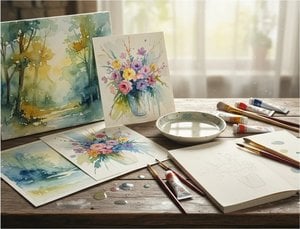
L'Aquarelle : Histoire, Techniques et Nuances d'une Peinture de Lumière Éphémère
Explorez l'histoire fascinante de l'aquarelle, des techniques ancestrales aux maîtres impressionnistes. Découvrez les artistes emblématiques et nos conseils pour apprécier et collectionner cette peinture lumineuse.

Ephemeral Visions: Exploring the Artistic Legacy & Contemporary Practice of Watercolor Painting
Explore the captivating world of watercolor painting! Discover its rich history, essential techniques, influential artists & collecting tips. A comprehensive guide for art enthusiasts from ArtsDot.


