


 Aperçu en situation
 Partager
 Partager
 Détails
 Guide imprimable

 Télécharger
 Articles similaires
 Radiographie
 Voir le diaporama
 Statistiques
untitled (9111)


 Afficher la suite
Reproduction à l'huile faite à la main
Huile sur toile peinte à la main, avec cadre et dimensions personnalisés, réalisée sur commande par nos artistes. ( Passer au format impression Passer au format image numérique)




P118B €10

P118H €10

P118W €10

P438Z €10

P508JH €12

P508YH €12

P805H €10

P805Z €10

P919BZ €10

P919G €10

P919XJ €10

P959ZH €10

P968JZ €12

W106C €8

W218G €10

W218JH €8

W218Y €10

W307PJ €10

W316G €10

W316PJ €8

W316Y €10

W398PJ €8

W4111J €10

W500HY €15

W500JH €15

W692G €12

W849H €8

W940BG €15

W953PJ €8




Choisissez parmi nos formats prédéfinis qui respectent les proportions originales de l’œuvre.

Saisissez la largeur et la hauteur souhaitées, pour s'adapter à votre cadre ou à votre mur. Cette œuvre est peinte à la main ; ainsi, pour un format de forme différente, l'artiste peut peindre un peu plus autour du tableau ou réduire légèrement les bords — c'est vous qui choisissez. Nous vous envoyons une maquette numérique pour approbation avant que la peinture ne commence. L'image présentée sur cette page ne reflète pas le résultat réel — seule la maquette le fait.
Après la commande, l’équipe ArtsDot.com contactera le client par e-mail pour recueillir ses instructions et lui fournira une maquette d’aperçu
Livraison dans le monde entier () en 3 à 4 semaines au lieu des 5 semaines habituelles. (25 octobre). Aucun compromis sur la qualité.

Livraison express gratuite dans le monde entier

Toile de lin de haute qualité

Assurance transport complète

Garantie de remboursement des droits de douane

Garantie de fidélité des couleurs

Garantie de retour de 100 jours (uniquement en cas de défaut)

Garantie de remboursement à 100%

Tarifs dégressifs sur quantité
 L'option verre n'est disponible que pour les dimensions inférieures à 110 cm.

untitled (9111)
Technique de reproduction
Format de la reproduction
-


Prix total final
€ 231
A Shadowed Beauty: Unveiling the Mystery of “Untitled (9111)”
This arresting portrait, often referred to as "Untitled (9111)," offers a glimpse into the intensely personal and profoundly melancholic world of Egon Schiele. The image presents a woman shrouded in mystery, her face partially obscured by a delicate veil, a gesture that immediately invites speculation about her identity and inner state. The painting possesses an undeniable vintage quality – a subtle blurring of edges and a muted palette suggest it’s not merely a reproduction but a piece imbued with the weight of time itself. It's a work that speaks volumes without uttering a single word, drawing the viewer into a quiet contemplation of human vulnerability and the unspoken anxieties of existence.
Schiele’s artistic journey was inextricably linked to personal tragedy. Born in 1890 in Tulln an der Donau, Austria – then part of the Austro-Hungarian Empire – his childhood was marked by illness and loss. The early death of his father from syphilis at the tender age of fourteen profoundly shaped his worldview, instilling a preoccupation with mortality that would permeate much of his oeuvre. This experience isn’t simply reflected in morbid subject matter; it's woven into the very fabric of his technique – a deliberate distortion of form and an unsettling intensity in his gaze. The woman before us embodies this legacy: she is not idealized, but presented with raw honesty, her downward glance hinting at a hidden sorrow.
Decoding Symbolism and Technique
Schiele’s style during this period – roughly 1910-1918 – is characterized by its expressive distortion and psychological depth. He moved away from the polished surfaces of academic art, embracing instead a visceral approach that prioritized emotional impact over realistic representation. Notice the elongated limbs, the subtly hunched posture, and the almost skeletal quality of the figure. These are not accidental choices; they’re deliberate attempts to convey a sense of fragility and impending doom. The veil itself is a potent symbol – it can represent modesty, concealment, or perhaps even a barrier between the viewer and the subject's true self.
Technically, Schiele employed a technique he termed “pointillé,” a dense network of tiny dots that created texture and movement on the canvas. This method, combined with his use of thin washes of color, lends the painting an ethereal quality, as if it’s caught between worlds – simultaneously present and fading away. The muted palette—primarily browns, greys, and ochres—further enhances this sense of melancholy and timelessness. The artist's hand is visible in places, a testament to his direct engagement with the medium and a rejection of idealized artistic detachment.
Historical Context: Vienna on the Brink
To understand “Untitled (9111),” it’s crucial to consider the historical context in which Schiele was working. Early 20th-century Vienna was a city teeming with intellectual ferment, but also gripped by social anxieties and political unrest. The Austro-Hungarian Empire was crumbling, and artists like Schiele were grappling with questions of identity, sexuality, and mortality – themes that resonated deeply within the cultural landscape. His work reflects this atmosphere of uncertainty and disillusionment, capturing a sense of impending change and the fragility of human existence in a world on the precipice.
Schiele’s life was tragically cut short during World War I, succumbing to influenza at the age of 28. His premature death only served to amplify the mystique surrounding his work, solidifying his reputation as one of the most innovative and emotionally charged artists of his generation. “Untitled (9111)” stands as a poignant reminder of his artistic genius – a hauntingly beautiful portrait that continues to resonate with viewers today.
A Timeless Masterpiece: Bringing Schiele Home
ArtsDot offers meticulously crafted, hand-painted reproductions of Egon Schiele’s “Untitled (9111),” allowing you to experience the raw emotion and captivating beauty of this iconic work in your own space. Our artists replicate Schiele's distinctive style with exceptional skill, capturing not only the visual details but also the underlying psychological intensity. Whether you are an art collector, interior designer seeking a statement piece, or simply someone drawn to the power of evocative imagery, a ArtsDot reproduction of “Untitled (9111)” is a timeless addition to any collection. Explore our range of sizes and canvas options today – and bring this enigmatic portrait into your world.
Questions et réponses
Quelle pièce s'accorde avec les couleurs de «untitled (9111)» de Egon Schiele ?
Compte tenu de ses couleurs Pastels, « untitled (9111) » est suggéré pour une Living Room.
«untitled (9111)» de Egon Schiele est-elle une œuvre lumineuse ou sombre ?
En termes de luminosité perçue, «untitled (9111)» de Egon Schiele est brilliant.
Dans quel mouvement et à quelle époque s'inscrit «untitled (9111)» de Egon Schiele ?
« untitled (9111) » appartient au mouvement Expressionist Egon Schiele, et son créateur a œuvré à l'époque Époque moderne.
Œuvres similaires


Biographie de l'artiste
Egon Schiele : Vie et Héritage
Jeunesse et Influences
- Né le 12 juin 1890 à Tulln an der Donau, en Basse Autriche, Egon Schiele a connu une enfance marquée à la fois par une inclination artistique et des difficultés personnelles.
- Son père, Adolf Schiele, était maître de gare, instaurant chez le jeune Egon une fascination pour les trains – un motif qui apparaîtra subtilement plus tard dans son œuvre.
- Le décès prématuré de son père à cause de la syphilis lorsqu'il avait 14 ans l'a profondément affecté, entraînant sa tutelle par son oncle maternel, Leopold Czihaczek.
- Czihaczek lui a apporté un soutien mais a également exercé une influence contrôlante, contribuant ainsi au paysage émotionnel complexe reflété dans l’art de Schiele.
Parcours Artistique et Développement
- La formation artistique de Schiele a commencé à la Kunstgewerbeschule (École des Arts et Métiers) de Vienne, mais il est rapidement passé à l’Akademie der bildenden Künste (Académie des Beaux-Arts).
- Il s'est rapidement désillusionné face à l’approche conservatrice de l’Académie, qu’il trouvait étouffante pour sa vision expressive. Il a finalement quitté la formation formelle.
- Ses influences précoces comprenaient Gustav Klimt, figure de proue de la Sécession viennoise, dont le style décoratif et son exploration du symbolisme résonnaient chez Schiele. Cependant, Schiele a rapidement développé un style distinctif.
- Ses premières œuvres présentaient souvent des portraits et autoportraits dérangeants, caractérisés par des figures déformées et une intensité émotionnelle.
Caractéristiques et Thèmes Clés
- L’art de Schiele est réputé pour son honnêteté brute et sa profondeur psychologique. Il a exploré sans crainte les thèmes de la sexualité, de la mort, de l'anxiété et de l'isolement.
- Son style distinctif se caractérise par des figures allongées, des poses contorsionnées et des lignes expressives qui transmettent un sentiment de vulnérabilité et de tourment émotionnel.
- Les autoportraits constituent une part importante de son œuvre, offrant des aperçus intimes dans son monde intérieur.
- Il a également créé de nombreux portraits d'autres personnes, les représentant souvent avec un réalisme sans complaisance et une perspicacité psychologique.
- La peinture de paysages a joué un rôle dans son travail, démontrant sa maîtrise de la forme et de la couleur, bien qu’elle soit moins centrale que ses œuvres figuratives.
Réalisations Majeures et Reconnaissance
- Malgré les censures et les défis juridiques (y compris une brève incarcération pour avoir été accusé de corruption infantile avec son art), Schiele a gagné la reconnaissance dans les cercles avant-gardistes de Vienne.
- Il a cofondé le Neues Wiener Kunstgruppe (Groupe d'Art Viennois Nouveau) en 1909, présentant son œuvre aux côtés d'autres artistes progressistes.
- Œuvres importantes comprennent Autoportrait avec physalis, Couple s’embrassant et Paysage de campagne (Kreuzberg près de Krumau).
- Au moment de sa mort prématurée, Schiele s'était établi comme une figure de proue de l'expressionnisme autrichien.
Signification Historique et Héritage
- Egon Schiele est décédé en 1918 pendant la pandémie d’influenza espagnole à l’âge de 28 ans, mettant fin prématurément à une carrière prometteuse.
- Son œuvre a profondément influencé les générations suivantes d'artistes, en particulier celles intéressées par l'exploration des thèmes psychologiques et le défi des normes artistiques conventionnelles.
- L’approche audacieuse de Schiele en matière de forme et de sujet reste pertinente pour les publics aujourd'hui, faisant de lui l'un des figures les plus importantes et les plus influentes de l'art du début du XXe siècle.
- Ses peintures sont aujourd'hui conservées dans les principales collections muséales du monde entier, et des reproductions de son œuvre sont largement disponibles, assurant ainsi la pérennité de son héritage artistique.

Egon Schiele
1890 - 1918 , Croatie
En bref
- Artistes Influents: ['Gustav Klimt']
- Date De Décès: 1918
- Date De Naissance: 12 juin 1890
- Influences Artistiques: ['Expressionnisme autrichien']
- Lieu De Naissance: Vienne, Croatie
- Mouvement Artistique: Expressionnisme
- Nationalité: Autrichien(ne)
- Nom Complet: Egon Schiele
- Oeuvres Notables:
- Portrait avec physalis
- Couple s'embrassant
- Paysage de champ (Kreuzberg)
Articles connexes

Egon Schiele : Expressionnisme, Angoisse et la Condition Moderne – Une Exploration Approfondie
Explorez l'univers poignant d'Egon Schiele : expressionnisme, angoisse et condition humaine. Analyse approfondie de son œuvre, son contexte viennois et son héritage artistique. Découvrez un artiste majeur avec ArtsDot.

Expressionnisme : 10 Chefs-d'œuvre Révolutionnaires pour une Décoration d'Art
Plongez au cœur de l'expressionnisme avec 10 chefs-d’œuvre emblématiques : Munch, Kirchner, Kandinsky… Découvrez les histoires et émotions derrière ces peintures révolutionnaires. Reproductions d'art de qualité muséale sur ArtsDot.com !

Expressionnisme : Les 10 Chefs-d'œuvre qui ont Marqué l'Histoire de l'Art
Plongez au cœur de l'Expressionnisme avec les 10 œuvres majeures qui ont marqué ce mouvement puissant. Découvrez Munch, Kirchner, Kandinsky et plus encore. Reproductions d'art de qualité muséale sur – Explorez la collection !

Échos du Temps : Nostalgie, Technique et Signification Culturelle dans la Peinture Vintage
Explorez la nostalgie en peinture vintage : des analyses d'experts sur Hopper, Katz et Wesselmann aux conseils pour collectionner l'art moderne. Découvrez comment ces œuvres captivent et inspirent.
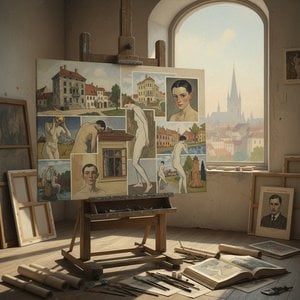
Egon Schiele : Les 25 Œuvres Maîtresses d'un Artiste Expressionniste
Plongez dans l'univers poignant d'Egon Schiele avec les 25 œuvres incontournables de ce maître expressionniste. Découvrez son style unique, ses nus audacieux et la profondeur émotionnelle de ses portraits. Reproductions de qualité muséale sur ArtsDot.com


