

- 813.0 x 588.0 cm


L'image s'adapte à vos choix : , .
Description de la pièce
Witness the captivating 'Study for The Sirens' by Edward Burne-Jones – a pre-Raphaelite masterpiece brimming with mythical figures and intricate detail. Explore its history & artistic significance.
 Lire la suite
Biographie de l'artiste
Découvrez l'art préraphaélite envoûtant d'Edward Burne-Jones (1833-1898). Peintures mythiques, vitraux exquis & designs décoratifs influents. Figure clé de l'esthétisme.
Reproduction à l'huile faite à la main
Huile sur toile peinte à la main, avec cadre et dimensions personnalisés, réalisée sur commande par nos artistes. ( Passer au format impression Passer au format numérique)
En savoir plus sur cette peinture
 Aperçu en situation
 Envoyer
 Partager
 Détails de l'œuvre
 Guide
Guide

 Télécharger l'image
 Articles similaires
 Radiographie
 Diaporama
 Questions et réponses
 Statistiques
Commandez votre tableau en quatre étapes simples
Prenez votre temps. Vous pouvez modifier chaque réponse ; le prix dans votre panier s'ajustera selon vos choix.
1 Première étape sur quatre
Quel format souhaitez-vous ?
Ces formats respectent les proportions de l'œuvre originale. Le dessin illustre votre choix sur un mur, au-dessus d'un canapé de deux mètres.
Ou indiquez vos propres dimensions
Choisissez parmi nos formats prédéfinis qui respectent les proportions originales de l’œuvre.

Saisissez la largeur et la hauteur souhaitées, pour s'adapter à votre cadre ou à votre mur. Cette œuvre est peinte à la main ; ainsi, pour un format de forme différente, l'artiste peut peindre un peu plus autour du tableau ou réduire légèrement les bords — c'est vous qui choisissez. Nous vous envoyons une maquette numérique pour approbation avant que la peinture ne commence. L'image présentée sur cette page ne reflète pas le résultat réel — seule la maquette le fait.
2 Deuxième étape sur quatre
Comment doit-il être préparé : roulé, tendu ou encadré ?
Les prix ci-dessous correspondent au format choisi à l'étape précédente.
Choisissez le type de bordure pour votre toile tendue
Choisissez votre cadre

Bords blancs €1

Bords estompés €1

Bords imprimés €1

P118B €10

P118H €10

P118W €10

P438Z €10

P508JH €12

P508YH €12

P805H €10

P805Z €10

P919BZ €10

P919G €10

P919XJ €10

P959ZH €10

P968JZ €12

W106C €8

W218G €10

W218JH €8

W218Y €10

W307PJ €10

W316G €10

W316PJ €8

W316Y €10

W398PJ €8

W4111J €10

W500HY €15

W500JH €15

W692G €12

W849H €8

W940BG €15

W953PJ €8

H24-GOLD €30

H24-SILVER €30

H36-GOLD €45

H36-SILVER €45
Sous cadre
Baguette : . Dimensions hors tout avec le cadre : .
3 Troisième étape sur quatre
Souhaitez-vous apporter des modifications à la peinture ?
La plupart des gens répondent non. Comme chaque peinture est réalisée à la main, notre artiste peut également l'adapter pour vous.
Après la commande, l'équipe de ArtsDot.com contactera le client par e-mail pour obtenir ses instructions et lui fournir un aperçu de la maquette
4 Quatrième étape sur quatre
Quelques options de finition
Tous sont facultatifs. Les réponses déjà sélectionnées ne comportent aucun coût supplémentaire.
Qui l'a peint ?
Livraison dans le monde entier () en 3 à 4 semaines au lieu des 5 semaines habituelles. (4 novembre). Aucun compromis sur la qualité.
Une plaque nominative, comme au musée ?
Détails de la plaque en bronze gravée
This elegant plaque features the artist's name and the title of the artwork, finely engraved for a timeless presentation.
It is made from bronze with a refined, elegant finish. The text is precisely laser-engraved for a sharp and permanent result. Measuring 9x2 cm, the plaque is compact yet easy to read. It's built to be durable and scratch-resistant, offering a professional, museum-quality look. Mounting is simple thanks to the included adhesive backing.
Détails de la plaque en acrylique transparent
The plaque includes essential engraved details such as the artist's name, the title of the artwork, the date it was created, the type of media used-like oil on canvas or watercolor-a brief description of the piece, and a QR code that links to the complete artwork information.
It is crafted from clear acrylic, offering a sleek, modern appearance. The text is UV-engraved in black to ensure strong visual contrast. With a size of 10x15 cm, it ensures optimal readability. It comes equipped with two metal hooks for secure wall mounting. The plaque is designed to be weather-resistant, making it suitable for various environments, and it includes interactive features that work seamlessly with smartphone scanning.
Détails de la plaque en acrylique noir
This elegant plaque includes engraved information such as the artist's name, the title of the artwork, the date it was created, the type of media used (like oil on canvas or watercolor), a short description of the artwork, and a QR code for quick access to more information.
The plaque itself is made from refined black acrylic with a premium finish. The text is laser-engraved in white for high contrast and readability. Its size is 10x15 cm, designed to be easy to read. It comes with two metal hooks for professional mounting. The design is sleek and fits any interior style. It is also weather-resistant and durable, with built-in digital integration for mobile compatibility.
Un vernis protecteur ?
Pour quand en avez-vous besoin ?
✓ Vérifier et commander
Votre tableau, tel que vous l'avez commandé

Study for
Technique de reproduction
Format de la reproduction
-

Artiste de prestige
Plus de détails, de finesse et un temps de production accru
-

Cadre de reproduction
-
-
Pour les œuvres ou reproductions dont un côté mesure plus de 105 cm (environ 41 pouces), le cadre sera expédié sous forme de kit démonté. Cette méthode garantit une livraison sécurisée et prévient tout dommage pendant le transport.
Assemblage professionnel requis - ce produit n'est pas destiné au bricolage (DIY).
Le kit doit être assemblé et la toile tendue par un encadreur professionnel expérimenté, en utilisant de la colle à bois (non fournie), une pince à tendre la toile et des serre-joints pour maintenir les traverses d'équerre pendant le séchage de la colle. Un assemblage incorrect ou une tension inégale de la toile peut endommager l'œuvre de manière irréversible et n'est pas couvert par notre garantie.
 Pour les œuvres ou reproductions dont un côté mesure plus de 105 cm (environ 41 pouces), le cadre sera expédié sous forme de kit démonté. Cette méthode garantit une livraison sécurisée et prévient tout dommage pendant le transport.
Toutes les baguettes en bois massif sont incluses, découpées avec précision à la taille requise.
À assembler avec les vis fournies, ainsi qu'avec de la colle à bois pour les assemblages d'angles (non fournie), à prévoir par votre encadreur.
L'utilisation d'outils professionnels est requise et non incluse : une pince à tendre la toile (tendeur) et des serre-joints pour maintenir les baguettes bien d'équerre pendant le séchage de la colle.
Important :
L'assemblage des angles nécessite de la colle à bois, les barres doivent être maintenues avec des serre-joints jusqu'au séchage complet de la colle, et le tendage de la toile sur le châssis assemblé nécessite une pince à tendre la toile. Aucun de ces éléments n'est inclus dans le kit. Veuillez consulter un encadreur professionnel expérimenté avant de commander ce format.

Cartel
-
-

Vernis de protection
Vernis brillant (intensifie les couleurs, protège de la lumière et de l'humidité)
-

Personnaliser mon œuvre
Exemples de personnalisation : remplacer le visage par une photo du client ; ajouter un animal de compagnie (par exemple, remplacer un chat par un chien) ; inclure un message caché en arrière-plan ; modifier le paysage ou les éléments d'arrière-plan.
-

Livraison urgente
Livraison dans le monde entier () en 3 à 4 semaines au lieu des 5 semaines habituelles. (4 novembre). Aucune concession sur la qualité.
-
Livraison express
Livraison dans le monde entier () sous 5 semaines. (11 novembre).
Inclus
Prix total
€ 234
L'option verre n'est disponible que pour les dimensions inférieures à 110 cm.
Inclus avec chaque commande
- Livraison express gratuite dans le monde entier
- Toile de lin de qualité supérieure
- Assurance transport complète
- Garantie de remboursement des droits de douane
- Garantie de fidélité des couleurs
- Politique de retour de 100 jours (uniquement en cas de défaut)
- Garantie de remboursement à 100%
- Offre de tarifs dégressifs


A Vision of Myth and Beauty: Edward Burne-Jones’s “Study for The Sirens”
Edward Coley Burne-Jones, a pivotal figure bridging the romantic currents of the Pre-Raphaelite Brotherhood with the burgeoning aesthetic sensibilities of late Victorian England, possessed an extraordinary ability to conjure worlds both fantastical and deeply human. His art wasn't merely decorative; it was a deliberate exploration of myth, symbolism, and the very essence of beauty. Among his most captivating works is this exquisite “Study for The Sirens,” a preparatory drawing that offers a tantalizing glimpse into the genesis of a monumental painting—a testament to Burne-Jones’s meticulous process and profound artistic vision. This particular study, recently rediscovered and now held within the Ringling Museum of Art in Sarasota, Florida, reveals not just a sketch but a carefully considered meditation on desire, temptation, and the alluring power of the unknown.
The drawing itself is executed with remarkable delicacy in black and red chalk, upon a sheet of high-quality paper. Burne-Jones’s hand moves with confident fluidity, capturing the subtle nuances of form and gesture with breathtaking precision. The composition—a partial view of two figures, a young man and a woman, seated on a grassy bank beside a stream—is deceptively simple yet brimming with latent drama. Notice the loose, expressive lines that define the contours of their bodies, suggesting both vulnerability and an underlying current of sensuality. The artist’s attention to detail is immediately apparent in the rendering of the foliage, the flowing water, and the delicate folds of fabric – elements that contribute significantly to the overall atmosphere of the piece.
Echoes of Mythology and Pre-Raphaelite Sensibilities
“The Sirens,” as Burne-Jones envisioned it, was deeply rooted in Greek mythology. The sirens were mythical creatures—often depicted as beautiful women whose enchanting songs lured sailors to their doom. However, Burne-Jones’s interpretation transcends the traditional cautionary tale. This study hints at a more complex narrative – one of irresistible attraction and the perilous allure of beauty. The figures are not presented as victims but as active participants in a scene of quiet contemplation, suggesting an awareness of the potential consequences of their encounter. The composition draws heavily on Pre-Raphaelite conventions: the emphasis on naturalism, the idealized portrayal of the human form, and the incorporation of classical motifs – all hallmarks of Burne-Jones’s distinctive style.
The influence of Dante Gabriel Rossetti is also palpable in this study. Like Rossetti, Burne-Jones was fascinated by medieval romance and folklore, and he frequently drew inspiration from Arthurian legends and other mythological tales. The use of rich colors, the dramatic lighting, and the evocative atmosphere all contribute to a sense of heightened emotion and psychological intensity – qualities that are characteristic of both artists’ work. The drawing's intimate scale further enhances its emotional impact, inviting the viewer to step into the scene and contemplate the unspoken desires and anxieties of the figures depicted.
A Window into the Artist’s Process
What makes this particular “Study for The Sirens” so compelling is that it offers a rare glimpse into Burne-Jones's creative process. It’s not a finished masterpiece but rather a preliminary sketch—a series of studies and drawings that he created as he developed his ideas for larger works. The drawing reveals the artist’s initial thoughts, experiments with composition, and adjustments to the figures’ poses and expressions. The fact that this particular study was previously misidentified as being by the circle of Augustus John adds an intriguing layer of historical complexity to its story.
Further research into Burne-Jones's work reveals a fascinating connection to the Institute for Advanced Study in Princeton, where scholars from across Europe sought refuge and intellectual stimulation during the tumultuous years following World War I. Burne-Jones’s own life was marked by both artistic triumph and personal tragedy – his marriage to Georgiana MacDonald ended in heartbreak after her death, and he struggled with bouts of depression throughout his career. Despite these challenges, he remained a prolific artist, producing some of the most enduring images of the Victorian era. The rediscovery of this “Study for The Sirens” serves as a poignant reminder of Burne-Jones’s extraordinary talent and his lasting contribution to the world of art.
A Timeless Appeal
“Study for The Sirens” is more than just a drawing; it's an invitation to lose oneself in a world of myth, beauty, and psychological depth. Its evocative atmosphere, masterful technique, and profound symbolism continue to resonate with viewers today. Whether you are an art collector seeking a rare and significant addition to your collection, or simply an admirer of Victorian art, this exquisite study offers a unique opportunity to connect with one of the most celebrated artists of the 19th century. Reproductions of this piece capture the essence of Burne-Jones’s vision, allowing you to bring its timeless beauty into your home or office.
Questions et réponses
Puis-je prévisualiser «Study for» de Edward Coley Burne-Jones avant de commander ?
Pour prévisualiser une reproduction de «Study for» de Edward Coley Burne-Jones, consultez la page d'aperçu de l'œuvre : Aperçu en situation.
Les couleurs de "Study for" sont-elles vives ou plutôt atténuées ?
«Study for» de Edward Coley Burne-Jones présente une saturation de Couleurs vives et nettes et une intensité Vif.
Quelle est la notoriété de « Study for » au sein du mouvement Pre-Raphaelite Brotherhood ?
Au sein du mouvement Pre-Raphaelite Brotherhood, « Study for » affiche un niveau de popularité Iconique.
Œuvres similaires


Edward Coley Burne-Jones
1833 - 1898, Royaume-Uni
Biographie de l'artiste
Premières années et éducation
Edward Coley Burne-Jones, un artiste et designer britannique renommé, est né le 28 août 1833 à Birmingham, au Royaume-Uni. Son enfance a été marquée par le décès de sa mère, Elizabeth Coley Jones, six jours après sa naissance. Élevé par son père, Edward Richard Jones, et la gouvernante familiale Ann Sampson, Burne-Jones a fréquenté King Edward VI Grammar School à partir de 1844 puis a étudié à l'école d'art de Birmingham de 1848 à 1852.Études universitaires et la Fraternité
Burne-Jones s’est tourné vers la théologie à Exeter College, Oxford, où il se lia d’amitié avec William Morris. Avec un groupe d’amis venus de Birmingham, connus sous le nom de « the Birmingham set », ils formèrent une société intime appelée « la Fraternité ». Cette période fut marquée par l'influence de John Ruskin et Tennyson sur son travail, ainsi que par des visites dans les églises et la vénération du Moyen Âge.Carrière artistique et œuvres notables
La carrière artistique de Burne-Jones s’est épanouie dans divers domaines, notamment la peinture, le vitrail et les arts décoratifs. Ses premières peintures furent influencées par Dante Gabriel Rossetti, mais il développa rapidement son propre style unique. Parmi ses œuvres notables figurent :- Le Rêve de Lancelot au Chapelle du Saint Graal, exposée à la Grosvenor Gallery en 1877, marquant son ascension comme étoile du mouvement esthétique.
- Des œuvres de vitrail intégrées dans diverses églises, telles que la cathédrale St Philip’s à Birmingham et l'église Holy Trinity, Sloane Square, Chelsea.
- Des collaborations avec William Morris sur les arts décoratifs, notamment des designs pour Morris, Marshall, Faulkner & Co.
Vie personnelle et dernières années
Burne-Jones a épousé Georgiana "Georgie" Macdonald en 1860, avec qui il eut trois enfants. Ses dernières années furent marquées par une liaison passionnée avec son modèle grecque, Maria Zambaco, qui se termina par une tentative de suicide. Malgré cela, Burne-Jones resta marié à sa femme jusqu'à son décès le 17 juin 1898.Héritage et influence
Les contributions d’Edward Coley Burne-Jones au mouvement préraphaélite et ses œuvres innovantes en vitrail ont laissé une marque indélébile sur l’art britannique. Son influence se retrouve dans divers aspects des arts décoratifs, de la céramique aux bijoux.- Explorez davantage les œuvres de Burne-Jones sur ArtsDot.com.
- Découvrez la collection du British Council, présentant des artistes notables, dans les collections d'art de ArtsDot.
Références :
- wikipedia: edward burne-jones
- l'assistant Wabot Art de ArtsDot pour des informations sur l'art et les artistes.


Articles connexes

Sir John Everett Millais: Pre-Raphaelite Rebellion & Victorian Narrative Detail
Explore the revolutionary art of Sir John Everett Millais & the Pre-Raphaelite Brotherhood. Discover their radical realism, symbolic narratives, and lasting impact on Victorian aesthetics. A deep dive into 19th-century masterpieces.

25 chefs-d'œuvre de Dante Gabriel Rossetti : l'âme du mouvement préraphaélite
Plongez dans l'univers préraphaélite de Dante Gabriel Rossetti. Explorez ses 25 chefs-d'œuvre sur ArtsDot.com.
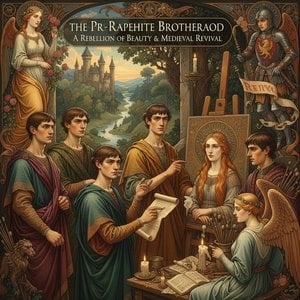
La Confrérie des Préraphaélites : Rébellion Esthétique et Renaissance Médiévale dans l'Art Victorien
Explorez la Confrérie des Préraphaélites : une rébellion artistique victorieenne fascinante. Découvrez leurs thèmes, leur influence et l'héritage durable de ce mouvement majeur. Analyse approfondie et expertise ArtsDot.