


 Aperçu en situation
 Partager
 Partager
 Détails
 Guide imprimable

 Télécharger
 Articles similaires
 Radiographie
 Voir le diaporama
 Statistiques
St Paul
 Acrylic On Canvas
- WallArt
- Pre-Raphaelite Brotherhood
 1862
1862 39.0 x 56.0 cm
 Birmingham Museum et Galerie d'Art
 Afficher la suite
Giclées et impressions d'art
Impressions giclées ou sur toile de qualité musée, avec une production rapide et des finitions au choix. ( Acheter la peinture faite à la main Passer au format image numérique)




P118B $10

P118H $10

P118W $10

P438Z $10

P508JH $12

P508YH $12

P805H $10

P805Z $10

P919BZ $10

P919G $10

P919XJ $10

P959ZH $10

P968JZ $12

W106C $8

W218G $10

W218JH $8

W218Y $10

W307PJ $10

W316G $10

W316PJ $8

W316Y $10

W398PJ $8

W4111J $10

W500HY $15

W500JH $15

W692G $12

W849H $8

W940BG $15

W953PJ $8




Choisissez parmi nos formats prédéfinis qui respectent les proportions originales de l’œuvre.

Vous pouvez saisir vos propres dimensions pour vous adapter à un cadre ou à un espace spécifique. Si la taille sélectionnée ne correspond pas aux proportions de l'image originale, nous recadrerons l'œuvre ou étendrons l'image avec une bordure en miroir ou une couleur unie. Une maquette numérique vous sera envoyée pour approbation avant le début de la production.
Veuillez noter que l'aperçu à l'écran ne reflète pas le recadrage ou l'extension réelle. Seule la maquette montrera avec précision la composition finale.
Bien que des tailles personnalisées soient disponibles, nous vous recommandons de choisir une dimension dans la liste prédéfinie afin de préserver les proportions originales.
Livraison dans le monde entier () en 2 semaines au lieu des 4/5 semaines habituelles. (26 septembre)

Livraison express gratuite dans le monde entier

Toile de lin de haute qualité

Assurance transport complète

Garantie de remboursement des droits de douane

Garantie de fidélité des couleurs

Garantie de retour de 100 jours (uniquement en cas de défaut)

Garantie de remboursement à 100%

Tarifs dégressifs sur quantité
 L'option verre n'est disponible que pour les dimensions inférieures à 110 cm.

St Paul
Giclées et impressions d'art
Format de la reproduction
-


Prix total final
$ 62
A Dream Woven in Color: The Life and Art of Edward Burne-Jones
Edward Coley Burne-Jones (1833 – 1898), born in Birmingham amidst the industrial fervor of Victorian England, stands as a monumental figure in British art history—a conduit between Romantic idealism and the burgeoning decorative arts movement. His artistic legacy transcends mere visual beauty; it embodies a profound engagement with medieval mythology and Christian symbolism, reflecting a broader cultural yearning for spiritual solace during an era defined by rapid technological advancement. Burne-Jones’s formative years were shaped by familial tragedy – his mother succumbed to diphtheria shortly after his birth – fostering within him a contemplative spirit nurtured by the unwavering devotion of his father and housekeeper Ann Sampson. This upbringing instilled a lifelong fascination with storytelling and imaginative exploration, propelling him toward Oxford University where he cultivated an enduring friendship with William Morris, establishing a collaborative partnership that would redefine aesthetic sensibilities.- Early Influences: Burne-Jones’s artistic trajectory was decisively influenced by the Pre-Raphaelite Brotherhood, a group of artists united by a fervent rejection of academic conventions and a passionate devotion to recreating the luminous beauty of medieval art – specifically illuminated manuscripts and Gothic cathedrals. This stylistic rebellion championed meticulous detail, vibrant color palettes derived from nature, and narratives drawn from biblical tales and Arthurian legends.
- Technique: Burne-Jones’s distinctive artistic approach centered on Indian ink wash technique—a method he honed during his studies at Exeter College—allowing for unparalleled tonal subtlety and capturing the ethereal quality characteristic of Pre-Raphaelite paintings. He meticulously layered washes of ink, building up complex textures and gradations that conveyed both visual splendor and psychological depth.
St Paul: Symbolism and Narrative Depth
“St Paul,” completed in 1862, exemplifies Burne-Jones’s masterful synthesis of artistic skill and symbolic representation. The painting depicts St Paul, the apostle to the Gentiles, wrestling with an inner torment—a palpable struggle against doubt and despair symbolized by the coiled serpent beneath his feet. This serpentine figure represents temptation and evil, mirroring St Paul's own internal battle for spiritual fortitude. Burne-Jones’s deliberate positioning of St Paul’s gaze downward emphasizes humility and introspection, conveying a profound meditation on faith and perseverance. The circular composition—a motif borrowed from medieval stained glass windows—further reinforces the painting’s symbolic significance, representing eternity and divine illumination.- Color Palette: Dominantly brown hues – ochre, umber, Sienna – imbue the canvas with warmth and solemnity, mirroring the spiritual seriousness of the subject matter. The subtle gradations of color contribute to the painting’s textural richness and heighten its emotional impact.
- Compositional Elements: Burne-Jones skillfully employs geometric forms—particularly circles—to create a harmonious visual balance and reinforce the overarching theme of divine order amidst inner turmoil.
Historical Context and Artistic Legacy
“St Paul” emerged during a period marked by intellectual ferment – Darwin’s theory of evolution challenged prevailing religious dogma, prompting artists to grapple with existential questions concerning humanity's place in the cosmos. Burne-Jones responded to these anxieties not through outright negation but rather through reaffirmation of spiritual values—expressed through evocative imagery rooted in Christian iconography and imbued with profound psychological insight. His work continues to inspire admiration for its artistic virtuosity and intellectual depth, securing his position as one of the most celebrated artists of the Victorian era – a testament to his enduring ability to capture both the beauty of visual form and the complexities of human experience. Burne-Jones’s influence reverberates throughout subsequent generations of artists, shaping aesthetic sensibilities and fostering an appreciation for storytelling that transcends temporal boundaries.Œuvres similaires


Biographie de l'artiste
Premières années et éducation
Edward Coley Burne-Jones, un artiste et designer britannique renommé, est né le 28 août 1833 à Birmingham, au Royaume-Uni. Son enfance a été marquée par le décès de sa mère, Elizabeth Coley Jones, six jours après sa naissance. Élevé par son père, Edward Richard Jones, et la gouvernante familiale Ann Sampson, Burne-Jones a fréquenté King Edward VI Grammar School à partir de 1844 puis a étudié à l'école d'art de Birmingham de 1848 à 1852.Études universitaires et la Fraternité
Burne-Jones s’est tourné vers la théologie à Exeter College, Oxford, où il se lia d’amitié avec William Morris. Avec un groupe d’amis venus de Birmingham, connus sous le nom de « the Birmingham set », ils formèrent une société intime appelée « la Fraternité ». Cette période fut marquée par l'influence de John Ruskin et Tennyson sur son travail, ainsi que par des visites dans les églises et la vénération du Moyen Âge.Carrière artistique et œuvres notables
La carrière artistique de Burne-Jones s’est épanouie dans divers domaines, notamment la peinture, le vitrail et les arts décoratifs. Ses premières peintures furent influencées par Dante Gabriel Rossetti, mais il développa rapidement son propre style unique. Parmi ses œuvres notables figurent :- Le Rêve de Lancelot au Chapelle du Saint Graal, exposée à la Grosvenor Gallery en 1877, marquant son ascension comme étoile du mouvement esthétique.
- Des œuvres de vitrail intégrées dans diverses églises, telles que la cathédrale St Philip’s à Birmingham et l'église Holy Trinity, Sloane Square, Chelsea.
- Des collaborations avec William Morris sur les arts décoratifs, notamment des designs pour Morris, Marshall, Faulkner & Co.
Vie personnelle et dernières années
Burne-Jones a épousé Georgiana "Georgie" Macdonald en 1860, avec qui il eut trois enfants. Ses dernières années furent marquées par une liaison passionnée avec son modèle grecque, Maria Zambaco, qui se termina par une tentative de suicide. Malgré cela, Burne-Jones resta marié à sa femme jusqu'à son décès le 17 juin 1898.Héritage et influence
Les contributions d’Edward Coley Burne-Jones au mouvement préraphaélite et ses œuvres innovantes en vitrail ont laissé une marque indélébile sur l’art britannique. Son influence se retrouve dans divers aspects des arts décoratifs, de la céramique aux bijoux.- Explorez davantage les œuvres de Burne-Jones sur ArtsDot.com.
- Découvrez la collection du British Council, présentant des artistes notables, dans les collections d'art de ArtsDot.
Références :
- wikipedia: edward burne-jones
- l'assistant Wabot Art de ArtsDot pour des informations sur l'art et les artistes.

Edward Coley Burne-Jones
1833 - 1898 , Royaume-Uni
En bref
- Artistes Influents:
- Dante Gabriel Rossetti
- John Ruskin
- Tennyson
- Date De Décès: 17 juin 1898
- Date De Naissance: 28 août 1833
- Influences Artistiques:
- Art décoratif
- Arts céramiques
- Bijoux
- Lieu De Naissance: Birmingham, Royaume-Uni
- Mouvement Artistique: Prérraphaélisme, Esthétisme
- Nationalité: Britannique
- Nom Complet: Edward Coley Burne-Jones
- Oeuvres Notables:
- Le Beguiling of Merlin
- Trois Femmes, Dansant et Jouant
- Fidélité
Articles similaires
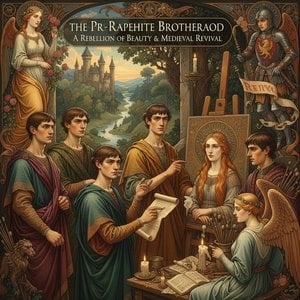
La Confrérie des Préraphaélites : Rébellion Esthétique et Renaissance Médiévale dans l'Art Victorien
Explorez la Confrérie des Préraphaélites : une rébellion artistique victorieenne fascinante. Découvrez leurs thèmes, leur influence et l'héritage durable de ce mouvement majeur. Analyse approfondie et expertise ArtsDot.

La Confrérie des Préraphaélites : Rébellion Esthétique et Renaissance Médiévale
Explorez la Confrérie des Préraphaélites : une rébellion artistique anglaise fascinante. Découvrez leur philosophie, leurs œuvres majeures et l'influence durable de ce mouvement pictural. Guide d'achat et conseils d'experts sur ArtsDot.

Dante Gabriel Rossetti : Les 25 Œuvres Maîtresses du Préraphaélisme à Redécouvrir
Plongez dans l'univers fascinant de Dante Gabriel Rossetti ! Découvrez les 25 œuvres majeures du préraphaélisme : symbolisme, poésie et beauté victorienne. Reproductions d'art exceptionnelles sur ArtsDot.com.

Edward Burne-Jones: A Pre-Raphaelite Vision of Myth, Symbolism & Aesthetic Idealism
Discover the enchanting world of Edward Burne-Jones and the Pre-Raphaelite Brotherhood. Explore his mythical paintings, distinctive style, and lasting influence on Victorian art & the Aesthetic Movement. Expert analysis & high-quality reproductions at ArtsDot.

Sir John Everett Millais: Pre-Raphaelite Rebellion & Victorian Narrative Detail
Explore the revolutionary art of Sir John Everett Millais & the Pre-Raphaelite Brotherhood. Discover their radical realism, symbolic narratives, and lasting impact on Victorian aesthetics. A deep dive into 19th-century masterpieces.


