


 Partager
 Partager
 Détails
 Guide
Guide

 Télécharger
 Articles similaires
 Voir le diaporama
 Statistiques
Saint George


 Afficher la suite
Reproduction à l'huile faite à la main
Huile sur toile peinte à la main, avec cadre et dimensions personnalisés, réalisée sur commande par nos artistes. ( Passer au format impression Passer au format image numérique)




































Choisissez parmi nos formats prédéfinis qui respectent les proportions originales de l’œuvre.

Vous pouvez saisir vos propres dimensions pour l'adapter à un cadre ou à un espace spécifique. Si la taille sélectionnée ne correspond pas aux proportions de l'image d'origine, nous recadrerons l'œuvre ou prolongerons la peinture avec des éléments peints à la main supplémentaires. Une maquette numérique vous sera envoyée pour approbation avant le début de la production.
Veuillez noter que l'aperçu à l'écran ne reflète pas le recadrage ou l'extension réels. Seule la maquette montrera fidèlement la composition finale.
Bien que des tailles personnalisées soient disponibles, nous vous recommandons de sélectionner une dimension dans la liste prédéfinie afin de préserver les proportions d'origine.
Après la commande, l’équipe ArtsDot.com contactera le client par e-mail pour recueillir ses instructions et lui fournira une maquette d’aperçu
Livraison dans le monde entier () en 3 à 4 semaines au lieu des 5 semaines habituelles. (23 septembre). Aucun compromis sur la qualité.

Livraison express gratuite dans le monde entier

Toile de lin de haute qualité

Assurance transport complète

Garantie de remboursement des droits de douane

Garantie de fidélité des couleurs

Garantie de retour de 100 jours (uniquement en cas de défaut)

Garantie de remboursement à 100%

Tarifs dégressifs sur quantité
 L'option verre n'est disponible que pour les dimensions inférieures à 110 cm.

Saint George
Technique de reproduction
Format de la reproduction
-


Prix total final
$ 263
A Renaissance Sentinel in Marble
In the heart of Florence, where the echoes of the Quattrocento still resonate through the cobblestone streets, stands a figure of unparalleled poise and quiet strength. Donatello’s Saint George, completed around 1417, is far more than a mere religious icon; it is a breathtaking embodiment of the burgeoning Renaissance spirit. Carved from luminous Carrara marble, the sculpture captures a moment of profound psychological depth. Unlike the rigid, stylized figures of the preceding Gothic era, this Saint George possesses a palpable human presence. His gaze, directed upward with an expression of focused determination and spiritual contemplation, invites the viewer into his internal struggle between earthly duty and divine devotion. For the discerning collector or lover of classical beauty, this piece offers a window into an age where art began to breathe with the vitality of human emotion.
The technical mastery displayed in this work is nothing short of extraordinary. Donatello utilized the medium of marble to achieve a delicate balance between the hardness of armor and the softness of skin. Through meticulous carving and polishing, he created a surface that catches the light with a subtle, pearlescent glow, lending the figure a lifelike vitality. The use of classical contrapposto—the slight shifting of weight onto one leg—imbues the statue with a sense of potential movement, as if the knight might step forward from his niche at any moment. Every fold of his drapery and every detail of his protective gear speaks to Donatello’s commitment to anatomical accuracy and textural realism, making it an ideal centerpiece for those seeking to bring a sense of historical weight and sophisticated texture to a curated interior.
Civic Pride and Symbolic Grandeur
To understand the soul of Saint George, one must look to the vibrant streets of 15th-century Florence. Commissioned by the powerful Guild of Armorers and Swordsmiths for the Orsanmichele, the statue served as a public declaration of both religious faith and civic excellence. In an era marked by political turbulence, Saint George stood as a symbol of Florentine resilience and courage. The sculpture’s placement within an intricate Gothic niche provided a dramatic architectural frame, yet the figure itself broke free from its surroundings through its sheer naturalism. This tension between the structured, geometric lines of the architecture and the organic, fluid form of the saint mirrors the very essence of the Early Renaissance: the marriage of classical order with humanistic passion.
For interior designers and art enthusiasts, incorporating a reproduction of this masterpiece means introducing a narrative of protection, honor, and timelessness into a space. The neutral, sophisticated palette of beige and cream tones allows the piece to integrate seamlessly into diverse decor styles, from the grandeur of a classical estate to the minimalist elegance of a modern gallery. It is not merely a decoration; it is an invitation to reflect on the virtues of steadfastness and grace. Owning such a work is an opportunity to surround oneself with the enduring legacy of Donatello, ensuring that the spirit of the Florentine Renaissance continues to inspire and command attention in the contemporary home.
Œuvres similaires


Biographie de l'artiste
Premières années et carrière
Œuvres clés et innovations L'œuvre la plus célèbre de Donatello, David, était la première sculpture masculine nue autoportante depuis l'Antiquité. Commandée par la famille Médicis, elle mettait en valeur son style innovant et son expertise technique. Parmi les autres œuvres notables figurent :- , créé pour le campanile de Santa Maria del Fiore à Florence, se caractérisait par de forts détails portraitistiques.
- Un crucifix (1425) pour Santa Croce, qui représentait le Christ dans un moment d’agonie.
Style artistique et héritage
Le style de Donatello peut être divisé en phases générales, commençant par le développement de l'expressivité et du monumentalité classique. Son travail n'a pas été immédiatement accepté par la communauté, mais est finalement devenu le plus populaire, influençant d’autres cours italiennes et des artistes européens. Mouvements artistiques clés :Vie personnelle et style de travail
Donatello était connu pour être aimable et apprécié, mais peu doué sur le plan commercial dans sa carrière. Il avait tendance à accepter plus de commandes qu’il ne pouvait en gérer, achevant souvent les œuvres avec retard ou en les confiant à d'autres sculpteurs. Œuvres d'art notables et artistes :- Leonardo da Vinci: Annonciation (détail)
- Amico Aspertini: Statua di pan/leone che azzanna un cavallo
- Michelangelo Buonarroti: Tondo Pitt
Musées et collections d'art :
- Museo della Collegiata (Empoli, Italie): un joyau caché de la Renaissance, présentant des œuvres de Francesco Botticini et Raffaello Botticini.
- Le mouvement artistique de la première Renaissance italienne

Donatello
1386 - 1466 , Italie
En bref
- Artistic Movement Or Style: Renaissance primitive
- Artists Or Movements Influenced By This Artist: ['Michel-Ange Buonarroti']
- Date Of Birth: c. 1386
- Date Of Death: 1466
- Full Name: Donatello (Donato di Niccolò)
- Nationality: Italienne
- Notable Artworks:
- David
- St. Louis de Toulouse
- Sacrifice d'Isaac
- Crucifix (1425)
- Place Of Birth: Florence, Italie
Articles similaires
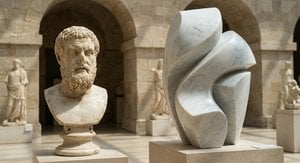
The Enduring Allure of Marble in Art History: From Classical Sculpture to Modern Abstraction
Explore the captivating history of marble sculpture from ancient Greece to modern art. Discover renowned artists like Canova & Michelangelo, carving techniques, and investment insights at ArtsDot.

Les 10 Chefs-d'œuvre Bronzes Qui Ont Révolutionné la Sculpture | ArtsDot
Plongez dans l'univers fascinant des 10 sculptures en bronze les plus emblématiques de l'histoire de l'art. Rodin, Degas et autres maîtres révélés ! Découvrez leur histoire, leurs techniques et trouvez l'œuvre parfaite pour sublimer votre intérieur sur ArtsDot.com.

The Enduring Form: Exploring Themes & Techniques in Sculpture Across Historical Periods
Explore the rich history of sculpture from ancient masterpieces to contemporary innovations. Discover key techniques, influential artists & investment potential for discerning art collectors.

Georges Braque : Les 25 Œuvres Maîtresses du Cubisme et de la Modernité | ArtsDot
Plongez dans l'univers de Georges Braque avec les 25 œuvres incontournables du cubisme. Découvrez l'histoire, les techniques et l'impact de ce maître de l'art moderne. Reproductions d'art exceptionnelles sur ArtsDot.com.

Georges Seurat : Les 25 Œuvres Maîtresses du Pointillisme | ArtsDot
Plongez dans l'univers lumineux de Georges Seurat ! Découvrez les 25 œuvres majeures du pointillisme, de 'Un dimanche après-midi à l'Île de la Grande Jatte' aux 'Poseuses'. Reproductions d'art exceptionnelles et inspiration déco sur ArtsDot.com.


