

 Aperçu en situation
 Envoyer
 Partager
 Détails de l'œuvre
 Guide
Guide

 Télécharger l'image
 Articles similaires
 Radiographie
 Diaporama
 Questions et réponses
 Statistiques
Nude with Calla Lilies

- 157.0 x 124.0 cm


 Lire la suite
L’œuvre d'art présentée sur cette page est protégée par le droit d'auteur, ce qui signifie que nous ne pouvons légalement créer ou vendre de reproduction identique. Cette protection est appliquée en vertu d'accords internationaux tels que la Convention de Berne et par les lois nationales, notamment celles énoncées par le Loi américaine sur le droit d'auteur - Titre 17.
Cette méthode est pleinement conforme aux réglementations sur le droit d'auteur car elle ne repose pas sur la copie ou la duplication de l'œuvre protégée. Il s'agit plutôt d'une réinterprétation créative — une nouvelle peinture qui s'inspire de l'original sans pour autant lui être identique.
Giclées et impressions d'art
Impressions giclées ou sur toile de qualité musée, avec une production rapide et des finitions au choix. ( Commander la reproduction peinte à la main Passer au format numérique)




P118B €10

P118H €10

P118W €10

P438Z €10

P508JH €12

P508YH €12

P805H €10

P805Z €10

P919BZ €10

P919G €10

P919XJ €10

P959ZH €10

P968JZ €12

W106C €8

W218G €10

W218JH €8

W218Y €10

W307PJ €10

W316G €10

W316PJ €8

W316Y €10

W398PJ €8

W4111J €10

W500HY €15

W500JH €15

W692G €12

W849H €8

W940BG €15

W953PJ €8




Choisissez parmi nos formats prédéfinis qui respectent les proportions originales de l’œuvre.

Saisissez la largeur et la hauteur souhaitées pour qu'elles s'adaptent à votre cadre ou à votre mur. Une impression peut être recadrée, mais jamais agrandie au-delà de l'image originale ; ainsi, un format de forme différente entraînera la perte d'une partie de l'image. Nous vous envoyons une maquette numérique pour approbation avant toute impression. L'image présentée sur cette page ne montre pas le recadrage réel — seule la maquette le permet.
Livraison dans le monde entier () en 2 semaines au lieu des 4/5 semaines habituelles. (4 novembre)

Livraison express gratuite dans le monde entier

Toile de lin de qualité supérieure

Assurance transport complète

Garantie de remboursement des droits de douane

Garantie de fidélité des couleurs

Politique de retour de 100 jours (uniquement en cas de défaut)

Garantie de remboursement à 100%

Offre de tarifs dégressifs
 L'option verre n'est disponible que pour les dimensions inférieures à 110 cm.

Nude with Calla Lilies
Giclées et impressions d'art
Format de la reproduction
-


Prix total
€ 56
Diego Rivera's Nude with Calla Lilies: A Study in Sensuality and Art Deco
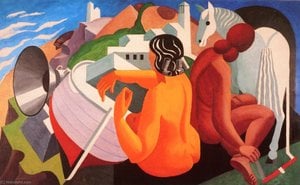
Diego Rivera’s “Nude with Calla Lilies,” completed in 1944, is more than just a depiction of a reclining figure; it’s a potent distillation of the artist’s core aesthetic – a masterful blend of raw sensuality, profound connection to nature, and the elegant formalism of Art Deco. This painting, measuring 157 x 124 cm, immediately draws the viewer into a world where the vulnerability of the human form intertwines with the opulent beauty of the calla lilies, creating an image that resonates with both eroticism and quiet contemplation.
- Subject Matter: The central figure, rendered in a strikingly direct manner, is presented in a state of repose, her back turned to the observer. This deliberate choice invites intimacy, encouraging the viewer to become a silent participant in this private moment.
- Floral Symbolism: The overwhelming presence of calla lilies is crucial to understanding Rivera’s intent. As he frequently employed, these flowers served as potent symbols – particularly representing phallic symbolism and fertility. Their stark white petals amplify the painting's sensual undertones while simultaneously grounding the scene in a naturalistic setting.
- Art Deco Influence: The composition itself is firmly rooted in the principles of Art Deco. Clean lines, geometric forms subtly suggested within the arrangement of the lilies, and a restrained palette contribute to a sense of sophisticated order. This stylistic choice reflects Rivera’s engagement with contemporary design trends and his desire to create works that were both visually arresting and intellectually stimulating.
A Painter's Context: Rivera Within Mexico's Artistic Landscape
Rivera’s “Nude with Calla Lilies” emerged during a pivotal moment in Mexican art history, following the completion of his monumental murals at the National Institute of Cardiology and preceding his ambitious project, "Tenochtitlan." This period saw him refining his artistic voice, exploring themes of social justice and human connection while simultaneously embracing his fascination with classical beauty. Notably, Rivera shared a kinship with Frida Kahlo, another towering figure in Mexican art, both artists dedicated to depicting peasant life on smaller canvases, though their approaches differed significantly. Kahlo’s “Portrait of Dona Rosita Morillo” demonstrates a similar focus on sensuality and eroticism within a domestic setting, highlighting the shared artistic concerns that bound these two revolutionary figures.
Technique and Materials: Oil on Panel – A Legacy of Craft
The artwork is executed in oil on panel, a technique favored by Rivera for its ability to capture subtle nuances of light and shadow. The smooth application of paint creates a luminous effect, particularly evident in the delicate petals of the calla lilies. Rivera’s meticulous attention to detail – from the texture of the woman's skin to the arrangement of the flowers – speaks to his dedication to craft and his desire to create works that were both aesthetically pleasing and emotionally resonant. The panel support allowed for a level of control and precision essential to Rivera’s distinctive style.
Museum Connections & Historical Significance
The painting's evolution is intertwined with the legacy of Diego Rivera himself. Originally housed in the Museo Dolores Olmedo, its current location reflects Rivera’s commitment to preserving and sharing his artistic vision. The connection to the Frida Kahlo Museum (Casa Azul) underscores the shared cultural heritage and artistic dialogues that shaped Mexico’s vibrant art scene. “Nude with Calla Lilies” stands as a testament to Rivera's enduring influence, offering a compelling glimpse into his creative process and his profound engagement with themes of beauty, sexuality, and social commentary.
Questions et réponses
Quelle est l'atmosphère de «Nude with Calla Lilies» de Diego Rivera ?
L'atmosphère générale de «Nude with Calla Lilies» de Diego Rivera est Romantic. Cette ambiance décrit l'impression globale de l'œuvre.
«Nude with Calla Lilies» de Diego Rivera est-il une œuvre célèbre ?
«Nude with Calla Lilies» de Diego Rivera affiche un niveau de popularité Recognized. Cette classification témoigne de la reconnaissance de l'œuvre auprès du public.
Comment "Nude with Calla Lilies" équilibre-t-il l'ombre et la lumière ?
Les valeurs enregistrées pour «Nude with Calla Lilies» de Diego Rivera sont : une luminosité de balanced, une luminance de Gentle Luminance.
Œuvres similaires




Biographie de l'artiste
Première Vie et Formation Artistique
- Né: 8 décembre 1886, Guanajuato, Mexique
- Décédé: 24 novembre 1957
- Le parcours artistique de Diego Rivera a commencé très tôt ; il a montré un intérêt pour l'art dès l'âge de trois ans.
- Il a étudié à l'Académie San Carlos à Mexico City.
- Teodoro A. dehesa Méndez a parrainé ses études en Europe, à partir de 1907.
- Il a d’abord étudié avec Eduardo Chicharro à Madrid, Espagne.
- Il s'est installé à Paris, en France, et est devenu partie intégrante de la communauté artistique du Montparnasse.
Influences Européennes et Développement Artistique
- Son travail européen précoce était influencé par le Réalisme.
- L'exposition au Cubisme a considérablement impacté son style après 1912.
- Il a été influencé par des artistes tels que Pablo Picasso et Georges Seurat.
- Ses peintures de cette période ont commencé à incorporer des formes géométriques et des plans croisés, reflétant le mouvement cubiste.
Retour au Mexique et le Mouvement Muraliste Mexicain
- Rivera est retourné au Mexique en 1921, un moment décisif dans sa carrière.
- Il est devenu une figure de proue du Mouvement Muraliste Mexicain, visant à créer un art public accessible à tous.
- Ses fresques représentaient souvent des scènes de l'histoire mexicaine et des thèmes sociaux.
- Des œuvres précoces notables incluent « Création » (1922) et les fresques au Secretaría de Educación Pública à Mexico City.
Œuvres Majeures et Style Artistique
- Création (1922): Sa première fresque importante, utilisant la technique d'encaustique.
- Rêves d’un dimanche dans l’Alameda: Controversée pour sa représentation de l’athéisme.
- Fresques du Secretaría de Educación Pública: Présentaient son style unique avec de grandes figures simplifiées et des couleurs vives influencées par l'art aztèque.
- Fresques de Detroit Industry (1933): Commandées pour le Detroit Institute of Arts, représentant les processus industriels et les travailleurs.
- Style de Rivera: Caractérisé par une échelle monumentale, des formes simplifiées, des couleurs vibrantes et un accent sur les récits sociaux et historiques. Il a incorporé des éléments de l'art populaire mexicain et de l'esthétique précolombienne dans son travail.
Héritage et Importance Historique
- Diego Rivera est considéré comme l’un des artistes les plus importants du XXe siècle.
- Ses fresques sont des exemples significatifs du réalisme social et de l'art public.
- Il a joué un rôle crucial dans l'établissement du Muralisme Mexicain en tant que mouvement artistique influent.
- Le travail de Rivera reflète ses convictions politiques, notamment ses opinions marxistes.
- Sa vie personnelle, y compris son mariage avec Frida Kahlo, a contribué à sa renommée durable et à sa signification culturelle.

Diego Rivera
1886 - 1957 , Mexique
L'essentiel de l'artiste
- Artistes Influents:
- El Greco
- Francisco Goya
- Diego Velazquez
- Pablo Picasso
- Date De Décès: 24 novembre 1957
- Date De Naissance: 8 décembre 1886
- Lieu De Naissance: Guanajuato, Mexique
- Mouvement Artistique: Mexican Muralisme
- Nationalité: Mexicain
- Nom Complet: Diego Rivera
- Oeuvres Notables:
- Création (1922)
- Rêves d'un dimanche
- Detroit Industry
Articles connexes

Revolution on Canvas: Exploring the Socio-Political Power & Artistic Legacy of Mexican Muralism
Explore the powerful world of Mexican muralism! Discover Diego Rivera, Frida Kahlo & Orozco's revolutionary art, social impact & lasting legacy. Expert insights & high-quality reproductions at ArtsDot.

The Gleaming Geometry of Desire: Exploring Art Deco's Enduring Influence on Visual Culture
Explore the captivating world of Art Deco! Discover its history, key characteristics, enduring influence on design & collecting with expert insights from ArtsDot.com.

The Enduring Allure of the Nude: A Historical & Artistic Exploration of the Human Form
Explore the captivating history of nude art! Discover iconic paintings & artists from classical to modern eras. Uncover symbolism, techniques & find museum-quality reproductions at ArtsDot.

Diego Rivera : Une Vision Révolutionnaire de l'Identité Mexicaine à Travers le Muralisme
Explorez l'univers révolutionnaire de Diego Rivera et du muralisme mexicain. Découvrez comment cet art puissant a façonné l'identité nationale, avec une analyse approfondie des œuvres clés et son héritage durable.

L'Âge d'Or Réinventé : Esthétique et Héritage Durable de l'Art Déco
Explorez l'histoire fascinante de l'Art Déco : influences, artistes emblématiques, matériaux luxueux et héritage durable. Découvrez comment ce style révolutionnaire continue d'inspirer le design contemporain.


