


 Aperçu en situation
 Partager
 Partager
 Détails
 Guide imprimable

 Télécharger
 Articles similaires
 Radiographie
 Voir le diaporama
 Statistiques
Sketch
 Oil On Canvas
- WallArt
- Early Modern
 1948
1948 132.0 x 99.0 cm
 Walker Art Gallery
 Afficher la suite
L’œuvre d'art présentée sur cette page est protégée par le droit d'auteur, ce qui signifie que nous ne pouvons légalement créer ou vendre de reproduction identique. Cette protection est appliquée en vertu d'accords internationaux tels que la Convention de Berne et par les lois nationales, notamment celles énoncées par le Loi américaine sur le droit d'auteur - Titre 17.
Cette méthode est pleinement conforme aux réglementations sur le droit d'auteur car elle ne repose pas sur la copie ou la duplication de l'œuvre protégée. Il s'agit plutôt d'une réinterprétation créative — une nouvelle peinture qui s'inspire de l'original sans pour autant lui être identique.
Giclées et impressions d'art
Impressions giclées ou sur toile de qualité musée, avec une production rapide et des finitions au choix. ( Acheter la peinture faite à la main Passer au format image numérique)




P118B €10

P118H €10

P118W €10

P438Z €10

P508JH €12

P508YH €12

P805H €10

P805Z €10

P919BZ €10

P919G €10

P919XJ €10

P959ZH €10

P968JZ €12

W106C €8

W218G €10

W218JH €8

W218Y €10

W307PJ €10

W316G €10

W316PJ €8

W316Y €10

W398PJ €8

W4111J €10

W500HY €15

W500JH €15

W692G €12

W849H €8

W940BG €15

W953PJ €8




Choisissez parmi nos formats prédéfinis qui respectent les proportions originales de l’œuvre.

Vous pouvez saisir vos propres dimensions pour vous adapter à un cadre ou à un espace spécifique. Si la taille sélectionnée ne correspond pas aux proportions de l'image originale, nous recadrerons l'œuvre ou étendrons l'image avec une bordure en miroir ou une couleur unie. Une maquette numérique vous sera envoyée pour approbation avant le début de la production.
Veuillez noter que l'aperçu à l'écran ne reflète pas le recadrage ou l'extension réelle. Seule la maquette montrera avec précision la composition finale.
Bien que des tailles personnalisées soient disponibles, nous vous recommandons de choisir une dimension dans la liste prédéfinie afin de préserver les proportions originales.
Livraison dans le monde entier () en 2 semaines au lieu des 4/5 semaines habituelles. (10 octobre)

Livraison express gratuite dans le monde entier

Toile de lin de haute qualité

Assurance transport complète

Garantie de remboursement des droits de douane

Garantie de fidélité des couleurs

Garantie de retour de 100 jours (uniquement en cas de défaut)

Garantie de remboursement à 100%

Tarifs dégressifs sur quantité
 L'option verre n'est disponible que pour les dimensions inférieures à 110 cm.

Sketch
Giclées et impressions d'art
Format de la reproduction
-


Prix total final
€ 53
The Genesis of a Vision: David Bomberg's 'Sketch'
David Bomberg’s “Sketch,” painted in 1948, isn’t merely a depiction of a scene; it’s an embodiment of the artist’s evolving vision during a pivotal period in British art. Born into a Polish-Jewish family in Birmingham and deeply influenced by the avant-garde movements swirling around London – Cubism, Futurism, and the radical ideas championed by Roger Fry – Bomberg sought to translate these complex influences into a distinctly personal language. This particular work, created shortly after his expulsion from the Slade School of Art for his perceived “audacity,” reflects both a rejection of academic constraints and an embrace of dynamic abstraction. The painting’s raw energy and fragmented forms speak volumes about the anxieties and transformations shaping the post-war artistic landscape.

A Symphony of Color and Geometry
Bomberg’s technique in “Sketch” is immediately arresting. He employs a bold, almost aggressively simplified palette dominated by vibrant reds, oranges, and yellows – colors that evoke both heat and intensity. These hues are layered and blended with remarkable skill, creating a sense of depth and movement despite the painting's predominantly geometric structure. The composition itself is fractured, composed of interlocking planes and angular shapes that seem to vibrate with energy. This deliberate fragmentation isn’t chaotic; rather, it mirrors the artist’s exploration of form and his desire to capture not just what he *saw*, but how he *felt* about what he saw. The use of thick impasto – applying paint in heavy layers – adds a tactile quality to the work, inviting the viewer to engage with its surface.
- Color Palette: Primarily reds, oranges, and yellows; punctuated by blues and greens.
- Technique: Bold impasto, layered application of paint, geometric abstraction.
- Composition: Fragmented planes and angular shapes creating a sense of dynamism.
Roots in the Whitechapel Boys and Beyond
Bomberg was part of the “Whitechapel Boys,” a group of young artists who challenged the established artistic conventions of early 20th-century London. This collective, including Mark Gertler and Stanley Spencer, were deeply influenced by the avant-garde movements emerging from Paris and Italy. His time at the Slade School of Art, under the tutelage of Henry Tonks, provided a crucial foundation, but Bomberg quickly surpassed his teacher’s more traditional approach. His work reflects this trajectory, incorporating elements of Cubism – particularly in its emphasis on multiple perspectives – alongside the dynamism of Futurism and the emotional intensity of Expressionism. Further research reveals that Bomberg's exploration of Jerusalem Church (as documented in a separate ArtsDot article) demonstrates his continued interest in capturing spiritual themes through abstract forms.
Decoding the Emotional Landscape
“Sketch” is more than just a visually striking composition; it's an exploration of emotional states. The intense colors and fragmented forms evoke feelings of both excitement and unease. Some art historians interpret the painting as a reflection of Bomberg’s personal struggles, particularly his experiences in the trenches during World War I. The dynamism of the composition suggests a restless spirit, while the underlying geometric structure hints at an attempt to impose order on chaos. Ultimately, “Sketch” invites viewers to contemplate the complexities of human experience and the power of art to capture the intangible.
Questions et réponses
Qui est l'artiste derrière « Sketch » ?
« Sketch » est attribué à David Bomberg.
À quelle période de la carrière de David Bomberg se situe « Sketch » ?
«Sketch» appartient à la période Early Modern de la carrière de David Bomberg. Cette classification relie l'œuvre à l'évolution de l'artiste.
En quelle année "Sketch" a-t-il été réalisé ?
«Sketch» date de 1948. Cette date inscrit l'œuvre dans la carrière de David Bomberg ainsi que dans son époque.
Comment le contraste et l'harmonie se conjuguent-ils dans « Sketch » ?
La composition chromatique de «Sketch» de David Bomberg allie un contraste Serene à une harmonie Unified Palette.
Existe-t-il un diaporama pour «Sketch» de David Bomberg ?
Le diaporama de « Sketch » peut être visionné sur la page Diaporama de l'œuvre.
Comment puis-je télécharger l'image de «Sketch» de David Bomberg ?
Un téléchargement est disponible pour « Sketch » : la page Télécharger de l'œuvre propose un téléchargement d'image numérique haute résolution.
À quel âge David Bomberg a-t-il créé « Sketch » ?
David Bomberg a réalisé « Sketch » à l'âge de 58. L'artiste est né en 1890 et l'œuvre date de 1948.
Œuvres similaires


Biographie de l'artiste
Jeunesse et Formation Artistique
- Né : Birmingham, Royaume-Uni (5 décembre 1890)
- Décédé : Londres, Royaume-Uni (19 août 1957)
- L'un des 'Whitechapel Boys' – un groupe d'artistes de l'East End qui ont émergé au début du XXe siècle.
Né dans une famille immigrante polonaise-juive, Abraham et Rebecca Bomberg, à Birmingham. La famille a déménagé à Whitechapel, Londres, en 1895.
A étudié initialement à la City and Guilds Technical Art School avant de se former comme lithographe à Birmingham.
A étudié sous Walter Sickert à Westminster School of Art (1908-1910), où il a été influencé par l'accent mis par Sickert sur la forme et la vie urbaine.
Exposition significative à Paul Cézanne grâce à l'exposition de 1910 de Roger Fry "Manet et les post-impressionnistes".
A fréquenté la Slade School of Art (1911), remportant le prix Tonks pour son dessin du camarade étudiant Isaac Rosenberg.
Les Années d'Avant-Garde : Cubisme, Futurisme et Controverse
- À la Slade, Bomberg faisait partie d'une génération remarquable comprenant Mark Gertler, Stanley Spencer, C.R.W. Nevinson et Dora Carrington.
- Influencé par les expositions londoniennes de 1912 des Futurs italiens et la deuxième exposition post-impressionniste de Fry (Picasso, Matisse, Fauves, Wyndham Lewis).
- A développé un style distinctif combinant le Cubisme et le Futurisme – caractérisé par des compositions géométriques, des palettes de couleurs limitées, des figures angulaires et des structures en forme de grille.
- Son approche radicale a conduit à son expulsion de la Slade School of Art en 1913, jugé trop audacieux pour les méthodes conventionnelles de l'institution.
- A été brièvement associé à l'Omega Workshops du Bloomsbury Group et a exposé avec le Camden Town Group.
- A montré une affinité avec le mouvement Vorticiste de Wyndham Lewis mais est resté indépendant, refusant toute implication complète.
De la Guerre au Paysage : Un Changement de Style
Les expériences en tant que soldat pendant la Première mondiale ont profondément influencé sa vision artistique, conduisant à un éloignement de l'abstraction.
Dans les années 1920, Bomberg a adopté un style plus figuratif, se concentrant sur des portraits et des paysages tirés directement de la nature.
A développé une technique expressionniste de plus en plus marquée, caractérisée par un impasto texturé et une intensité émotionnelle.
De nombreux voyages à travers le Moyen-Orient (en particulier la Palestine) et l'Europe ont considérablement influencé son œuvre ultérieure. Ses représentations de Jérusalem sont particulièrement notables.
Les Dernières Années et Héritage
- De 1945 à 1953, a enseigné à Borough Polytechnic (aujourd'hui London South Bank University), influençant une génération d'artistes dont Frank Auerbach, Leon Kossoff, Philip Holmes, Cliff Holden, Edna Mann, Dorothy Mead, Gustav Metzger, Dennis Creffield, Cecil Bailey et Miles Richmond.
- A épousé la peintre de paysages Lilian Holt.
- Malgré des périodes d'obscurité relative pendant sa vie, l'œuvre de Bomberg a acquis une reconnaissance croissante ces dernières décennies en tant que contribution significative à l'art britannique moderne.
- La David Bomberg House se trouve à London South Bank University en son honneur.
- Son héritage réside dans sa synthèse unique des mouvements d'avant-garde européens et son développement ultérieur d'un style de paysage puissant et expressif qui capturait l'essence du lieu et de l'expérience humaine.

David Bomberg
1890 - 1957 , Royaume-Uni
En bref
- Artistes Influencés:
- Frank Auerbach
- Leon Kossoff
- Artistes Influents:
- Paul Cézanne
- Walter Sickert
- Date De Décès: 19 août 1957
- Date De Naissance: 5 décembre 1890
- Lieu De Naissance: Birmingham, Royaume-Uni
- Mouvement Artistique:
- Cubisme
- Futurisme
- Expressionnisme
- Nationalité: Britannique
- Nom Complet: David Garshen Bomberg
- Oeuvres Notables:
- Self Portrait (1937)
- Jerusalem
- Kitty...
Articles similaires

Les 10 Chefs-d'œuvre Dominés par le Bleu Ardoise : Art, Histoire & Décor
Plongez dans l'univers fascinant des 10 plus beaux tableaux dominés par le bleu ardoise. Découvrez l'histoire, les artistes et les techniques de ces chefs-d'œuvre impressionnistes et contemporains. Inspirez votre décoration intérieure avec !

The Eloquent Line: Exploring the Artistic Significance of Sketches Across Movements and Media
Explore the profound artistic significance of sketches throughout history. From Renaissance masters to modern innovators like Van Gogh & Guston, discover how these foundational works reveal technique, emotion, and vision. Learn more at ArtsDot.
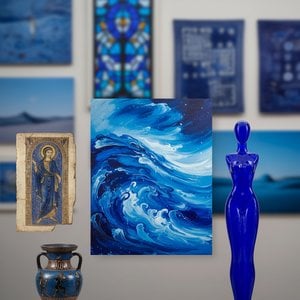
The Allure of Azure: Exploring the Symbolic & Aesthetic Depths of Blue in Art History
Explore the rich history of blue in art! Discover its symbolism, from ancient pigments to modern masterpieces by Kandinsky & Seurat. Uncover the psychological impact and cultural meanings behind this captivating hue.

Crimson Threads of Narrative: Exploring Symbolism & Representation in Artworks Featuring the Red Dress
Explore the rich symbolism of the red dress in art history! From ancient power displays to iconic portraits like Cézanne’s 'Madame Cezanne', discover the cultural and artistic significance behind this captivating color. Expert analysis & insights.

David Bomberg: Reassessing the Pioneering Spirit of Early British Abstraction
Explore the groundbreaking work of David Bomberg, a pivotal figure in British abstraction. Discover his artistic evolution, influences, and lasting legacy through insightful analysis & expert commentary.


