

 Aperçu en situation
 Envoyer
 Partager
 Détails de l'œuvre
 Guide
Guide

 Télécharger l'image
 Articles similaires
 Radiographie
 Diaporama
 Questions et réponses
 Statistiques
Blue Gaze

- 23.0 x 20.0 cm


 Lire la suite
Giclées et impressions d'art
Impressions giclées ou sur toile de qualité musée, avec une production rapide et des finitions au choix. ( Commander la reproduction peinte à la main Passer au format numérique)




P118B €10

P118H €10

P118W €10

P438Z €10

P508JH €12

P508YH €12

P805H €10

P805Z €10

P919BZ €10

P919G €10

P919XJ €10

P959ZH €10

P968JZ €12

W106C €8

W218G €10

W218JH €8

W218Y €10

W307PJ €10

W316G €10

W316PJ €8

W316Y €10

W398PJ €8

W4111J €10

W500HY €15

W500JH €15

W692G €12

W849H €8

W940BG €15

W953PJ €8




Choisissez parmi nos formats prédéfinis qui respectent les proportions originales de l’œuvre.

Saisissez la largeur et la hauteur souhaitées pour qu'elles s'adaptent à votre cadre ou à votre mur. Une impression peut être recadrée, mais jamais agrandie au-delà de l'image originale ; ainsi, un format de forme différente entraînera la perte d'une partie de l'image. Nous vous envoyons une maquette numérique pour approbation avant toute impression. L'image présentée sur cette page ne montre pas le recadrage réel — seule la maquette le permet.
Livraison dans le monde entier () en 2 semaines au lieu des 4/5 semaines habituelles. (10 novembre)

Livraison express gratuite dans le monde entier

Toile de lin de qualité supérieure

Assurance transport complète

Garantie de remboursement des droits de douane

Garantie de fidélité des couleurs

Politique de retour de 100 jours (uniquement en cas de défaut)

Garantie de remboursement à 100%

Offre de tarifs dégressifs
 L'option verre n'est disponible que pour les dimensions inférieures à 110 cm.

Blue Gaze
Giclées et impressions d'art
Format de la reproduction
-


Prix total
€ 56
A Glimpse into the Mind of a Revolutionary: Arnold Schoenberg’s “Blue Gaze”
“Blue Gaze,” painted in 1910 by the titan of musical innovation, Arnold Schoenberg, is more than just a portrait; it's a visceral manifestation of artistic struggle and a testament to the burgeoning power of abstraction. Created during a pivotal period in Schoenberg’s life – a time when he was simultaneously wrestling with the radical new techniques of atonality in music and exploring the uncharted territories of visual expression – this small oil-on-board painting (23 x 20 cm) offers an intimate, unsettling glimpse into his creative process. The work's impact extends beyond its aesthetic qualities, profoundly influencing public perception of Schoenberg himself, as documented by Egon Wellesz’s insightful account.
- Subject: The painting depicts a distorted human face, dominated by an intensely blue gaze.
- Colors: A striking contrast is created between the cool blues and the warm orange hues of the background.
- Dimensions: 23 x 20 cm – a manageable size that belies the profound ideas it contains.
Schoenberg’s foray into painting, driven by an almost obsessive need to translate his musical innovations onto another medium, is remarkable. He abandoned the harmonic structures he had so meticulously crafted in music, seeking instead to capture a raw, emotional essence – a “color vision,” as he termed it. The deliberate distortion of the face suggests a rejection of conventional representation, mirroring the challenges inherent in Schoenberg’s revolutionary musical approach. It's a visual echo of his compositional techniques, pushing boundaries and demanding an active engagement from the viewer.
Technique and Materials: A Window into Schoenberg’s Process
Executed in oil on board, “Blue Gaze” demonstrates Schoenberg’s surprisingly adept skill as a painter. The brushwork is loose and expressive, prioritizing emotional impact over meticulous detail. The layering of orange hues creates an atmospheric depth that complements the intensity of the blue gaze. The choice of oil paint allowed for rich color saturation and blending – crucial elements in conveying the complex emotions Schoenberg sought to capture. This intimate medium reflects his dedication to a direct, unmediated artistic expression.
- Medium: Oil on Board
- Brushwork: Loose and expressive, prioritizing emotional impact.
- Color Palette: Contrasting blues and oranges create a dynamic visual effect.
Historical Context and Symbolism
Painted in 1910, “Blue Gaze” exists within the context of Schoenberg’s groundbreaking musical work – particularly his exploration of atonality. The painting can be interpreted as an attempt to externalize the anxieties and complexities associated with this radical shift in musical thought. The blue gaze itself is a potent symbol: often associated with melancholy, introspection, or even madness, it reflects the internal turmoil that Schoenberg was experiencing during this period. The orange background could represent passion, energy, or perhaps the vibrant hues of his musical imagination.
Furthermore, the painting’s exhibition at Heller’s Art Gallery in 1910 proved to be a watershed moment. It elevated Schoenberg from a composer to a cultural figure, demonstrating the power of abstract art to provoke thought and challenge conventional perspectives – a phenomenon that would continue to shape the 20th century.
Collecting “Blue Gaze”: A Statement of Artistic Appreciation
Today, this remarkable painting is housed at the Arnold Schönberg Center in Vienna. A hand-painted reproduction offers an unparalleled opportunity to own a piece of art history – a tangible connection to one of the most influential composers of all time. This artwork’s evocative power and historical significance make it a compelling addition to any discerning collection, offering both aesthetic pleasure and intellectual stimulation. Its dimensions (23 x 20 cm) make it suitable for a wide range of interior design settings, from small studies to larger living spaces. Code: ART-SCHOENBERG-BLUEGAZE
Questions et réponses
Quel est le format de « Blue Gaze » ?
«Blue Gaze» de Arnold Schoenberg est une composition en Paysage. Il convient de vérifier les proportions avant de choisir un format d'impression.
Où puis-je acheter une reproduction numérique de «Blue Gaze» de Arnold Schoenberg ?
« Blue Gaze » est disponible en tant que téléchargement d'une image numérique haute résolution, à acheter directement sur sa page Image numérique haute résolution.
D'où viennent les visiteurs de «Blue Gaze» de Arnold Schoenberg ?
Les statistiques concernant «Blue Gaze» de Arnold Schoenberg sont disponibles sur la page Statistiques de l'œuvre : nombre de visites mensuelles, consultations des autres œuvres de l'artiste, ainsi que la répartition des visiteurs récents par pays et par langue.
Œuvres similaires


Biographie de l'artiste
Early Life and Musical Beginnings
Arnold Schoenberg, Austrian-American composer who created new methods of musical composition involving atonality, namely serialism and the twelve-tone row. He was also one of the most influential teachers of the 20th century; among his most significant pupils were Alban Berg and Anton Webern. He was born on September 13, 1874, in Vienna, Austria. His early life was marked by a humble beginning, with his father being a shoe-shopkeeper. Despite this, Schoenberg’s innate passion for music led him to largely self-educate himself in the field. Schoenberg's early works showcased a Brahmsian–Wagnerian synthesis. As he progressed, he became the central figure of the second Viennese School, alongside Anton Webern and Alban Berg. His compositions, including String Quartet No. 2 (1907–1908), Erwartung (1909), and Pierrot Lunaire (1912), exemplified his innovative approach to atonality.Notable Works
Schoenberg’s oeuvre is remarkably diverse, encompassing orchestral music, chamber ensembles, vocal works, piano pieces, and film scores. However, he is undeniably best known for his groundbreaking explorations of atonality and serialism—methods that fundamentally reshaped the landscape of musical composition. Among his most celebrated achievements are: Suite No. 2 (1930), which showcases a masterful blend of tonal and dissonant elements; Music Typewriter (1928), an experimental piece utilizing a typewriter as a musical instrument; String Quartet No. 2 (1907–1908), considered a cornerstone of Viennese Expressionism; Erwartung (1909), a dramatic opera exploring themes of anxiety and anticipation; Pierrot Lunaire (1912), a song cycle that utilizes Sprechstimme—a vocal technique combining speech and singing—to convey profound emotional depth. Furthermore, Schoenberg’s film music includes scores for films such as “The Seven Deadly Sins” and “Moses and Aaron,” demonstrating his versatility as a composer across various genres.Influence and Legacy
Schoenberg's musical innovations exerted an indelible influence on subsequent generations of composers. His pioneering use of serialism—a compositional technique based on mathematical sequences—established a new paradigm for tonal music, prompting composers like Alban Berg and Anton Webern to develop their own distinctive styles rooted in Schoenberg’s principles. Beyond the realm of composition, Schoenberg's aesthetic and music-historical views profoundly impacted musicologists Theodor W. Adorno and Carl Dahlhaus, shaping debates about musical interpretation and artistic expression. His uncompromising stance against prevailing musical conventions solidified his reputation as a visionary artist who challenged accepted norms and paved the way for radical experimentation in music.Later Life and Recognition
Following the rise of Nazism in Germany, Schoenberg reluctantly abandoned Austria and emigrated to the United States in 1933, where he taught at Yale University until 1944. During World War II, he continued his musical pursuits while grappling with the horrors of the Holocaust—a profound experience that inspired him to create Survivor from Warsaw (1947), a poignant memorial to victims of Nazi persecution. In 1951, Schoenberg received honorary citizenship in Vienna and was elected president of the Israel Conservatory and Academy of Music, cementing his enduring legacy as one of the most influential figures in twentieth-century music history.
Arnold Schoenberg
1874 - 1951 , Autriche
L'essentiel de l'artiste
- Artistic Movement Or Style: Technique à douze tons; Expressionnisme
- Artists Or Movements Influenced By This Artist:
- Anton Webern
- Alban Berg
- Artists Who Influenced This Artist:
- Johannes Brahms
- Richard Wagner
- Date Of Birth: Septembre 13, 1874
- Full Name: Arnold Schoenberg
- Nationality: Autrichien-Américain
- Notable Artworks:
- Suite, op. 29
- Music Typewriter
- Staffliner
- Place Of Birth: Vienne, Autriche
Articles connexes

The Enduring Power of Painting: A Historical & Contemporary Exploration of Form and Emotion
Explore the rich history & enduring techniques of oil painting with ArtsDot. Discover masterpieces, learn about art collecting, and find authentic handmade reproductions crafted by skilled artists.

L'Huile sur Toile : Exploration Historique et Technique d'un Médium Artistique Intemporel
Explorez l'histoire fascinante de la peinture à l'huile, des techniques ancestrales aux maîtres flamands comme Van Eyck. Découvrez les secrets des pigments, liants et glacis pour comprendre cet art intemporel.

Les 10 Chefs-d'œuvre Dominés par le Bleu Ardoise : Art, Histoire & Décor
Plongez dans l'univers fascinant des 10 plus beaux tableaux dominés par le bleu ardoise. Découvrez l'histoire, les artistes et les techniques de ces chefs-d'œuvre impressionnistes et contemporains. Inspirez votre décoration intérieure avec !
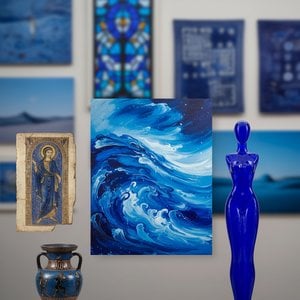
The Allure of Azure: Exploring the Symbolic & Aesthetic Depths of Blue in Art History
Explore the rich history of blue in art! Discover its symbolism, from ancient pigments to modern masterpieces by Kandinsky & Seurat. Uncover the psychological impact and cultural meanings behind this captivating hue.

The Enduring Legacy of Oil on Canvas: Technique, History & Aesthetic Impact
Explore the rich history & techniques of oil painting – from Renaissance masters to Impressionism. Discover pigments, layering methods, and why this timeless medium endures. Expert insights for artists & art enthusiasts.


