


 Aperçu en situation
 Partager
 Partager
 Détails
 Guide imprimable

 Télécharger
 Articles similaires
 Radiographie
 Voir le diaporama
 Statistiques
Hamlet

 Afficher la suite
Reproduction à l'huile faite à la main
Huile sur toile peinte à la main, avec cadre et dimensions personnalisés, réalisée sur commande par nos artistes. ( Passer au format impression Passer au format image numérique)




P118B €10

P118H €10

P118W €10

P438Z €10

P508JH €12

P508YH €12

P805H €10

P805Z €10

P919BZ €10

P919G €10

P919XJ €10

P959ZH €10

P968JZ €12

W106C €8

W218G €10

W218JH €8

W218Y €10

W307PJ €10

W316G €10

W316PJ €8

W316Y €10

W398PJ €8

W4111J €10

W500HY €15

W500JH €15

W692G €12

W849H €8

W940BG €15

W953PJ €8




Choisissez parmi nos formats prédéfinis qui respectent les proportions originales de l’œuvre.

Saisissez la largeur et la hauteur souhaitées, pour s'adapter à votre cadre ou à votre mur. Cette œuvre est peinte à la main ; ainsi, pour un format de forme différente, l'artiste peut peindre un peu plus autour du tableau ou réduire légèrement les bords — c'est vous qui choisissez. Nous vous envoyons une maquette numérique pour approbation avant que la peinture ne commence. L'image présentée sur cette page ne reflète pas le résultat réel — seule la maquette le fait.
Après la commande, l’équipe ArtsDot.com contactera le client par e-mail pour recueillir ses instructions et lui fournira une maquette d’aperçu
Livraison dans le monde entier () en 3 à 4 semaines au lieu des 5 semaines habituelles. (23 octobre). Aucun compromis sur la qualité.

Livraison express gratuite dans le monde entier

Toile de lin de haute qualité

Assurance transport complète

Garantie de remboursement des droits de douane

Garantie de fidélité des couleurs

Garantie de retour de 100 jours (uniquement en cas de défaut)

Garantie de remboursement à 100%

Tarifs dégressifs sur quantité
 L'option verre n'est disponible que pour les dimensions inférieures à 110 cm.

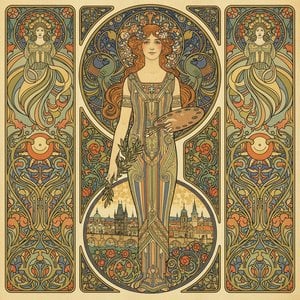
Hamlet
Technique de reproduction
Format de la reproduction
-


Prix total final
€ 231
A Symphony in Gold and Bloom: Alphonse Mucha’s “Age of Reason”
The painting "Age of Reason," attributed to Alphonse Maria Mucha, isn't merely an image; it’s a carefully constructed meditation on illumination and serenity—a cornerstone of Art Nouveau’s aesthetic philosophy. Created circa 1896-1897 during Mucha’s Parisian zenith, this monumental canvas transcends the decorative impulse often associated with the movement, delving into profound thematic concerns that resonate powerfully even today. Its impact extends beyond the realm of visual art, influencing interior design trends and shaping perceptions of beauty itself.- Subject Matter: Mucha’s vision centers on a luminous garden bathed in dappled sunlight—a deliberate contrast to the anxieties prevalent at the time concerning industrialization and societal upheaval. Figures emerge from the foliage, engaged in quiet contemplation, suggesting an antidote to the frenetic pace of modern life.
- Style: Mucha’s signature Art Nouveau style dominates every element of the composition. The undulating lines—characteristic of the movement—are not merely decorative; they embody a belief in organic harmony and fluidity, mirroring the natural world he seeks to capture. These curves dominate the canvas, creating an illusion of constant motion while simultaneously conveying stability.
- Technique: Mucha employed meticulous glazing techniques—applying thin layers of translucent pigment over opaque undercoats—to achieve breathtaking luminosity and depth. This painstaking process allowed him to reproduce the subtle gradations of color found in natural light, elevating the painting beyond mere representation into a realm of emotive expression.
Historical Context: Embracing Aesthetic Idealism Amidst Industrial Change
“Age of Reason” emerged during a period marked by significant social and technological transformations—the rapid expansion of factories and cities challenging traditional values. Mucha, acutely aware of these developments, responded with an artistic stance rooted in idealism. He championed the notion that beauty could serve as a moral compass, offering solace and inspiration amidst uncertainty. The painting’s serene depiction of nature reflects this broader philosophical preoccupation.Symbolism: Light, Flowers, and Contemplative Presence
The garden itself is laden with symbolic significance. Sunlight represents enlightenment—spiritual illumination—a concept central to Art Nouveau’s intellectual currents. The flowers—primarily lilies and roses—symbolize purity and love—values upheld by Mucha's artistic vision. More importantly, the figures embody contemplative presence—a deliberate rejection of materialism and an affirmation of inner peace.Emotional Impact: A Balm for the Soul
Ultimately, “Age of Reason” succeeds in conveying a profound emotional resonance. Its tranquil atmosphere invites viewers to pause and reflect—to reconnect with their own sense of wonder and appreciation for beauty. Mucha’s masterful handling of color and line creates an immersive experience that transcends time, securing its place as one of Art Nouveau's most enduring masterpieces.Questions et réponses
Quelle est la saturation des couleurs de «Hamlet» de Alphonse Maria Mucha ?
La palette de « Hamlet » présente une saturation Clear Color Presence.
Comment le style de « Hamlet » s'inscrit-il dans l'époque de son créateur ?
« Hamlet » appartient au mouvement Art Nouveau, et son créateur a œuvré à l'époque XIXe siècle.
Qu'est-ce que "Hamlet" partage avec le reste de l'œuvre de Alphonse Maria Mucha ?
«Hamlet» partage avec les autres œuvres de Alphonse Maria Mucha son style Art Nouveau ainsi que ses thèmes récurrents : symbolic art nouveau, theater promotion, czech nationalism, decorative elegance, artist legacy.
Œuvres similaires


Biographie de l'artiste
Première Vie et Formation
- Né : Le 15 juillet 1860, à Ivanačice, Moravie (aujourd'hui faisant partie de la République tchèque)
- A montré un talent artistique dès son plus jeune âge.
- A étudié à l'Académie des beaux-arts de Prague mais s'est désillusionné face aux approches traditionnelles.
- S'est installé à Paris en 1887 pour poursuivre son propre style.
Style Artistique et Œuvres Notables
- Connu pour un style Art Nouveau distinctif caractérisé par des lignes fluides, des formes organiques et un sentiment de mouvement.
- Influencé par des artistes tels que Pierre-Auguste Renoir et Gustave Moreau.
- Œuvres Notables :
- La Révolte Slave - Présente un mélange de motifs tchèques traditionnels avec des éléments Art Nouveau modernes.
- Salon des Cent
- Peintures inspirées d'œuvres telles que Les Filles de Tespio de Gustave Moreau, et La Ribambelle des Gobelins de Piero Dorazio.
- Illustrations basées sur De Jeunes Fermiers Brisant le Lin de Sir Hubert von Herkomer.
- Présentait fréquemment des femmes idéalisées dans des robes fluides entourées de fleurs luxuriantes.
Moments Forts de Carrière et Commandes Majeures
- Collaboration avec Sarah Bernhardt : A créé des affiches et des designs pour l'actrice Sarah Bernhardt, à commencer par l'affiche de Gismonda (1894), qui a lancé sa carrière.
- Exposition Universelle à Paris (1900) : Son style Art Nouveau a gagné une reconnaissance internationale lors de cet événement. Il a décoré le pavillon de Bosnie-Herzégovine et collaboré au pavillon autrichien.
- Mécénat de Charles Richard Crane : A reçu le soutien de Charles Richard Crane, ce qui lui a permis de créer la série monumentale Le Cycle Slave (1912-30).
- Tchécoslovaquie Indépendante : A conçu des timbres, des billets de banque et des documents gouvernementaux pour la Tchécoslovaquie nouvellement indépendante.
Influences et Héritage
- Influencé par les traditions artistiques tchèques et les mouvements artistiques européens modernes.
- Son style unique a ouvert la voie aux futures générations d'artistes dans l'Art Nouveau et la Sécession.
- A inspiré d'autres artistes comme Eva Prokopcová.
- L'héritage s'étend au-delà de son œuvre pour influencer le design et l'esthétique.
Vie Tardive et Décès
- S'est marié avec Maruska (Marie/Maria) Chytilová en 1906.
- A visité les États-Unis de 1906 à 1910, où leur fille Jaroslava est née.
- Est décédé le 14 juillet 1939 à Prague, Tchécoslovaquie.

Alphonse Maria Mucha
1860 - 1939 , République tchèque
En bref
- Artistes Influencés: ['Eva Prokopcová']
- Artistes Influents:
- Pierre-Auguste Renoir
- Gustave Moreau
- Date De Décès: 1939
- Date De Naissance: 15 juillet 1860
- Lieu De Naissance: Brno, République tchèque
- Mouvement Artistique: Art nouveau
- Nationalité: Tchèque
- Nom Complet: Alphonse Maria Mucha
- Oeuvres Notables:
- La révolte slave
- Salon des Cent
- Les filles de Tespio
- La Ribambelle des Gobelins
Articles connexes

10 Œuvres d'Art Pleines d'Esprit : Joie et Décoration Intérieure
Découvrez 10 œuvres d'art iconiques débordantes de joie et d'esprit ! Explorez l'histoire de Matisse, Renoir, Van Gogh et plus encore. Trouvez l'inspiration déco et achetez des reproductions de tableaux de qualité musée sur ArtsDot.com.

La Ligne Fluide et la Forme Épanouie : Explorer l'Héritage Esthétique de l'Art Nouveau
Explorez l'héritage fascinant de l'Art nouveau : Sécession viennoise, Jugendstil et influences clés. Découvrez les motifs emblématiques et l'impact durable de ce mouvement artistique révolutionnaire.

Art Nouveau : Les 10 Chefs-d'œuvre Indémodables à Redécouvrir
Plongez dans l'univers fascinant de l'Art Nouveau ! Découvrez les 10 chefs-d’œuvre emblématiques de Klimt, Mucha et autres artistes majeurs. Inspirez votre décoration intérieure avec ces icônes du style floral et du symbolisme. Explorez la collection complète sur
Alphonse Mucha: A Comprehensive Exploration of Art Nouveau's Master of Decorative Symbolism
Explore the life & art of Alphonse Mucha, master of Art Nouveau! Discover his iconic posters, stunning illustrations, and the monumental Slav Epic. A comprehensive guide for collectors & enthusiasts.

Raphael Kirchner: A Poetic Vision of Belle Époque Society Through Art Nouveau Lithography
Explore the captivating world of Raphael Kirchner, a master of Art Nouveau illustration during the Belle Époque. Discover his iconic 'Kirchner Girls,' pioneering pin-up art & lasting influence.


