


The picture follows your choices: , .
Description de la pièce
Albert Edelfelt Explore Albert Edelfelt's iconic portrait of Louis Pasteur—a masterpiece capturing scientific brilliance and humanist compassion. Discover the artist’s meticulous observation and impressionistic realism.
 Lire la suite
Biographie de l'artiste
Explore les peintures réalistes d’Albert Edelfelt (1854-1905), artiste finlandais pionnier célébré pour ses portraits, paysages et son influence sur l'art finlandais. Découvrez des œuvres majeures comme « Portrait de Louis Pasteur » et « Sous les bouleaux ».
Reproduction à l'huile faite à la main
Huile sur toile peinte à la main, avec cadre et dimensions personnalisés, réalisée sur commande par nos artistes. ( Passer au format impression Passer au format numérique)
More about this painting
 Aperçu en situation
 Envoyer
 Partager
 Détails de l'œuvre
 Guide
Guide

 Télécharger l'image
 Articles similaires
 Radiographie
 Diaporama
 Q&A
Q&A Statistiques
Order your painting in four simple steps
Take your time. You can change any answer; the price in your order card follows each choice.
1 Step one of four
Which size would you like?
These sizes keep the proportions of the original painting. The drawing shows your choice on a wall, above a two-metre sofa.
Or give your own measurements
Choisissez parmi nos formats prédéfinis qui respectent les proportions originales de l’œuvre.

Saisissez la largeur et la hauteur souhaitées, pour s'adapter à votre cadre ou à votre mur. Cette œuvre est peinte à la main ; ainsi, pour un format de forme différente, l'artiste peut peindre un peu plus autour du tableau ou réduire légèrement les bords — c'est vous qui choisissez. Nous vous envoyons une maquette numérique pour approbation avant que la peinture ne commence. L'image présentée sur cette page ne reflète pas le résultat réel — seule la maquette le fait.
2 Step two of four
How should it be prepared: rolled, stretched or framed?
The prices below are for the size you chose in step one.
Choose the edges of the stretched canvas
Choose your frame

White €1

Blurside €1

Extended €1

P118B €10

P118H €10

P118W €10

P438Z €10

P508JH €12

P508YH €12

P805H €10

P805Z €10

P919BZ €10

P919G €10

P919XJ €10

P959ZH €10

P968JZ €12

W106C €8

W218G €10

W218JH €8

W218Y €10

W307PJ €10

W316G €10

W316PJ €8

W316Y €10

W398PJ €8

W4111J €10

W500HY €15

W500JH €15

W692G €12

W849H €8

W940BG €15

W953PJ €8

H24-GOLD €30

H24-SILVER €30

H36-GOLD €45

H36-SILVER €45
Sous cadre
Moulding: . Overall size with the frame: .
3 Step three of four
Would you like anything changed in the painting?
Most people answer no. Because each painting is made by hand, our artist can also adapt it for you.
After order, ArtsDot.com team will email client for instructions and provide a mockup preview
4 Step four of four
A few finishing options
All of them are optional. The answers already selected cost nothing extra.
Who paints it?
Livraison dans le monde entier () en 3 à 4 semaines au lieu des 5 semaines habituelles. (30 octobre). Aucun compromis sur la qualité.
A nameplate, as in a museum?
Détails de la plaque en bronze gravée
This elegant plaque features the artist's name and the title of the artwork, finely engraved for a timeless presentation.
It is made from bronze with a refined, elegant finish. The text is precisely laser-engraved for a sharp and permanent result. Measuring 9x2 cm, the plaque is compact yet easy to read. It's built to be durable and scratch-resistant, offering a professional, museum-quality look. Mounting is simple thanks to the included adhesive backing.
Détails de la plaque en acrylique transparent
The plaque includes essential engraved details such as the artist's name, the title of the artwork, the date it was created, the type of media used-like oil on canvas or watercolor-a brief description of the piece, and a QR code that links to the complete artwork information.
It is crafted from clear acrylic, offering a sleek, modern appearance. The text is UV-engraved in black to ensure strong visual contrast. With a size of 10x15 cm, it ensures optimal readability. It comes equipped with two metal hooks for secure wall mounting. The plaque is designed to be weather-resistant, making it suitable for various environments, and it includes interactive features that work seamlessly with smartphone scanning.
Détails de la plaque en acrylique noir
This elegant plaque includes engraved information such as the artist's name, the title of the artwork, the date it was created, the type of media used (like oil on canvas or watercolor), a short description of the artwork, and a QR code for quick access to more information.
The plaque itself is made from refined black acrylic with a premium finish. The text is laser-engraved in white for high contrast and readability. Its size is 10x15 cm, designed to be easy to read. It comes with two metal hooks for professional mounting. The design is sleek and fits any interior style. It is also weather-resistant and durable, with built-in digital integration for mobile compatibility.
A protective varnish?
When do you need it?
✓ Check and order
Your painting, as you ordered it

Jean-Baptiste Pasteur
Technique de reproduction
Format de la reproduction
-

Artiste de prestige
Plus de détails, de finesse et un temps de production accru
-

Cadre de reproduction
-
-
Pour les œuvres ou reproductions dont un côté mesure plus de 105 cm (environ 41 pouces), le cadre sera expédié sous forme de kit démonté. Cette méthode garantit une livraison sécurisée et prévient tout dommage pendant le transport.
Assemblage professionnel requis - ce produit n'est pas destiné au bricolage (DIY).
Le kit doit être assemblé et la toile tendue par un encadreur professionnel expérimenté, en utilisant de la colle à bois (non fournie), une pince à tendre la toile et des serre-joints pour maintenir les traverses d'équerre pendant le séchage de la colle. Un assemblage incorrect ou une tension inégale de la toile peut endommager l'œuvre de manière irréversible et n'est pas couvert par notre garantie.
 Pour les œuvres ou reproductions dont un côté mesure plus de 105 cm (environ 41 pouces), le cadre sera expédié sous forme de kit démonté. Cette méthode garantit une livraison sécurisée et prévient tout dommage pendant le transport.
Toutes les baguettes en bois massif sont incluses, découpées avec précision à la taille requise.
À assembler avec les vis fournies, ainsi qu'avec de la colle à bois pour les assemblages d'angles (non fournie), à prévoir par votre encadreur.
L'utilisation d'outils professionnels est requise et non incluse : une pince à tendre la toile (tendeur) et des serre-joints pour maintenir les baguettes bien d'équerre pendant le séchage de la colle.
Important :
L'assemblage des angles nécessite de la colle à bois, les barres doivent être maintenues avec des serre-joints jusqu'au séchage complet de la colle, et le tendage de la toile sur le châssis assemblé nécessite une pince à tendre la toile. Aucun de ces éléments n'est inclus dans le kit. Veuillez consulter un encadreur professionnel expérimenté avant de commander ce format.

Cartel
-
-

Vernis de protection
Vernis brillant (intensifie les couleurs, protège de la lumière et de l'humidité)
-

Personnaliser mon œuvre
Exemples de personnalisation : remplacer le visage par une photo du client ; ajouter un animal de compagnie (par exemple, remplacer un chat par un chien) ; inclure un message caché en arrière-plan ; modifier le paysage ou les éléments d'arrière-plan.
-

Livraison urgente
Livraison dans le monde entier () en 3 à 4 semaines au lieu des 5 semaines habituelles. (30 octobre). Aucune concession sur la qualité.
-
Livraison express
Livraison dans le monde entier () sous 5 semaines. (6 novembre).
Inclus
Prix total
€ 232
L'option verre n'est disponible que pour les dimensions inférieures à 110 cm.
Included with every order
- Livraison express gratuite dans le monde entier
- Toile de lin de qualité supérieure
- Assurance transport complète
- Garantie de remboursement des droits de douane
- Garantie de fidélité des couleurs
- Politique de retour de 100 jours (uniquement en cas de défaut)
- Garantie de remboursement à 100%
- Offre de tarifs dégressifs


A Portrait of Genius: Albert Edelfelt’s Vision of Louis Pasteur
The painting of Louis Pasteur by Albert Edelfelt stands as an emblem of scientific achievement and humanist compassion—a testament to the transformative power of art when allied with intellectual curiosity. Completed in 1881, it transcends mere representation; instead, Edelfelt captured not just Pasteur’s physical likeness but also his profound dedication to unraveling the mysteries of life and combating disease. This remarkable artwork resides within the Musée d’Orsay in Paris, offering visitors a chance to contemplate its enduring legacy.The Artist's Approach: Collaboration and Observation
Albert Edelfelt wasn’t merely commissioned to depict Pasteur; he actively participated in shaping the portrait’s narrative. Driven by an unwavering belief in the importance of scientific inquiry, Edelfelt meticulously documented Pasteur’s laboratory environment—a deliberate decision that underscored his commitment to portraying Pasteur as a man deeply engaged with his craft. As evidenced by Edelfelt's correspondence with his mother, he undertook extensive preparatory sketches and studies, capturing Pasteur’s posture and facial expressions with painstaking accuracy. These detailed observations informed the artist’s vision, resulting in an image imbued with palpable sincerity and intellectual depth.Style and Technique: Impressionistic Realism
Edelfelt’s style exemplifies a harmonious blend of impressionistic realism—a hallmark of his era—characterized by luminous brushstrokes and subtle tonal gradations. He skillfully employed oil paints on canvas to achieve a velvety texture that conveys both the solidity of Pasteur's physique and the ethereal quality of scientific contemplation. The artist’s masterful use of light creates an atmosphere of quiet intensity, drawing viewers into Pasteur’s world and emphasizing his serene gaze—a symbol of unwavering resolve and intellectual perseverance. Edelfelt’s technique reflects a broader artistic movement that sought to capture fleeting moments of experience while maintaining fidelity to observed reality.Historical Context: Science and Art in Belle Époque Paris
The painting emerged during the Belle Époque, a period marked by unprecedented optimism and cultural flourishing in Paris—a time when science and art intertwined to celebrate human progress. Pasteur’s groundbreaking discoveries in microbiology revolutionized medicine and challenged prevailing scientific dogma, establishing him as a beacon of intellectual brilliance. Edelfelt recognized this significance, elevating Pasteur's portrait to the status of an icon—a visual embodiment of the virtues prized by the Parisian intelligentsia. The artwork served as a powerful affirmation of the humanist spirit that permeated Belle Époque society.Symbolism: Calm Reflection and Intellectual Integrity
Beyond its technical prowess, Edelfelt’s portrait resonates with symbolic meaning. Pasteur's seated posture exudes composure and thoughtfulness—a deliberate gesture conveying his unwavering dedication to scientific pursuits. His clasped hands symbolize both physical strength and mental focus—representing the artist’s conviction that intellectual integrity is paramount to achieving profound understanding. The inclusion of a simple chair underscores the importance of solitude and contemplation—essential conditions for fostering creativity and pursuing knowledge with earnestness.Emotional Impact: A Legacy of Inspiration
The painting continues to inspire admiration for its ability to convey both scientific rigor and human compassion. It serves as a poignant reminder that intellectual curiosity can coexist harmoniously with empathy—a message particularly relevant in our contemporary world. Edelfelt’s portrait transcends mere depiction; it embodies the spirit of inquiry and perseverance—qualities celebrated throughout history as catalysts for transformative change. Its enduring presence within the Musée d’Orsay ensures that Louis Pasteur's image—and Albert Edelfelt’s masterful artistic vision—will continue to captivate audiences for generations to come.Questions et réponses
En quelle année «Jean-Baptiste Pasteur» de Albert Edelfelt a-t-il été créé ?
«Jean-Baptiste Pasteur» de Albert Edelfelt a été créé en 1881.
Quelle palette et quelle émotion "Jean-Baptiste Pasteur" associe-t-il ?
«Jean-Baptiste Pasteur» de Albert Edelfelt allie une palette Tons terreux à un ton Contemplatif.
Quelle technique a été utilisée pour «Jean-Baptiste Pasteur» de Albert Edelfelt ?
« Jean-Baptiste Pasteur » est réalisé en Acrylique sur toile.
Œuvres similaires


Albert Edelfelt
1854 - 1905, Finlande
Biographie de l'artiste
Premières années et formation
Albert Gustaf Aristides Edelfelt est né le 21 juillet 1854 à Porvoo, en Finlande. Ses parents, Carl Albert Edelfelt et Alexandra Brandt, étaient d'origine suédoise-finlandaise. Son père était architecte et sa mère issue d’une famille de marchands aisée. Très tôt, Edelfelt a montré une passion pour l'art qui l'a conduit à étudier à l'École de dessin de la Société finnoise des arts en 1869. Il a ensuite poursuivi ses études à l'Académie royale des beaux-arts d'Anvers (1873-74) et à l'École nationale supérieure des beaux-arts de Paris (1874-78), où il a été l’élève de Jean-Léon Gérôme. Il a également passé un certain temps à Saint-Pétersbourg (1881-82).Développement artistique et influences
Sous l'influence de son maître Gérôme, Edelfelt s'est d'abord orienté vers la peinture historique. Cependant, il s’est ensuite tourné vers le naturalisme à partir de 1880. Il a été influencé par Jules Bastien-Lepage et, dans une certaine mesure, par l'impressionnisme. Son style mêlant naturalisme et modernité lui a assuré un grand succès. Ses premières œuvres parisiennes, comme "Le Billet doux", lui ont valu des prix prestigieux. Il partagea un atelier avec Julian Alden Weir et se lia d’amitié avec John Singer Sargent.Œuvres majeures et reconnaissance
Edelfelt a connu une percée significative lors de l'Exposition universelle de Paris en 1889, où il a remporté une médaille d'or. Parmi ses œuvres les plus notables figurent : le "Portrait de Louis Pasteur", qui lui a valu la Légion d’honneur en 1886 ; "Une jeune femme dans son boudoir”, témoignant de sa maîtrise dans la capture de l'essence féminine ; et “Sous les bouleaux”, une représentation poignante des paysages finlandais. Il a également réalisé des portraits de personnalités importantes, notamment Aino Ackté et la famille impériale russe.Impact et héritage
Edelfelt est considéré comme l’un des premiers artistes finlandais à atteindre une renommée internationale. Son succès a ouvert la voie à d'autres peintres finlandais, tels qu'Akseli Gallen-Kallela et Gunnar Berndtson, qui ont également étudié à Paris. Il a contribué de manière significative au mouvement artistique réaliste en Finlande et son influence s’est étendue aux générations suivantes. Sa carrière a été marquée par un retour en Finlande en 1891 et par des œuvres patriotiques vers la fin de sa vie. Son héritage a été célébré par l'émission d'une pièce commémorative de 100 euros à l'occasion de son 150e anniversaire en 2004.


Articles connexes
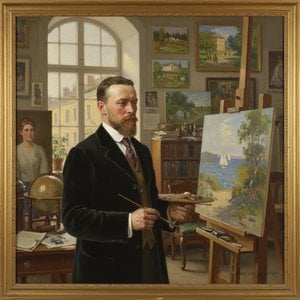
Albert Edelfelt: A Pioneer of Finnish Realism & International Impressionist Circles
Explore the life & work of Albert Edelfelt, a pioneering Finnish Realist painter who bridged Impressionism & national identity. Discover his masterpieces and lasting influence on art history.

Charles-André van Loo: A Study in Rococo Portraiture & the French Court's Artistic Dynamics
Explore the elegant world of Charles-André van Loo, a master of Rococo portraiture at the French court. Discover his life, techniques, and enduring influence on 18th-century art. Hand-painted reproductions available.

The Enduring Legacy of French Art: Movements, Masters & Cultural Impact
Explore the rich history of French art, from the Salon to Impressionism & beyond. Discover iconic masters, key movements, and expert guidance for collecting timeless masterpieces. ArtsDot.