

 Aperçu en situation
 Envoyer
 Partager
 Détails de l'œuvre
 Guide
Guide

 Télécharger l'image
 Articles similaires
 Radiographie
 Diaporama
 Q&A
Q&A Statistiques
Shadows at Noon

- 25.0 x 35.0 cm


 Lire la suite
L’œuvre d'art présentée sur cette page est protégée par le droit d'auteur, ce qui signifie que nous ne pouvons légalement créer ou vendre de reproduction identique. Cette protection est appliquée en vertu d'accords internationaux tels que la Convention de Berne et par les lois nationales, notamment celles énoncées par le Loi américaine sur le droit d'auteur - Titre 17.
Cette méthode est pleinement conforme aux réglementations sur le droit d'auteur car elle ne repose pas sur la copie ou la duplication de l'œuvre protégée. Il s'agit plutôt d'une réinterprétation créative — une nouvelle peinture qui s'inspire de l'original sans pour autant lui être identique.
Giclées et impressions d'art
Impressions giclées ou sur toile de qualité musée, avec une production rapide et des finitions au choix. ( Commander la reproduction peinte à la main Passer au format numérique)




































Choisissez parmi nos formats prédéfinis qui respectent les proportions originales de l’œuvre.

Saisissez la largeur et la hauteur souhaitées pour qu'elles s'adaptent à votre cadre ou à votre mur. Une impression peut être recadrée, mais jamais agrandie au-delà de l'image originale ; ainsi, un format de forme différente entraînera la perte d'une partie de l'image. Nous vous envoyons une maquette numérique pour approbation avant toute impression. L'image présentée sur cette page ne montre pas le recadrage réel — seule la maquette le permet.
Livraison dans le monde entier () en 2 semaines au lieu des 4/5 semaines habituelles. (2 novembre)

Livraison express gratuite dans le monde entier

Toile de lin de qualité supérieure

Assurance transport complète

Garantie de remboursement des droits de douane

Garantie de fidélité des couleurs

Politique de retour de 100 jours (uniquement en cas de défaut)

Garantie de remboursement à 100%

Offre de tarifs dégressifs
 L'option verre n'est disponible que pour les dimensions inférieures à 110 cm.

Shadows at Noon
Giclées et impressions d'art
Format de la reproduction
-


Prix total
€ 55
Delving into the Artist's Vision
Alan Crane's Shadows at Noon is a testament to his exceptional skill and artistic vision. The lithograph measures 25 x 35 cm and showcases the artist's ability to play with light and shadow, creating an atmosphere that is both serene and thought-provoking. The scene depicts people sitting on the ground in front of a building, with animals scattered around them, evoking a sense of tranquility and harmony.Exploring the Artistic Style
The use of lithography as a medium adds a unique texture to the piece, giving it a sense of depth and dimensionality. Alan Crane's style is characterized by his attention to detail and his ability to capture the subtleties of light and shadow. This is evident in Shadows at Noon, where the interplay between light and dark creates a sense of tension and balance.- Lithography as a medium allows for a range of tonal values, from deep blacks to subtle grays.
- The composition of the piece is carefully balanced, with the figures and animals arranged in a harmonious manner.
- The use of light is a key element, with the shadows adding depth and dimensionality to the scene.
The allure of Shadows at Noon lies in its ability to evoke a sense of calm and contemplation, inviting the viewer to step into the serene world created by Alan Crane. As we gaze upon this masterpiece, we are reminded of the power of art to transport us to another time and place.
Questions et réponses
En quelle année et dans quel mouvement "Shadows at Noon" a-t-elle été réalisée ?
« Shadows at Noon » a été créé en 1952, s'inscrivant dans le mouvement Contemporary Realism. La date et le mouvement ancrent l'œuvre dans l'histoire de l'art.
À quelle période de la carrière de Alan Crane se situe « Shadows at Noon » ?
Au cours de la carrière de Alan Crane, « Shadows at Noon » s'inscrit dans la période Mature Period. Cette phase permet de le comparer aux autres œuvres de l'artiste.
D'où viennent les visiteurs de «Shadows at Noon» de Alan Crane ?
La page Statistiques de «Shadows at Noon» de Alan Crane présente les statistiques de visites publiques : le nombre de visites mensuelles de cette œuvre, une comparaison avec les œuvres les plus consultées de l'artiste, ainsi que la provenance des visiteurs.
Œuvres similaires


Biographie de l'artiste
Alan Crane: Weaver of Light and Shadow in the American West
Alan Crane, a name perhaps less familiar than some of his contemporaries, nevertheless holds a significant place within the landscape of 20th-century American art. Born in Brooklyn, New York, in 1901, Crane’s artistic journey was one marked by a deep connection to the natural world, particularly the rugged beauty and evocative light of the American West, coupled with a masterful command of lithography – a medium he embraced with an almost obsessive dedication.
Crane's early life provided fertile ground for his future artistic pursuits. He studied at Pratt Institute, absorbing the principles of design and illustration while simultaneously developing a keen eye for detail and composition. Crucially, he found mentorship under Winold Weiss, a pioneering figure in American muralism, and later collaborated with Richard Boleslawsky, a renowned theatrical designer known for his innovative use of color and form. These early influences instilled in Crane a respect for craftsmanship, an appreciation for dramatic lighting, and a willingness to experiment with new techniques – qualities that would define his distinctive style.
Crane’s artistic trajectory took a pivotal turn when he relocated to New England, immersing himself in the landscapes of Massachusetts and Maine. It was during this period that he truly discovered his passion for lithography, recognizing its potential to capture the subtle nuances of light, shadow, and texture with unparalleled precision. He joined numerous art organizations – including the Salmagundi Club, Audubon Artists, and the Rockport Art Association – demonstrating a commitment to artistic community and continuous learning.
The Lithographic Vision
Crane’s work is overwhelmingly defined by his extraordinary skill as a lithographer. He wasn't simply reproducing images; he was translating them onto stone with an almost alchemical precision. His prints are characterized by a remarkable ability to render atmospheric effects – the shimmering heat of the desert sun, the cool dampness of a forest floor, the dramatic interplay of light and shadow in a mountain range. This mastery stemmed from countless hours spent meticulously working on his stones, refining each line and tone until it perfectly conveyed the essence of his subject.
His subjects often centered around the American West – vast landscapes, weathered buildings, and scenes of rural life. However, Crane’s approach wasn't merely descriptive; he imbued his prints with a sense of mood and emotion. He frequently employed a muted palette, dominated by earthy tones and subtle gradations of gray, creating an atmosphere of quiet contemplation and understated beauty. The influence of European landscape painters, particularly the Barbizon School, is evident in his use of light and color, but Crane’s work possesses a uniquely American sensibility – a reverence for the ruggedness and resilience of the West.
Mexico: A Source of Inspiration
A significant chapter in Crane's artistic development unfolded during his extended visits to Mexico. Beginning in 1948, he spent several years exploring the country’s diverse landscapes and cultures, producing a remarkable series of lithographs that captured the spirit of this vibrant nation. These prints – “Haunted Garden, Mexico,” “Indian Laurels, Chapala,” “Clouds and Spires, San Miguel Allende” – are considered among his finest works, showcasing his ability to translate the exotic beauty of Mexico onto stone with sensitivity and respect.
His time in Mexico wasn’t merely a period of observation; it was a transformative experience that profoundly shaped his artistic vision. He developed a deeper understanding of color theory, composition, and the interplay between light and shadow – skills he subsequently applied to his depictions of the American West. The Mexican landscapes provided him with new perspectives on form, texture, and atmosphere, enriching his already considerable talent.
Notable Works and Legacy
Beyond his lithographs, Crane produced a substantial body of work in other media, including illustrations for books and magazines. His book *Pepita Bonita* (1942), *Gloucester Joe* (1943) and *Nick and Nan in Yucatan* (1945) are prime examples of his versatility and artistic range. His Smithsonian artwork “Village in the Sun” is a testament to his meticulous attention to detail and ability to capture the essence of architectural design.
Alan Crane’s legacy extends beyond his individual works; he played a vital role in the development of American lithography, demonstrating its potential as a medium for capturing the subtleties of light, shadow, and texture. His prints continue to be admired for their beauty, craftsmanship, and evocative power – a testament to his artistic vision and unwavering dedication to his craft. He died in 1969, leaving behind a rich body of work that continues to inspire artists and art lovers alike.
Further Exploration
- Spires and Clouds (1949): A stunning lithograph showcasing architectural grandeur & dramatic skies. (/en/art/alan-crane-spires-and-clouds-AQTHB6-en/)
- Shadows at Noon (1952): Captivating 1952 lithograph showcasing serene rural scenes & masterful light/shadow play. (/en/art/alan-crane-shadows-at-noon-AQTHAJ-en/)
- Village in the Sun (1946): A serene 1946 masterpiece of architectural detail & light. (/en/art/alan-crane-village-in-the-sun-AQTHAU-en/)
- Alan Crane - Artists | The Old Print Shop: https://oldprintshop.com/artists/268

Alan Crane
1901 - 1969
L'essentiel de l'artiste
- Artistic Movement Or Style: Lithography, Illustration
- Artists Or Movements Influenced By This Artist: ['Elizabeth Borton de Trevino']
- Artists Who Influenced This Artist:
- Winold Weiss
- Richard Boleslawski
- Date Of Birth: 1901
- Date Of Death: 1969
- Full Name: Alan Horton Crane
- Nationality: American
- Notable Artworks:
- Spires and Clouds
- Shadows at Noon
- Village in the Sun
- Place Of Birth: Brooklyn, New York
Articles connexes

Josef Kriehuber: A Life Immersed in Viennese Topography – From Lithographic Precision to Romantic Observation
Explore the life and work of Josef Kriehuber, a master lithographer who captured 19th-century Vienna. Discover his portraits of nobility, landscapes, & artistic techniques. A guide for collectors & art enthusiasts.

The Eloquent Darkness: Exploring Shadow as Subject, Symbolism & Technique in Art History
Explore the captivating history of shadow in art! Discover chiaroscuro & tenebrism techniques used by masters like Caravaggio & Rembrandt. Uncover symbolism, emotional impact & enduring legacy with ArtsDot.

Walter Crane: Aestheticism, Socialism & the Evolution of British Decorative Art
Explore the life & work of Walter Crane, a pivotal figure in Aestheticism & the Arts & Crafts movement. Discover his socialist ideals, stunning illustrations, and lasting impact on British art & design.

Maîtriser la solitude : les 25 chefs-d'œuvre emblématiques d'Edward Hopper
Explorez les 25 chefs-d'œuvre d'Edward Hopper et son réalisme unique. Découvrez toute la collection sur ArtsDot.com.
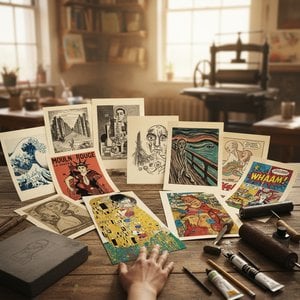
Les 10 Chefs-d'œuvre Lithographiques qui ont Révolutionné l'Art | ArtsDot
Plongez dans l'univers fascinant des 10 chefs-d'œuvre lithographiques qui ont marqué l'histoire de l'art. Découvrez Toulouse-Lautrec, Munch & Picasso sur ArtsDot.com ! Reproductions d'art de qualité muséale pour une décoration intérieure unique. Explorez la collection en ligne.