The Enduring Legacy of Wu Dacheng: A Master of Classical Chinese Calligraphy and Painting
Wu Dacheng, a contemporary artist deeply rooted in the traditions of classical Chinese art, stands as a vital link to centuries of artistic heritage. While biographical details remain somewhat elusive – a testament perhaps to his focus on the work itself rather than personal renown – his impact is powerfully evident in his exquisite seal script calligraphy, evocative Qing dynasty landscape paintings, and scholarly Jinwen (ancient bronze inscriptions) reproductions. Born in China and continuing to create today, Wu Dacheng embodies a dedication to preserving and revitalizing the artistic spirit of past dynasties. He isn’t merely replicating tradition; he *lives* it, imbuing each brushstroke with a profound understanding of history, philosophy, and technique. His work is not simply seen, but experienced – a meditative journey into the heart of Chinese aesthetics.A Scholar's Path: Influences and Early Development
Wu Dacheng’s artistic foundation lies in rigorous scholarly training. He dedicated years to mastering the intricacies of seal script (zhuanshu), considered one of the most challenging forms of Chinese calligraphy. This early immersion wasn’t simply about replicating shapes; it was a deep dive into the philosophical underpinnings of the script itself, its connection to ancient rituals and cosmological beliefs. The influence of epigraphers – scholars who study inscriptions on bronze vessels and stone tablets – is also profoundly apparent in his work. His fascination with Jinwen, the archaic characters cast onto ritual bronzes during the Shang and Zhou dynasties, speaks to a desire to connect directly with the origins of Chinese writing and culture. This pursuit wasn’t confined to textual study; Wu Dacheng meticulously copied these inscriptions, absorbing their form, weight, and historical context. The landscapes he paints are similarly informed by the great masters of the Qing dynasty – artists like Wang Hui and Bada Shanren – but filtered through his own unique sensibility and scholarly understanding. He doesn’t imitate blindly, but rather internalizes the principles of composition, brushwork, and ink wash to create works that feel both timeless and deeply personal.The Art of Seal Script: More Than Just Writing
Wu Dacheng's seal script calligraphy is arguably his most recognizable achievement. He elevates this ancient form beyond mere communication into a realm of pure artistic expression. Each character isn’t simply rendered; it’s *constructed* – a careful balance of line, space, and texture. The weight of the brush, the flow of ink, and the subtle variations in pressure all contribute to a sense of dynamic energy within the seemingly static form. His seals are not merely decorative; they function as miniature landscapes themselves, evoking mountains, rivers, and forests through their intricate designs. The choice of stone is also crucial, with Wu Dacheng carefully selecting materials that complement the character’s meaning and aesthetic qualities. He often carves his own seals, further emphasizing his control over every aspect of the artistic process. Beyond aesthetics, his seal script carries a weight of historical significance. By faithfully reproducing this ancient form, he ensures its survival in a rapidly changing world, offering viewers a tangible connection to China’s rich cultural past.Landscapes Echoing Tradition: Qing Dynasty Aesthetics Reimagined
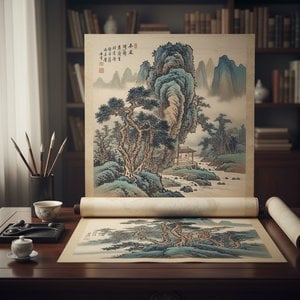
Wu Dacheng's landscape paintings demonstrate his mastery of traditional techniques while simultaneously revealing a distinct artistic voice. He draws inspiration from the monumental landscapes of the Qing dynasty, particularly those characterized by meticulous detail and atmospheric perspective. However, he avoids mere imitation, infusing his works with a sense of quiet contemplation and personal reflection.- His compositions often feature towering mountains, winding rivers, and secluded villages,
- evoking a sense of harmony between humanity and nature.
- The use of ink wash is particularly noteworthy, with Wu Dacheng employing subtle gradations of tone to create depth, atmosphere, and a feeling of ethereal beauty.
- He often incorporates elements of poetry and calligraphy into his landscapes,
- further enriching their meaning and aesthetic impact.
Historical Significance: A Contemporary Guardian of Classical Art
In an era dominated by modern art movements, Wu Dacheng’s unwavering commitment to classical Chinese traditions is particularly remarkable. He represents a vital counterpoint to the forces of globalization and cultural homogenization, offering a powerful affirmation of China’s artistic heritage. His work serves as a bridge between past and present, reminding viewers of the enduring beauty and philosophical depth of traditional art forms. By meticulously preserving and revitalizing these techniques, he ensures their survival for future generations. Wu Dacheng isn't simply an artist; he is a scholar, a historian, and a cultural guardian – a dedicated practitioner who embodies the spirit of classical Chinese art in the 21st century. His legacy lies not only in the exquisite beauty of his creations but also in his unwavering commitment to preserving and celebrating China’s rich artistic past.Kysymykset ja vastaukset
Mihin tyylisuuntauksiin Wu Dacheng kuului?
Wu Dachengn edustamat taidesuuntaukset löytyvät artistin Kaikki taidesuuntaukset -sivulta, jossa teokset on ryhmitelty tyylisuuntien mukaan.
Mitä tunnelmia Wu Dacheng's teokset välittävät?
Wu Dacheng-taiteilijan Tunnelmallinen huone kokoaa taideteokset tunnelman mukaan.
Miten Wu Dachengin ura on jaettu eri aikakausiin?
Wu Dacheng'n ura avautuu vaihe vaiheelta artistin Ura kronikka -sivulla: vaakasuuntainen aikajana teoksista, ryhmiteltynä uravaiheiden mukaisiin lukuihin.