The Life and Early Talent of Primo Conti
Primo Conti was an Italian futurist artist whose creative output began with an unusual intensity. Born in Florence on 16 October 1900, he displayed a precocious talent for music, poetry, and painting before he had even reached his tenth year. By the age of eight or nine, his technical facility in these diverse disciplines was already evident. This early multidisciplinary aptitude suggests a mind that refused to settle into a single medium from the start.
His entry into the avant-garde was swift. In 1913, Conti met the Futurists, a connection that would define much of his professional trajectory. This encounter integrated his burgeoning skills into the most radical movements of the early twentieth century. He was not merely a participant in the era's shifts; he was a practitioner who translated the energy of the age into both visual and literary forms. His presence in the movement was cemented by his ability to navigate the tension between traditional technique and the aggressive innovation required by Futurism.
Conti remained an active force in Italian art until his death on 12 November 1988 in Fiesole. His life spanned nearly the entire century, moving from the experimental fervor of the early 1900s through decades of complex stylistic shifts. He did not simply exist within a movement; he actively shaped the visual language of his time through a relentless commitment to his craft.
Artistic Movements and Evolving Styles
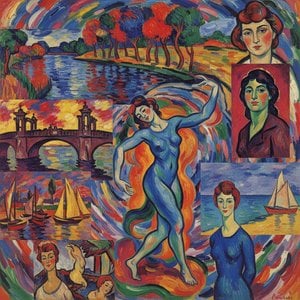
Conti’s visual language was never static. While his early drawings leaned toward the innovations of the era, his painting developed a distinct, hybrid identity. He did not adhere to a single school, instead constructing a style that fused elements of Art Nouveau, Fauvism, Expressionism, and Orphism. This refusal to settle into one mode allowed him to navigate the shifting currents of Italian modernism with a specific, personal intensity.
The year 1917 marked a definitive shift in his trajectory. Following meetings with Giacomo Balla in Rome and Filippo Tommaso Marinetti in Naples, Conti became an active participant in the Futurist movement. This period of engagement was not limited to theory; his output between 1917 and 1919 saw his work take on a distinct metaphysical style. He moved beyond mere representation to explore the more cerebral, unsettling qualities of Pittura Metafisica.
The 1920s saw a further expansion of his technical interests. He moved through Mannerism and Exoticism, often drifting into large-scale historical and religious painting. This period was characterized by a restless exploration of form and subject matter, ranging from the theatrical to the spiritual. He was not merely a painter of scenes but an investigator of different aesthetic systems, constantly recalibrating his approach to match the complexity of the era.
Later Life and Religious Devotion
By the 1940s, Conti had returned to the core of his creative identity, revisiting Futurist subjects and engaging in new experiments. This period was not a retreat into the past but a deliberate re-engagement with the avant-garde energy that had defined his earlier years. His work during this decade shows a refusal to abandon the radicalism of his youth, even as his personal life moved toward more structured, disciplined environments. This era also saw him expanding his visual language into the theatrical realm through his involvement in designing stage sets for the opera house with the foundation of the Maggio Musicale Fiorentino.
A profound shift occurred between 1948 and 1963, when Conti followed the rules of the Order of the Franciscans. This period of religious devotion did not signal the end of his output. He continued to paint throughout these years, maintaining his artistic practice while adhering to the strictures of the Order. This duality suggests a man who could reconcile the chaotic, forward-looking impulses of Futurism with the disciplined, inward focus of Franciscan life. His ability to maintain a consistent creative presence while navigating such a significant spiritual transition defines the final chapters of his career.
Where to See the Works Today
The physical legacy of Primo Conti remains concentrated in the region surrounding Florence. Most of his output is housed within the Museo Primo Conti, a facility also recognized as the Primo Conti Foundation Museum. This institution is situated at Villa le Coste in Fiesole. It serves as the primary repository for his visual production and historical records.
For those researching his technical development or literary output, the archives are managed by the Fondazione Primo Conti ETS. These archives provide the necessary documentation to understand the breadth of his activity. The concentration of his works in Fiesole ensures that his specific contributions to the Futurist and metaphysical traditions remain accessible in a single geographic location.
Kysymykset ja vastaukset
Voinko tutkia Primo Conti's värinkäyttöä kaikissa teoksissa?
Primo Conti-taiteilijan Paletin sielunmaisema esittelee taiteilijan tuotannon väriprofiilin.
Mistä Primo Conti on kotoisin?
Primo Conti on syntynyt Italy.
Miten voin selata kaikki Primo Conti -taiteilijan teokset?
Voit selata kaikkia tämä sivusto-sivuston Primo Conti teoksia artistin Kaikki teokset -sivulta.
Mitä tunnelmia Primo Conti's teokset välittävät?
Primo Conti:n teoksia voi selata tunnelman mukaan artistin Tunnelmallinen huone -sivulta, jossa teokset on järjestetty niiden välittämän tunnelman mukaan.