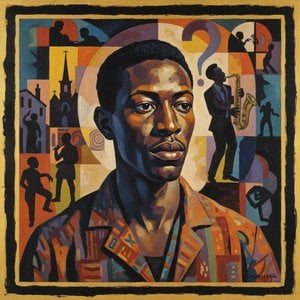
The Artistic Journey of Merton Simpson
Born in Charleston, South Carolina, Merton Simpson’s relationship with art began during his childhood while recovering from diphtheria and rheumatic fever. His early sketches and doodles eventually caught the attention of local artist William Halsey, who mentored him for four years, introducing him to the foundations of painting and the concept of abstract art. After graduating from Burke High School in 1949, Simpson moved to New York City, where he attended New York University and Cooper Union. During his time in New York, he worked in the frame shop of Herbert Benevy, a place where he encountered many well-known artists who critiqued his work and developed relationships with him.
Simpson’s service in the Air Force saw him working as an official Air Force artist, where he painted portraits of military commanders, including General Dwight D. Eisenhower. Following his service, he returned to his studies at NYU. His reputation grew through exhibitions at the Museum of Modern Art and the Guggenheim Museum, eventually leading to a one-person exhibition at the Bertha Schaefer Gallery in 1955.
Style and Legacy
Simpson’s artistic evolution was marked by significant shifts in style. In the 1960s, influenced by the social and political movements of the decade and the Harlem Riot of 1964, he created the Confrontation series, which featured schematized black and white faces in intense encounters. He was also a member of the Spiral arts alliance, a group formed in 1963 by African-American artists to discuss political and social issues.
Beyond his own canvas, Simpson became a prominent dealer of traditional African and tribal art, establishing the Merton D. Simpson Gallery. His interests were deeply connected to both modern and indigenous art forms. In addition to his visual art, Simpson was a passionate musician, playing the saxophone, tenor sax, clarinet, and flute, performing with various jazz groups and ensembles.
Kysymykset ja vastaukset
Voinko selata Merton Simpson teoksia väripaletin mukaan?
Merton Simpson'n teoksia voi selata väripaletin mukaan taiteilijan Väripalettien mukaan -sivulla.
Mistä voin löytää tilastoja Merton Simpson teoksista?
Merton Simpson-artistille on olemassa Tilastot-sivu, joka esittää tilastoja artistin teoksista tämä sivusto-sivustolla.
Mistä voin nähdä Merton Simpson'n teokset aikajärjestyksessä?
Merton Simpson'n teokset ovat nähtävissä aikajärjestyksessä artistin Teosten aikajana -sivulla.
Onko Merton Simpson esitelty aikajärjestyksessä?
Merton Simpson-taiteilijan Ura kronikka on vieritettävä aikajana, joka esittää taiteilijan teokset kronologisessa järjestyksessä jaettuna uravaiheita vastaaviin lukuihin.