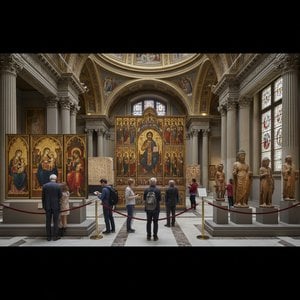
A Soul Illuminated Through Faith and Resilience
The life of Ladislav Záborský (1921–2016) stands as a profound testament to the indomitable nature of the human spirit when anchored by unwavering conviction. Born in the quiet town of Tisovec, Slovakia, Záborský did not merely paint scenes; he sought to capture the very essence of the divine. His journey was one of extraordinary creative heights and devastating personal trials, a duality that would eventually define his unique contribution to Slovak art history. To look upon his work is to witness a dialogue with eternity, where every brushstroke serves as an attempt to discover God amidst the shadows of earthly suffering.
His artistic foundation was laid through rigorous formal training at the Drawing and Painting Department of the Bratislava Technical University. Under the mentorship of legendary Slovak masters such as Martin Benka, Gustáv Mallý, and Ján Mudroch, Záborský honed a technical mastery rooted in classical draughtsmanship. This period of education provided him with the tools to translate complex theological narratives into visual realities. However, his life took a much more turbulent path than that of a traditional academic painter. Following his marriage to Gabriela Bartošová in 1945, he began a career as a high school teacher in Martin, but his outspoken religious devotion placed him directly in the crosshairs of the oppressive communist regime.
The Crucible of Imprisonment and Creative Rebirth
The mid-20th century in Czechoslovakia was a period of intense persecution for those whose loyalties lay with the Church. For Záborský, this resulted in a harrowing seven-year imprisonment between 1953 and 1957. Confined within the grim walls of prisons in Ružomberok, Prague, and Valdice, he endured interrogation, intimidation, and the crushing weight of solitary confinement. Yet, it was within this very darkness that his creative spirit underwent a profound metamorphosis. During five months of isolation, the artist turned inward, composing thirty poems that served as a spiritual chronicle of his dialogue with God. This period of intense suffering did not break his resolve; instead, it distilled his artistic purpose, transforming him from a skilled painter into a visionary chronicler of faith.
Upon his release, barred from returning to his teaching profession due to his political and religious standing, Záborský found new avenues for expression. He turned his talents toward book illustration, where he could continue to weave narrative and meaning through graphic precision. This era of his life was marked by a resilient adaptation, using the medium of print to bypass the limitations placed upon him by the state. His work during these years reflects a man who refused to let his voice be silenced, finding beauty and rhythm in the very act of storytelling.
A Legacy Written in Light and Glass
The true zenith of Záborský’s career lies in his monumental contributions to sacred spaces. He emerged not just as a painter, but as a church artist whose work redefined the spiritual atmosphere of numerous sanctuaries. His most enduring achievements are found in the breathtaking stained glass windows he designed for twenty-five churches across Slovakia and Moravia. These works act as vessels for light, where the interplay of color and translucency brings biblical narratives to life, casting a celestial glow upon the faithful. Alongside these windows, his ambitious installations of the Stations of the Cross—totaling twenty-one sets—stand as profound meditations on the passion and sacrifice of Christ.
Ultimately, the historical significance of Ladislav Záborský transcends the boundaries of religious iconography. He remains a singular figure who bridged the gap between classical technique and deeply personal, spiritual expression. His life serves as a bridge between the traditional Slovak landscape painting of his mentors and a more introspective, symbolic modernism driven by existential necessity. Through his resilience, he ensured that even in an era of profound darkness, the light of faith would continue to be captured, preserved, and shared through the enduring power of art.
Kysymykset ja vastaukset
Onko Ladislav Záborský teoksista saatavilla täydellinen lista?
Voit selata kaikkia tämä sivusto-sivuston Ladislav Záborský teoksia artistin Kaikki teokset -sivulta.
Mistä voin nähdä Ladislav Záborský teosten väriprofiilin?
Ladislav Záborský:n teosten värien käyttö tämä sivusto-sivustolla on tarkasteltavissa artistin Paletin sielunmaisema -sivulla.
Miten Ladislav Záborskýn taide kehittyi ajan myötä?
Ladislav Záborský'n ura avautuu vaihe vaiheelta artistin Ura kronikka -sivulla: vaakasuuntainen aikajana teoksista, ryhmiteltynä uravaiheiden mukaisiin lukuihin.