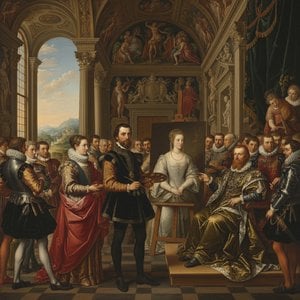
A Life in Color and History
Born in Linz, Austria, Josef Munsch began his professional journey working as a gilder in his father's shop. His artistic talent eventually led him to the Munich Academy, where he was encouraged by Philipp Foltz. After receiving a travel scholarship to Italy, he settled in Munich, where he became a prominent history and genre painter. His work often captured significant historical moments, such as the death of Rudolf of Habsburg or the murder of the Duke of Guise.
Munsch's versatility allowed him to move between grand historical scenes and intimate genre paintings. He contributed to the decoration of several royal residences, including the castles of Ludwig II, such as Neuschwanstein, and the palaces of Herrenchiemsee. His ability to render detailed scenes earned him comparisons to the German Meissonier in his later years, particularly as he turned toward small-scale paintings and shadow pictures.
Artistic Legacy and Works
Throughout his career, Munsch's repertoire expanded from large-scale historical compositions to delicate genre scenes. His notable works include:
His paintings were widely recognized, appearing in contemporary illustrations like Die Gartenlaube and being exhibited in major cities including Munich, Vienna, Berlin, Paris, and London. He was also a member of the Polytechnical Association in Munich and served on the jury for the Munich Annual Exhibition at the Glaspalast.
Kysymykset ja vastaukset
Missä kaupungissa ja maassa Josef Munsch on syntynyt?
Josef Munsch on syntynyt Linz, Austria.
Miten löydän teoksia artistilta Josef Munsch tietyn väripaletin mukaan?
Väripalettien mukaan-sivulla Josef Munsch:n teokset on ryhmitelty niiden väripalettien mukaan.
Missä ja minä vuonna Josef Munsch on syntynyt?
Josef Munsch syntyi Linzssä vuonna 1832.
Miten löydän kaikki Josef Munsch teokset tietyssä tekniikassa?
Josef Munsch:n teoksia voi selata tekniikan mukaan artistin Kaikki tekniikat -sivulla.