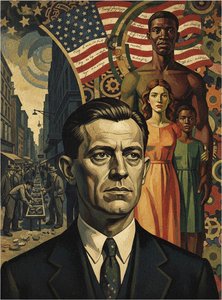
Benjamin Kopman: A Painter of American Grit
Benjamin Kopman (1887-1965) wasn’t a name that frequently graces the hallowed halls of art history, yet his canvases hold a remarkable power—a raw, unflinching portrayal of American life in the early 20th century. Born in Vitebsk, Russia, and immigrating to the United States with his family as a young boy, Kopman’s artistic journey was shaped by displacement, observation, and a deeply rooted connection to the working class. His work, often characterized by its stark realism and distinctive use of bold outlines, offers a poignant glimpse into a nation undergoing rapid transformation – a world of bustling cityscapes, humble farms, and the quiet dignity of everyday laborers.
Kopman’s early artistic training occurred at the Pennsylvania Academy of Fine Arts in Philadelphia. This period proved crucial, exposing him to the principles of academic realism while simultaneously fostering an independent approach. However, it was his time spent working as a stage designer for traveling circuses and fairs that profoundly influenced his style. These experiences immersed him in the vibrant chaos of American popular culture—the spectacle of performers, the energy of crowds, and the faces of those who toiled behind the scenes. This immersion translated directly into his paintings, imbuing them with an immediacy and a sense of authentic observation rarely found in more formal artistic circles.
A defining characteristic of Kopman’s oeuvre is his masterful depiction of portraiture, particularly of working-class individuals. His subjects weren't idealized heroes; they were ordinary men and women—farmers, factory workers, circus performers – rendered with a remarkable sensitivity and attention to detail. His self-portraits, in particular, reveal a contemplative artist grappling with his own identity and the complexities of his life. The ‘Self Portrait’ (1920s) is a particularly revealing example, showcasing his ability to capture not just physical likeness but also an underlying sense of melancholy and introspection. His use of dark outlines, reminiscent of artists like Rousseau and Roualt, served to emphasize form and create a dramatic effect, drawing the viewer's eye to key features and adding a layer of emotional intensity.
Among his most celebrated works is ‘The Organist’ (circa 1920s), a scene brimming with life and detail. The painting captures a moment within a bustling circus – an organist lost in his performance, surrounded by a captivated audience. It's not merely a snapshot; Kopman imbues the scene with a palpable sense of atmosphere, conveying the excitement, the noise, and the collective experience of the spectacle. Similarly, ‘Man with Cap’ (circa 1920s) offers a quiet study in observation, presenting a weathered farmer contemplating his surroundings – a testament to the enduring spirit of rural America.
Kopman's artistic output extended beyond portraiture and scenes of popular entertainment. He also produced evocative depictions of American landscapes and urban settings. His work reflects a deep appreciation for the beauty found in the commonplace, transforming ordinary subjects into compelling works of art. During the Great Depression, Kopman contributed to the Works Progress Administration (WPA), further solidifying his commitment to documenting the realities of American life. This period saw him working on numerous public murals and creating thousands of paintings, offering a valuable record of the era.
Legacy and Influence
Despite not achieving widespread fame during his lifetime, Benjamin Kopman’s legacy endures through his powerful and enduring artwork. His distinctive style—characterized by bold outlines, realistic detail, and an empathetic portrayal of working-class subjects—has resonated with art historians and collectors alike. His work is held in prestigious collections including the Whitney Museum of American Art, the Brooklyn Museum, and the Pennsylvania Academy of Fine Arts, a testament to its artistic merit and historical significance.
Furthermore, Kopman’s story serves as an important reminder of the diverse voices within American art history. An immigrant artist navigating a rapidly changing nation, he offered a unique perspective on the social and cultural landscape of his time. His paintings continue to invite viewers to contemplate the lives of ordinary Americans—a poignant reflection on the values, struggles, and enduring spirit of the United States.
Sources:
- Benjamin Kopman - Whitney Museum of American Art: https://whitney.org/artists/717
- Benjamin Kopman | RoGallery: https://www.rogallery.com/artists/benjamin-kopman/
- Benjamin Kopman - UAG collection: https://collections.uag.pitt.edu/Detail/entities/883
- Benjamin Zuskin: https://en.wikipedia.org/wiki/Benjamin_Zuskin
Kysymykset ja vastaukset
Millä muilla nimillä tai nimimerkeillä Benjamin Kopman tunnetaan?
Benjamin Kopman tunnetaan myös nimellä Benjamin D. Kopman, Kopman.
Voinko tutkia Benjamin Kopman teoksia aiheen mukaan?
Benjamin Kopman:n teoksia voi tutkia aiheen mukaan artistin Aiheatlas -sivulla.
Miten Benjamin Kopmanin ura on jaettu eri aikakausiin?
Benjamin Kopman'n ura avautuu vaihe vaiheelta artistin Kronikka -sivulla: vaakasuuntainen aikajana teoksista, ryhmiteltynä uravaiheiden mukaisiin lukuihin.