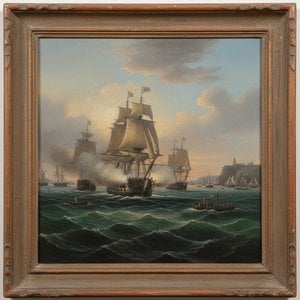
The Maritime Documentarian
Alexander C. Stuart was a painter of precision, a man whose brush was as much a tool of record as it was an instrument of art. He did not merely paint ships; he documented a transformative era of naval engineering. His work carries the weight of technical accuracy, a necessity born from a life spent navigating the intersection of military service and industrial progress. To look at a Stuart work is to see the specific mechanics of the mid-19th century, captured by a man who understood the anatomy of a vessel from the inside out.
His perspective was shaped by direct experience. Before he was an illustrator, he was a man of action, having served in the British Army during the Crimean War and the Indian Mutiny. This background provided a discipline that translated directly into his maritime subjects. He moved from the battlefield to the naval yards of the United States, serving in the Marines and the Navy until 1866. This transition from soldier to artist was not a change in character, but a change in medium.
A Life of Technical Precision
Stuart’s career was defined by his proximity to the iron and steam that changed warfare and commerce. His value to history lies in his ability to translate the complex lines of shipbuilding into visual reality. He worked in the shipyards near the Delaware River, a hub of industrial activity, where his eye for detail became a professional asset. His employment by major firms provided him with a steady subject and a clear purpose.
His professional trajectory included several distinct phases:
- His tenure with John Roach & Son in Chester from 1872 to 1880.
- His work for Harlan & Hollingsworth in Wilmington, Delaware.
- His period as a physician in Eustis, Florida.
- His final years spent painting marine subjects in Camden, New Jersey.
These roles were not mere detours. His time with shipbuilding companies allowed him to produce illustrations of early iron steamships that remain vital documentary sources today. He captured the transition from wood and sail to iron and steam with a clarity that purely imaginative painters could never achieve.
The Final Record
The later years of Stuart's life were marked by a shift in geography and a decline in financial stability, yet his focus remained fixed on the sea. From the bustling shipyards of the Delaware to the quieter stretches of New Jersey, he continued to document the maritime world. His work, such as his 1862 depiction of the Merrimac Sinking the Cumberland, serves as a factual anchor to a chaotic period of naval history. He was a specialist who understood that a ship is more than a silhouette; it is a machine of wood, iron, and intent.
Kysymykset ja vastaukset
Missä kaupungissa ja maassa Alexander C. Stuart on syntynyt?
Alexander C. Stuart on syntynyt Glasgow, United Kingdom.
Mistä voin nähdä Alexander C. Stuart teosten väriprofiilin?
Alexander C. Stuart:n teosten värien käyttö tämä sivusto-sivustolla on tarkasteltavissa artistin Paletin sielunmaisema -sivulla.
Missä ja minä vuonna Alexander C. Stuart on syntynyt?
Alexander C. Stuart syntyi Glasgowssä vuonna 1831.