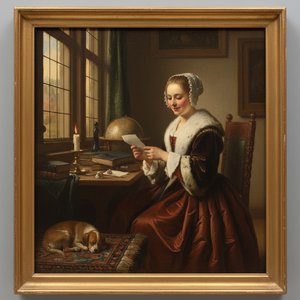
The Leiden Genre Tradition
Abraham de Pape belongs to that specific, disciplined lineage of Dutch painters who found meaning in the mundane. Operating out of Leiden, he did not chase the grandiosity of history painting but focused instead on the quiet, often gritty realities of domestic life. His work reflects a period where the depiction of everyday labor and household objects carried significant weight. He was a draftsman and a painter who understood the mechanics of light and the texture of a lived-in room.
His technical foundation was built under the direct supervision of Gerrit Dou. This apprenticeship in 1644 was no mere formality; it dictated the precision of his execution. By studying under Dou, de Pape inherited a commitment to the fine details that defined the Leiden fijnschilder style. He took these lessons and applied them to the genre scenes that would define his output, focusing on the physical presence of his subjects.
Technical Focus and Subject Matter
De Pape’s output is characterized by a focus on the human condition through the lens of domesticity. He did not rely on spectacle. Instead, he utilized the following elements to construct his compositions:
- The depiction of elderly figures engaged in routine tasks.
- The careful rendering of interior spaces and light.
- The use of oil on panel to achieve specific textures.
- A focus on genre subjects such as spinning or food preparation.
His work, such as Old Woman Plucking a Cock, demonstrates a preoccupation with the tactile. He captured the specific weight of a bird or the way light hits a weathered face. This was not about idealization. It was about the reality of the moment, captured with a draftsman's eye for accuracy.
Historical Placement
The significance of de Pape lies in his adherence to the stylistic rigor of his era. He died in Leiden in 1666, leaving behind a body of work that remains a clear example of mid-seventeenth-century Dutch genre painting. His paintings, like The repast, exist as physical records of the visual language used by the Leiden school. He was a practitioner of a specific, highly skilled method of observation that prioritized the tangible over the imagined.
Kysymykset ja vastaukset
Mistä voin nähdä Abraham de Pape's teokset 3D-galleriassa?
Abraham de Pape'n teoksia voi ihailla 3D-galleriassa artistin 3D-galleria -sivulla.
Miten Abraham de Papein ura on jaettu eri aikakausiin?
Abraham de Pape:n tuotanto esitellään kronologisesti taiteilijan Ura kronikka -sivulla, jossa teokset etenevät luomisjärjestyksessä luku luvulta.
Missä ja minä vuonna Abraham de Pape on syntynyt?
Abraham de Pape syntyi Leidenssä vuonna 1620.