

 Esikatselu
 Jaa teos
 Jaa
Jaa
 Tiedot
 Opas
Opas

 Lataa kuva
 Samanlaisia kohteita
 Röntgenkuvaus
 Diaesitys
 Kysymykset ja vastaukset
 Tilastot
Trinity (detail)


 Lue lisää
Giclée- ja taideprintit
Museolaatuisia giclée- tai kankaitaulun tulosteita nopealla tuotannolla ja joustavilla viimeistelyvaihtoehdoilla. ( Osta käsinmaalattu taideteos Siirry digitaaliseen kuvaan)




P118B €10

P118H €10

P118W €10

P438Z €10

P508JH €12

P508YH €12

P805H €10

P805Z €10

P919BZ €10

P919G €10

P919XJ €10

P959ZH €10

P968JZ €12

W106C €8

W218G €10

W218JH €8

W218Y €10

W307PJ €10

W316G €10

W316PJ €8

W316Y €10

W398PJ €8

W4111J €10

W500HY €15

W500JH €15

W692G €12

W849H €8

W940BG €15

W953PJ €8




Valitse valmiista mitoistamme sellaiset, jotka vastaavat teoksen alkuperäisiä mittasuhteita.

Syötä tarvitsemasi leveys ja korkeus, jotta tuloste sopii kehyksiisi tai seinällesi. Tulostetta voidaan vain leikata, sitä ei voida koskaan suurentaa alkuperäistä kuvaa suuremmaksi, joten eri muotoinen koko aiheuttaa osan kuvasta katoamisen. Lähetämme sinulle digitaalisen mallikuvan hyväksyttäväksi ennen kuin aloitamme tulostuksen. Tällä sivulla näkyvä kuva ei näytä lopullista rajausta — vain mallikuva näyttää sen.
Maailmanlaajuinen toimitus () 2 viikossa tavallisen 4–5 viikon sijaan. (8 marraskuu)

Ilmainen pikatoimitus ympäri maailman

Korkealaatuinen pellavakangas

Kattava kuljetusvakuutus

Tulliveron palautustakuu

Takuu täydellisestä värien vastaavuudesta

100 päivän palautusoikeus (vain valmistusvirheet)

100% rahat takaisin -takuu

Määräalennus tarjolla
 Lasivaihtoehto on saatavilla vain alle 110 cm kokoisille teoksille

Trinity (detail)
Giclée- ja taideprintit
Replikaatin koko
-


Kokonaishinta
€ 56
The Trinity (Detail): A Dawn of Renaissance Realism
Masaccio’s “Trinity (detail),” housed within the magnificent Santa Maria Novella in Florence, isn't merely a fresco; it’s a pivotal moment in art history – a visual manifesto declaring the arrival of the High Renaissance. Painted between 1425 and 1427, this intimate section captures the essence of Masaccio’s revolutionary approach to depicting reality, a departure from the stylized elegance of the preceding Gothic era and a profound influence on generations of artists to come. The scene, centered around an elder figure representing God the Father, is imbued with a startling sense of depth, volume, and emotional resonance that was unprecedented for its time.
The fresco’s immediate impact lies in its masterful use of linear perspective. Masaccio didn't simply depict space; he created it – a meticulously constructed illusion of three-dimensionality that draws the viewer directly into the scene. The architecture, modeled after Roman precedents and likely informed by Filippo Brunelleschi’s groundbreaking experiments with perspective, recedes realistically towards a vanishing point, anchoring the figures within a believable environment. This isn't a flat surface; it’s a stage where forms exist in relation to each other, creating an astonishingly convincing sense of space.
A Symphony of Color and Light
Masaccio’s palette is restrained yet remarkably effective. Earth tones – ochres, siennas, and umbers – dominate the composition, lending it a dignified solemnity. However, within this muted range, he skillfully employs chiaroscuro—the dramatic interplay of light and shadow—to sculpt the figures and define their forms. The light source, emanating from an unseen point above and to the right, casts deep shadows that accentuate the musculature of the Father’s body, imbuing him with a palpable sense of weight and presence. This subtle manipulation of light isn't merely decorative; it’s integral to Masaccio’s goal of creating realistic figures that appear to exist within a tangible world.
The figure of the Father is particularly striking. His face, rendered with astonishing detail – the furrowed brow, the thoughtful gaze—conveys an intense contemplation. He isn't depicted as a distant deity but as a human being grappling with profound questions. The folds of his garment are meticulously modeled, demonstrating Masaccio’s mastery of drapery and his commitment to accurately representing the texture and weight of fabric.
Symbolism and Spiritual Depth
Beyond its technical brilliance, “Trinity (detail)” is rich in symbolic meaning. The central figure represents God the Father, while the dove hovering above symbolizes the Holy Spirit. The presence of Mary and Saint John—both deeply revered figures within Christian iconography—adds layers of spiritual significance to the scene. The inclusion of a *memento mori* – a reminder of death – beneath the depiction of the Trinity serves as a poignant counterpoint, reminding viewers of the ephemeral nature of earthly existence and the importance of seeking salvation.
The donor figures flanking the central archway are particularly intriguing. Their placement within the architectural framework suggests that they represent patrons who commissioned the fresco—likely members of the Florentine elite. The gesture of prayer, with their hands raised in supplication, underscores the devotional purpose of the artwork and its intended audience.
A Legacy of Innovation
Masaccio’s “Trinity (detail)” represents a watershed moment in art history. It marked a decisive shift away from the stylized conventions of the Gothic era and toward a more naturalistic and intellectually rigorous approach to painting. His innovations in perspective, his mastery of chiaroscuro, and his profound understanding of human anatomy profoundly influenced artists like Leonardo da Vinci and Michelangelo, shaping the course of Western art for centuries to come. Reproductions of this masterpiece offer a unique opportunity to experience firsthand the genius of one of the Renaissance’s most visionary painters.
Additional Research:
Kysymykset ja vastaukset
Onko teoksessa "Trinity (detail)" voimakkaita valon ja varjon kontrasteja?
Teoksen Masaccio:n "Trinity (detail)" kontrastitaso on Gentle.
Miten teoksen "Trinity (detail)" tyyli suhteutuu sen tekijän aikakauteen?
Teoksessa Masaccio:n "Trinity (detail)" Early Renaissance-suuntaus ja Renessanssi-aikakausi kohtaavat.
Milloin ja mihin tyylisuuntaan "Trinity (detail)" on tehty?
Masaccio:n "Trinity (detail)" on peräisin vuodelta 1425 ja edustaa tyylisuuntaa Early Renaissance.
Samankaltaisia teoksia


![Stanze Vaticane - The Parnassus (detail) [07] — Rafael, High Renaissance](/media/artworks/images-thumb/3c/a1/3ca1620e84d3f2fe4e94d9bb954e0eca.jpg)


Taiteilijan elämäkerta
Masaccio (1401-1428): The Dawn of Renaissance Realism
Tommaso di Ser Giovanni di Simone Cassai, better known as Masaccio (meaning "clumsy Tom"), was a pivotal figure in the Early Italian Renaissance. Born on December 21, 1401, in San Giovanni Valdarno, Italy, and dying tragically young in 1428, his brief career revolutionized painting with groundbreaking realism, perspective, and chiaroscuro (the use of strong contrasts between light and dark). Despite his short life, Masaccio’s impact on subsequent generations of artists was profound, establishing a new standard for naturalism and influencing the course of Western art.Early Life and Training
Masaccio's origins were humble; he descended from Ser Giovanni di Mone Cassai, a notary, and Jacopa di Martinozzo di Dino. His family name, Cassai, derived from his paternal grandfather’s trade as a cabinet maker – a craft that would subtly inform Masaccio’s meticulous attention to detail in his artwork. Orphaned at age five when his father succumbed to illness, Masaccio was cared for by his brother Giovanni (Lo Scheggia), who also pursued a vocation in art. The specifics of Masaccio's artistic training remain shrouded in mystery – an unusual circumstance considering the prevailing practices of Renaissance artists. Scholars believe he likely apprenticed around the age of 12, but definitive documentation regarding his master has proven elusive. This lack of verifiable mentorship contributes to the enduring fascination surrounding his rapid ascent to mastery and the astonishing innovation of his techniques. He joined the painters’ guild (Arte de’ Medici e Speziali) in Florence on January 7, 1422, marking his emergence as an independent artist and signaling a decisive step away from the patronage system that dominated artistic life at the time.Artistic Development and Major Works
Masaccio's artistic journey began under the influence of Giotto di Bondone – a predecessor who championed naturalism and imbued his frescoes with palpable emotion. However, Masaccio swiftly surpassed Giotto’s achievements in mastering perspective and anatomical accuracy. He was particularly captivated by Filippo Brunelleschi’s rediscovery of linear perspective, recognizing its transformative potential for representing three-dimensional space on a flat surface. This intellectual breakthrough fueled his artistic experimentation and propelled him to develop techniques that would redefine the visual language of painting. Masaccio pioneered several groundbreaking innovations:- Linear Perspective: Employed vanishing points with mathematical precision to create an illusion of depth, fundamentally altering how artists depicted reality.
- Chiaroscuro: Masterfully utilized light and shadow to sculpt forms, generating a sense of volume and realism previously unattainable in Medieval art.
- Naturalism: Depicted figures with anatomical detail and expressive gestures, mirroring the humanist ideals that were gaining traction during his time – a departure from stylized representations prevalent earlier in the century.
Historical Significance and Legacy
Masaccio’s legacy extends far beyond the confines of Florence and the Brancacci Chapel. Giorgio Vasari, a prominent Renaissance biographer, eloquently captured Masaccio’s genius, proclaiming him “the best painter of his generation” due to his unwavering commitment to imitating nature and conveying human emotion with breathtaking realism. His groundbreaking techniques irrevocably altered artistic conventions, establishing a new standard for naturalism that resonated throughout Europe. He served as an inspiration for artists like Leonardo da Vinci and Michelangelo—who diligently studied Masaccio’s frescoes—and cemented his place as one of the foundational figures of Western art history. Despite his untimely demise at the age of 26 – circumstances surrounding which remain obscure – Masaccio's brief but brilliant life ensured that his artistic innovations would endure for centuries to come, shaping the trajectory of Renaissance painting and profoundly impacting the visual culture of Europe.
Masaccio
1401 - 1429 , Italia
Pähkinänkuoressa
- Artistic Movement Or Style: Early Renaissance
- Artists Who Influenced This Artist:
- Giotto
- Filippo Brunelleschi
- Date Of Birth: 21. joulukuuta 1401
- Full Name: Tommaso di Ser Giovanni di Simone Guidi Cassai
- Nationality: Italian
- Notable Artworks:
- Brancacci Chapel fresk.
- Pyhä Johannes
- Kristuksen Poika ja Pyhä Anna
- Place Of Birth: San Giovanni Valdarno, Italia
Aiheeseen liittyvät artikkelit

The Enduring Legacy of Fresco: Technique, History & Artistic Expression Across Cultures
Explore the rich history & enduring legacy of fresco painting! Discover ancient techniques, Giotto's masterpieces, and modern applications. Expert insights for art lovers & professionals.

Masaccio: Revolutionizing Renaissance Painting Through Innovation & Emotional Realism
Explore the revolutionary art of Masaccio, the first great Italian Renaissance painter. Discover his groundbreaking techniques in perspective, realism & emotional depth – a pivotal figure shaping Western art history.

Taide, joka elää kanssasi: Räätälöidyn sisäfreskon emotionaalinen voima
Tutustu freskon emotionaaliseen voimaan ja sen kykyyn kertoa tarinoita kodissasi. Räätälöidyt seinämaalaukset luovat ainutlaatuisen tunnelman. Lue asiantuntija-artikkelimme!

The Enduring Legacy of Fresco Painting: Techniques, History & Contemporary Relevance
Explore the rich history & enduring artistry of fresco painting – from Giotto to Michelangelo! Discover techniques, conservation efforts, & modern applications. Learn how ArtsDot brings this timeless art form to your home.
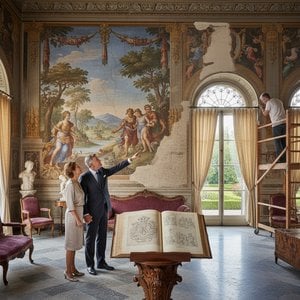
Fresko perinnön vartijana: Maalaa sukuhistoriasi seinille
Elävöitä sukuhistoriasi upeilla freskoilla! Opas seinämaalausten suunnitteluun, symboliikkaan ja toteutukseen. Inspiraatiota ja vinkkejä perintösi vaalimiseen.


