


 Lähetä
 Jaa
Jaa
 Tarkemmat tiedot
 Opas
Opas

 Lataa kuva
 Samanlaisia kohteita
 Diaesitys
 Tilastot
Block for printing textiles
 Textile
- Celtic-inspired design
 1905
1905 14.0 x 11.0 cm
 Palazzo Fortuny
 Lue lisää
Giclée- ja taideprintit
Museolaatuisia giclée- tai kankaitaulun tulosteita nopealla tuotannolla ja joustavilla viimeistelyvaihtoehdoilla. ( Tilaa käsinmaalattu jäljennös Siirry digitaaliseen kuvaan)




































Valitse valmiista mitoistamme sellaiset, jotka vastaavat teoksen alkuperäisiä mittasuhteita.

Voit syöttää omat mitat sopiaksesi tiettyyn kehykseen tai tilaan. Jos valittu koko ei vastaa alkuperäisen kuvan mittasuhteita, rajaamme teosta tai laajennamme kuvaa peilatulla tai yhtenäisellä reunalla. Digitaalinen mallikuva lähetetään hyväksyttäväksi ennen tuotannon aloittamista.
Huomaathan, että näytöllä näkyvä esikatselu ei vastaa lopullista rajausta tai laajennusta. Vain mallikuva näyttää lopullisen sommittelun tarkasti.
Vaikka räätälöityjä kokoja on saatavilla, suosittelemme valitsemaan mitat valmiista listasta alkuperäisten mittasuhteiden säilyttämiseksi.
Maailmanlaajuinen toimitus () 2 viikossa tavallisen 4–5 viikon sijaan. (26 syyskuu)

Ilmainen pikatoimitus ympäri maailman

Korkealaatuinen pellavakangas

Kattava kuljetusvakuutus

Tulliveron palautustakuu

Takuu täydellisestä värien vastaavuudesta

100 päivän palautusoikeus valmistusvirhetapauksissa

100% rahat takaisin -takuu

Määräalennus saatavilla
 Lasivaihtoehto on saatavilla vain alle 110 cm kokoisille teoksille

Block for printing textiles
Giclée- ja taideprintit
Replikaatin koko
-


Kokonaishinta
$ 62
A Fragment of Ancient Echoes: Mariano Fortuny’s ‘Block for Printing Textiles’
Within the hushed galleries of art history resides a deceptively simple object – a wooden block, carved with an intricate dance of geometric forms and subtly suggestive Celtic motifs. This is not merely a tool; it's a portal to a bygone era, a tangible link to the artistic ingenuity of Mariano Fortuny y Madrazo, a Spanish polymath whose vision transcended mere decoration. Fortuny’s ‘Block for Printing Textiles’ (1905), now meticulously reproduced in exquisite detail, offers a glimpse into his revolutionary approach to design and theatrical lighting, revealing a mind deeply influenced by both ancient traditions and the burgeoning innovations of the early 20th century.
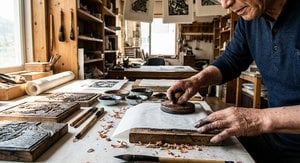
The block itself is crafted from boxwood, a material prized for its density and ability to retain fine details. Its surface isn’t smooth; rather, it bears the marks of deliberate carving – deep grooves that would have held the inked patterns during the printing process. The design is remarkably restrained yet profoundly evocative. Dominating the block are two opposing faces, each presenting a stylized human form, seemingly caught in an eternal embrace or contemplation. These aren’t literal representations; they're abstracted figures, hinting at themes of duality, balance, and perhaps even the interplay between masculine and feminine energies – a recurring motif throughout Fortuny’s oeuvre.
The Weaver of Light and Shadow: Fortuny’s Theatrical Legacy
To fully appreciate this block, one must understand Fortuny's broader artistic ambitions. Born in Granada in 1871, he inherited his father’s legacy as a painter but quickly developed an insatiable curiosity for diverse crafts – from sculpture and architecture to photography and stage lighting. His fascination with the theatre, particularly the work of Richard Wagner, proved transformative. Fortuny recognized that traditional theatrical design relied on jarring transitions between scenes, disrupting the immersive experience he envisioned. He sought to create a seamless flow, mimicking the natural progression of light and shadow.
This quest led him to develop the “Fortuny cyclorama dome,” a revolutionary device that utilized indirect lighting reflected off various surfaces to eliminate harsh shadows and create a continuous, atmospheric illumination across the stage. His treatise, ‘Eclairage Scenique’ (1904), meticulously documented his discoveries – a radical departure from conventional stage design. The block for printing textiles wasn't simply a decorative element; it was intrinsically linked to this larger project, serving as a visual representation of the geometric principles underpinning his lighting system. The precise patterns carved into the wood mirrored the complex interplay of light and shadow he sought to achieve on stage.
Roots in Ancient Techniques: Woodblock Printing’s Enduring Allure
Fortuny's work is deeply rooted in the rich history of woodblock printing, a technique that stretches back millennia. From its origins in ancient China – where it was used for both textiles and paper – to its flourishing in Japan (ukiyo-e prints), this method has served as a powerful tool for artistic expression. The block itself embodies this legacy: a testament to the skill of artisans who patiently carved intricate designs into wood, preparing them for the application of ink and subsequent transfer onto fabric.
Consider the influence of traditional Japanese ukiyo-e prints, characterized by bold outlines, flat planes of color, and a focus on capturing fleeting moments of beauty. While Fortuny’s style is distinctly his own – incorporating elements of Celtic design and a refined European aesthetic – one can discern echoes of this ancient tradition in the block's composition and its emphasis on geometric abstraction. The careful consideration given to the carving process itself speaks volumes about the dedication and artistry involved.
A Timeless Echo: Reproduction and Artistic Resonance
Today, ‘Block for Printing Textiles’ is brought back to life through meticulous hand-painted reproductions. These aren't mere copies; they are faithful interpretations that capture the essence of Fortuny’s original vision. The subtle variations in color, texture, and detail reflect the inherent imperfections of the handcrafted process – a reminder that each reproduction possesses its own unique character.
Whether adorning a contemporary interior or serving as a focal point in an art collection, this block offers more than just visual appeal. It’s a window into the mind of a visionary artist, a celebration of ancient techniques, and a testament to the enduring power of design to evoke emotion and inspire contemplation. It's a fragment of ancient echoes, brought vividly back to life.
Samankaltaisia teoksia


Taiteilijan elämäkerta
Early Life and Inspiration
Mariano Fortuny, a name synonymous with theatrical innovation and exquisite textiles, was born in Granada, Spain, on May 11, 1871. His early life was marked by profound loss – his father, Mariano Fortuny y Marsal, a respected genre painter, tragically died when the young boy was just three years old. This event spurred his family’s relocation to Paris, France, where his mother, Cecilia de Madrazo, exposed him to the world of textiles and fabrics, laying the foundation for his future artistic endeavors. From a remarkably young age, Fortuny demonstrated an extraordinary talent across various disciplines: painting, photography, sculpting, architecture, etching, and even theatrical stage lighting design. His innate curiosity and inventive spirit quickly became apparent, leading to a series of groundbreaking inventions that would revolutionize the world of theatre.Artistic Talents and Revolutionary Inventions
Fortuny’s artistic journey began with a clear display of skill in multiple mediums. He honed his painting abilities early on, absorbing influences from the burgeoning artistic movements of the time. However, it was his inventive mind that truly set him apart. Between 1901 and 1934, he patented over twenty remarkable inventions – a testament to his relentless pursuit of innovation. Perhaps his most significant contribution was the “fortuny cyclorama dome,” a quarter-dome structure crafted from plaster or cloth designed to create seamless transitions between scenes in theatrical productions. This ingenious device utilized indirect lighting, dramatically altering colors and intensities, and fundamentally changing how stage sets were illuminated. Fortuny’s meticulous treatise, "Eclairage Scenique" (1904), meticulously documented his discoveries regarding reflecting light – a technique that allowed for unprecedented control over the visual experience of a performance. His work wasn't limited to lighting; he also developed innovative methods for creating durable and vibrant dyes, further solidifying his reputation as a true visionary.Collaborations and Recognition
Fortuny’s unique approach quickly garnered widespread recognition in the 1920s. He forged significant collaborations with prominent figures, including the celebrated German composer Richard Wagner, whose operas deeply inspired Fortuny's artistic interpretations of stage design. His work at La Scala opera house in Milan was particularly noteworthy; he adapted his dome for the theater’s vast space and even invented a suction fan to maintain its taut structure – a remarkable feat of engineering for the time. Beyond music, Fortuny’s influence extended to fashion. He worked closely with the influential designer Elsie McNeill Lee, who became his sole distributor in America, introducing his luxurious fabrics and designs to a global audience. His creations, particularly the iconic “Delphos” gown – a flowing, pleated silk garment – became coveted symbols of elegance and sophistication, worn by celebrated figures like Eleonora Duse, Isadora Duncan, and Oona Chaplin.Legacy and Enduring Influence
Mariano Fortuny passed away on May 3, 1949, in Venice, Italy, leaving behind a legacy that continues to resonate today. His work profoundly influenced the French novelist Marcel Proust, who famously described Fortuny’s fabrics as “the tempting phantom of that invisible Venice.” His inventive spirit and artistic vision remain deeply embedded within the world of theatrical design, inspiring generations of stage technicians and designers. The Museo Mariano Fortuny y Madrazo in Venice serves as a testament to his life's work, showcasing his paintings, textiles, and inventions – offering visitors a unique glimpse into the mind of this extraordinary polymath. Fortuny’s story is one of artistic brilliance, technological innovation, and an unwavering dedication to creating immersive and unforgettable experiences for audiences around the world.
Mariano Fortuny
1871 - 1949 , Espanja
Tietoa taiteilijasta
- Artistic Movement Or Style: Orientalismi taide
- Artists Or Movements Influenced By This Artist: ['Marcel Proust']
- Artists Who Influenced This Artist: ['Richard Wagner']
- Date Of Birth: 11 toukokuuta 1871
- Date Of Death: 3 toukokuuta 1949
- Full Name: Mariano Fortuny y Marsal
- Nationality: Espanjalainen
- Notable Artworks:
- Teagown
- Virkailija
- Place Of Birth: Granada, Espanja
Aiheeseen liittyvät artikkelit

The Enduring Legacy of Fine Art Prints: Technique, History & Aesthetic Impact
Explore the rich history & techniques of fine art prints. Discover investment potential, assess authenticity, and learn how to preserve your collection with expert guidance. Trusted insights for discerning collectors.

Mariano Fortuny: A Fusion of Art, Fashion & Design – Exploring a Venetian Innovator's Legacy
Explore the captivating world of Mariano Fortuny – artist, designer & innovator. Discover his revolutionary textiles, iconic Delphos gown, and lasting influence on art, fashion & interiors. A collector's guide to a Venetian master.
The Enduring Legacy of Woodblock Printmaking: Technique, History & Artistic Expression
Explore the rich history of woodblock printmaking – from ancient techniques to Ukiyo-e masterpieces. Discover expert insights on collecting, preserving & appreciating this enduring art form.

Katsushika Hokusain 25 mestariteosta: Ukiyo-e taidetta ja sisustuksen inspiraatiota
Tutustu Katsushika Hokusain 25 mestariteokseen! Ukiyo-e taidetta, Fuji-vuori ja ikoninen Suuri aalto Kanagawassa. Löydä japanilaisen estetiikan kauneus ja inspiroi sisustusta museolaatuisilla taideprintteillä ArtsDot.comissa.

Giclée Prints: Archival Quality & Aesthetic Nuances for the Discerning Collector
Explore the world of giclée prints with ArtsDot. Learn about archival quality, aesthetic nuances & investment potential. Expert guidance for discerning art collectors seeking museum-quality reproductions and lasting value.
