

 Esikatselu
 Jaa
Jaa Jaa
Jaa
 Tarkemmat tiedot

 Lataa
Lataa
 Samanlaisia
 Röntgenkuva
 Diaesitys
Buzzard
 Acrylic On Canvas
- WallArt
- Contemporary Realism
 2005
2005 134.0 x 99.0 cm
 Nasher Museum of Art at Duke University
 Näytä lisää
Käsinmaalattu öljykopio
Käsinmaalattu öljyväri kankaalle haluamassasi koossa ja kehyksissä, taiteilijoidemme valmistamana tilauksesta. ( Osta printti Osta kuva)




P118B $10

P118H $10

P118W $10

P438Z $10

P508JH $12

P508YH $12

P805H $10

P805Z $10

P919BZ $10

P919G $10

P919XJ $10

P959ZH $10

P968JZ $12

W106C $8

W218G $10

W218JH $8

W218Y $10

W307PJ $10

W316G $10

W316PJ $8

W316Y $10

W398PJ $8

W4111J $10

W500HY $15

W500JH $15

W692G $12

W849H $8

W940BG $15

W953PJ $8




Valitse valmiista mitoistamme sellaiset, jotka vastaavat teoksen alkuperäisiä mittasuhteita.

Voit syöttää omat mitat sopimaan tiettyyn kehykseen tai tilaan. Jos valitsemasi koko ei vastaa alkuperäisen kuvan mittasuhteita, rajaamme taideteoksen tai jatkamme maalausta käsin maalatuilla elementeillä. Digitaalinen esikatselu lähetetään hyväksyttäväksi ennen tuotannon aloittamista.
Huomioithan, että näytöllä oleva esikatselu ei vastaa todellista rajausta tai jatkamista. Vain digitaalinen mallikuva näyttää lopullisen sommittelun tarkasti.
Vaikka mittatilaustyöt ovat mahdollisia, suosittelemme valitsemaan mitan ennalta määritetystä listasta alkuperäisten mittasuhteiden säilyttämiseksi.
Tilauksen jälkeen ArtsDot.com -tiimi lähettää asiakkaalle ohjeet ja esikatselukuvan.
Maailmanlaajuinen toimitus () 3–4 viikossa tavallisen 5 viikon sijaan. (19 elokuu). Laadusta ei tingitä.

Ilmainen pikatoimitus ympäri maailman

Korkealaatuinen pellavakangas

Kattava kuljetusvakuutus

Tulliveron palautustakuu

Täydellinen värien vastaavuustakuu

60 päivän palautusoikeus (vain valmistusvirheet)

100% rahat takaisin -takuu

Määräalennus tarjous
 Lasivaihtoehto on saatavilla vain alle 110 cm kokoisina teoksina

Buzzard
Reproduktiotekniikka
Replikaatin koko
-


Kokonaishinta
$ 313
Teoksen kuvaus
Kara Walker’s Buzzard: A Silhouette of History
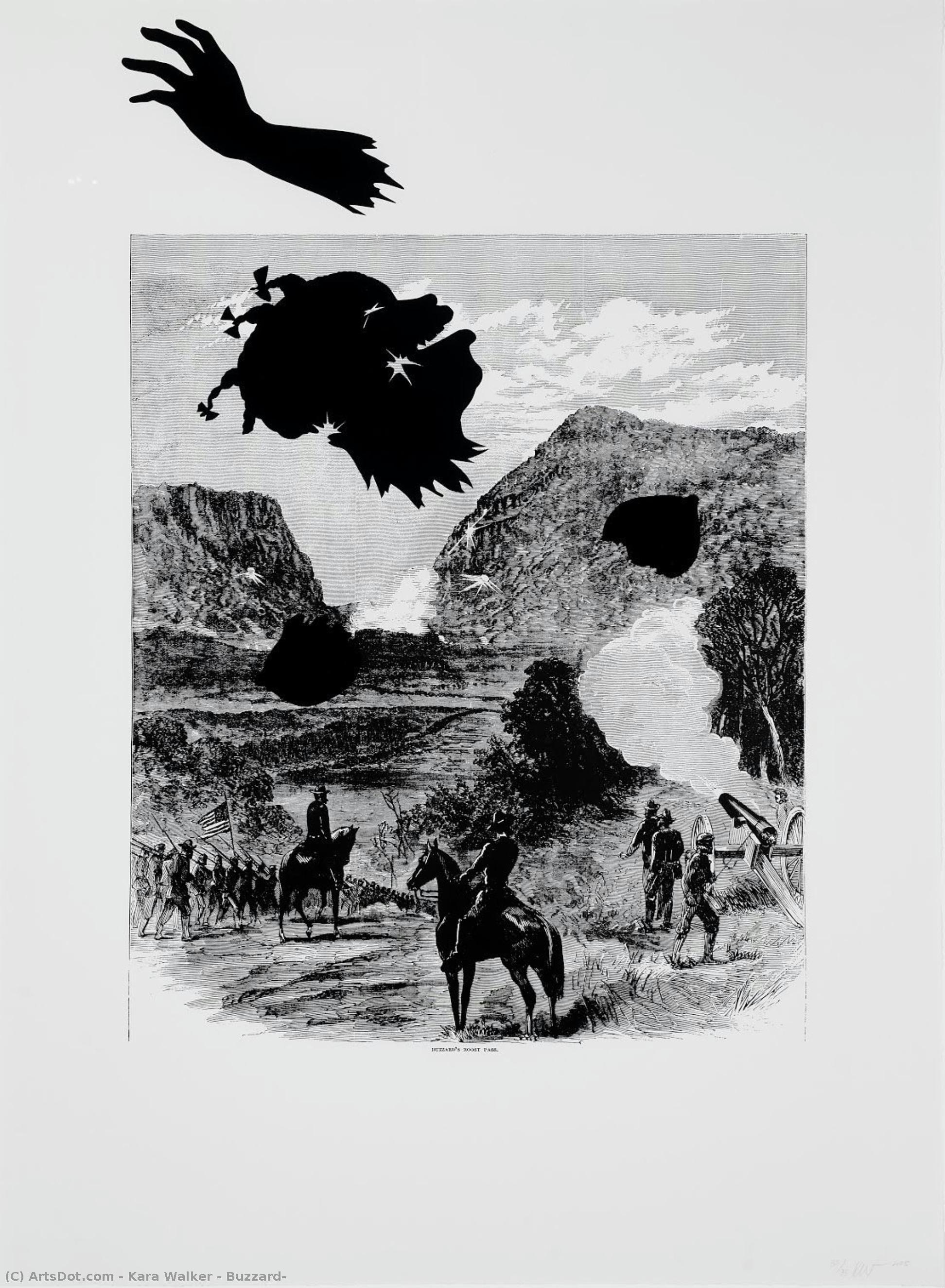
Kara Walker's "Buzzard," created in 2005, isn’t merely a print; it’s a deliberate provocation—a masterful distillation of historical anxieties and racial stereotypes presented through the striking medium of cut-paper silhouette. This piece resides within LeRoy Neiman Center for Print Studies at Columbia University, New York, and was generously purchased with funds from the Print Committee. Its dimensions are substantial – 53 x 39 inches (134.6 x 99.1 cm), showcasing an image of 42 7/8 x 27 13/16 inches (108.9 x 70.6 cm). The photograph captures the essence of Walker’s artistic vision, highlighting the intricate detail achieved through her technique.- Subject Matter & Historical Context: Walker draws inspiration from historical imagery—specifically depictions of westward expansion and frontier narratives—but reimagines them through a critical lens informed by her profound understanding of slavery's legacy in American culture. The buzzard itself serves as a potent symbol, embodying predation and impending doom, mirroring anxieties prevalent during the era of Manifest Destiny.
- Style & Technique: Walker’s signature style is characterized by silhouette artistry—a technique rooted in Victorian-era cut-paper printing—which lends an air of elegance while simultaneously concealing considerable depth. The artist meticulously cuts out shapes from black paper, layering them to create complex compositions that demand careful observation.
- Composition & Visual Elements: The artwork’s composition centers around a dominant buzzard figure positioned prominently in the upper frame, contrasted by riders on horses traversing a valley towards distant mountains. This arrangement generates a palpable sense of movement and unease, emphasizing Walker's deliberate use of perspective to convey atmospheric depth.
- Color Palette & Line Work: Strikingly monochromatic—primarily shades of black, white, and grey—the image utilizes hatching and cross-hatching techniques to build tonal values and define shapes with remarkable precision. Fine lines dominate the artwork’s visual language, creating silhouettes and detailing landscapes with meticulous care.
- Symbolic & Emotional Impact: “Buzzard” transcends mere aesthetic beauty; it evokes a deep emotional response rooted in Walker's artistic exploration of trauma and power dynamics. The buzzard’s presence symbolizes vulnerability alongside danger—a poignant reminder of the historical injustices endured by African Americans and prompting contemplation on enduring societal prejudices.
Samankaltaisia teoksia


Taiteilijan elämäkerta
A Silhouette of History: The Provocative World of Kara Walker
Kara Walker emerged as a powerful voice in contemporary art, fearlessly confronting the complex and often brutal history of race, gender, sexuality, and violence in America. Born in Stockton, California, in 1969, her artistic journey began with a relatively calm upbringing before being dramatically reshaped by a move to Stone Mountain, Georgia, at age thirteen. This relocation proved pivotal, exposing young Kara to the lingering racial tensions and subtle—and not-so-subtle—prejudices of the South. The experience instilled in her a profound awareness of the weight of history and the enduring legacy of slavery, themes that would come to dominate her artistic explorations. Her father, Larry Walker, a painter and professor, provided an early creative influence, while her mother, Gwendolyn, offered steadfast support. This foundation propelled her through her education at Atlanta College of Art, where she earned a BFA in 1991, and then to the Rhode Island School of Design, culminating in an MFA in painting in 1994. Initially hesitant to directly address race in her work, Walker found herself drawn to it during her graduate studies, recognizing its inescapable presence in American identity.The Language of Shadows: Technique and Themes
Walker is perhaps best known for her large-scale installations featuring intricate cut-paper silhouettes against a stark white background. These aren’t merely decorative; they are powerful visual narratives that evoke the romanticized yet deeply problematic imagery of the Antebellum South. The silhouettes, often depicting scenes of slavery, exploitation, and racial violence, possess an unsettling beauty, drawing viewers in while simultaneously forcing them to confront uncomfortable truths. This deliberate ambiguity is central to Walker's artistic strategy. She doesn’t offer easy answers or moral judgments; instead, she presents a fragmented, distorted reflection of history, prompting dialogue and challenging conventional narratives. Beyond silhouettes, Walker has expanded her repertoire to include gouache paintings, watercolor studies, video animations, shadow puppet performances, magic lantern projections, and monumental sculptural installations. This diverse exploration of mediums allows her to engage with her themes in multifaceted ways, constantly pushing the boundaries of artistic expression. Her work is deeply rooted in drawing, which she views as a liberation from the constraints of Western painting traditions, offering a space for reflection and experimentation. The stark contrast between the black silhouettes and the white background creates a dramatic tension, emphasizing the vulnerability and power dynamics at play within each scene. Walker’s meticulous attention to detail—the subtle shifts in expression, the carefully rendered folds of fabric—adds layers of complexity to her work, inviting viewers to linger and contemplate the stories she is telling.Recognition and Landmark Achievements
Walker’s breakthrough moment arrived in 1994 with “Gone, An Historical Romance of a Civil War as It Occurred Between the Dusky Thighs of One Young Negress and Her Heart.” This mural, a sprawling tableau of silhouetted figures engaged in both intimacy and brutality, immediately garnered attention for its provocative subject matter and innovative technique. The title itself is a pointed reference to Margaret Mitchell’s “Gone with the Wind,” subverting the romanticized portrayal of the Old South. The scale of the work—a staggering 15 meters long—further amplified its impact, transforming the gallery space into an immersive experience. In 1997, at just twenty-eight years old, Walker received a MacArthur Foundation “genius” grant, solidifying her position as a rising star in the art world. This recognition allowed her to further develop her artistic vision and tackle increasingly ambitious projects. Her commitment to challenging conventions culminated in “A Subtlety, or the Marvelous Sugar Baby” (2014), a monumental installation created for the abandoned Domino Sugar refinery in Brooklyn. The sculpture—a colossal sphinx-like figure coated in white sugar—was a powerful commentary on the history of slavery and the exploitation of labor. The installation involved thousands of visitors who contributed to the sculpture’s construction, transforming it into a collective artwork that symbolized both the burden of the past and the potential for future transformation. Further demonstrating her versatility, Walker served as director and designer for Vincenzo Bellini’s *Norma* at Teatro La Fenice in Venice (2015), showcasing her ability to translate her artistic sensibilities into a different medium. Numerous solo exhibitions, including “Kara Walker: My Complement, My Oppressor, My Enemy, My Love” (2007) and a comprehensive retrospective of her drawings in 2021, have cemented her legacy as one of the most important artists of our time.Influences and Lasting Impact
Walker’s artistic lineage is diverse, drawing inspiration from a range of sources. She acknowledges the influence of Adrian Piper's politically charged self-portraits, which directly address issues of racism. The pop art aesthetic of Andy Warhol also resonates in her work, particularly his use of repetition and appropriation. Robert Colescott’s incorporation of cartoonish imagery into historical scenes provided another point of reference. However, Walker doesn’t simply imitate these artists; she synthesizes their approaches to create a unique visual language that is distinctly her own. Her work has had a profound impact on contemporary art discourse, challenging artists and viewers alike to confront difficult truths about American history and identity. She bridges the gap between folklore and historical documentation, raising critical questions about gender and identity for African-American women. Walker’s silhouettes are not merely representations of the past; they are living documents that continue to resonate in the present. She has become a pivotal figure for emerging artists, particularly those from marginalized communities, demonstrating the power of art to provoke dialogue, challenge assumptions, and inspire social change.A Legacy of Provocation and Dialogue
Kara Walker’s significance extends beyond her technical skill or artistic innovation; it lies in her unwavering commitment to confronting uncomfortable truths. She doesn’t shy away from the complexities of race, gender, sexuality, and violence, instead choosing to engage with them head-on, even when—and perhaps especially when—it elicits controversy. By reclaiming and subverting historical stereotypes, she exposes their inherent biases and reveals the enduring impact of systemic oppression. Her work is a powerful reminder that history is not simply a collection of facts; it’s a contested narrative shaped by power dynamics and individual perspectives. Walker's art forces us to question our own assumptions, confront our own prejudices, and engage in critical self-reflection. She has irrevocably altered the landscape of contemporary art, paving the way for a more inclusive and honest dialogue about American identity and its troubled past. Her silhouettes are not just images; they are invitations—demands, even—to look closely, to think critically, and to acknowledge the shadows that linger in our collective memory.
Kara Walker
1995 - , Yhdysvallat
Pikatiedot
- Artistic Movement Or Style: Siluettitaide, asennukset
- Artists Or Movements Influenced By This Artist: ['Contemporary art']
- Artists Who Influenced This Artist:
- Adrian Piper
- Andy Warhol
- Robert Colescott
- Date Of Birth: 26. marraskuuta 1969
- Full Name: Kara Elizabeth Walker
- Nationality: Amerikkalainen
- Notable Artworks:
- Gone
- Exodus...
- Deadbrook...
- Place Of Birth: Stockton, USA
Liittyvät artikkelit

Grant Wood & American Regionalism: Identity, Myth & the Rural Landscape
Explore the world of Grant Wood & American Regionalism with ArtsDot. Discover the symbolism behind 'American Gothic', recurring themes, and the movement's lasting impact on art history. High-quality reproductions available.

William Aiken Walker: A Southern Luminist's Vision of River Life & Antebellum Society
Explore the evocative paintings of William Aiken Walker, a master of Southern Luminism. Discover his poignant depictions of post-Civil War life, African American culture & antebellum landscapes. Learn about this important artist's legacy.

Amerikkalaisen realismin mestariteokset: Taidetta ja tarinoita kotiisi
Tutustu amerikkalaisen realismin 10 mestariteokseen! Andrew Wyethistä Edward Hopperiin – taidetta, tarinoita ja inspiraatiota kotiisi. Laadukkaat taideprintit ArtsDot.comissa. Tutustu kokoelmaan verkossa!

American Regionalism: A Crucible of Identity – Exploring Themes of Place, Labor & Social Commentary
Explore American Regionalism's powerful depiction of the American heartland during the Great Depression. Discover Grant Wood, Thomas Hart Benton & more. Expert analysis & high-quality art reproductions at ArtsDot.

Echoes of Place: Regionalism & American Identity in Interwar Art
Explore the rise of American Regionalism in interwar art! Discover Grant Wood, Thomas Hart Benton & the movement's impact on American identity. Expert analysis & historical context.

