

 Esikatselu
 Jaa teos
 Jaa
Jaa
 Tiedot
 Opas
Opas

 Lataa kuva
 Samanlaisia kohteita
 Röntgenkuvaus
 Diaesitys
 Q&A
Q&A Tilastot
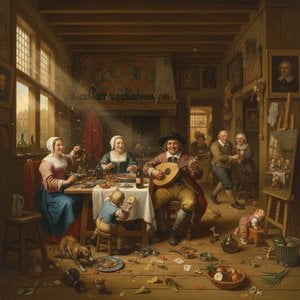
The Bashful Cousin

- 63.0 x 76.0 cm


 Lue lisää
Tällä sivulla esitettyä taideteosta suojaa tekijänoikeuslaki, mikä tarkoittaa, ettemme voi laillisesti luoda tai myydä täsmälleen samanlaista jäljennöstä. Tämä suoja toteutetaan kansainvälisten sopimusten, kuten esimerkiksi Berne-konventio ja kansallisilla laeilla, mukaan lukien niillä määritellyt Yhdysvaltain tekijänoikeuslaki – Luku 17. Kaikki oikeudet pidätetään. Luvaton kopiointi tai jäljittely on kielletty.
Tämä menetelmä noudattaa täysin tekijänoikeussäännöksiä, sillä se ei sisällä suojatun taideteoksen kopioimista tai jäljentämistä. Sen sijaan kyseessä on luova uudelleentulkinta – uusi maalaus, joka ammentaa vaikutteita alkuperäisestä, mutta ei ole sen identtinen kopio.
Giclée- ja taideprintit
Museolaatuisia giclée- tai kankaitaulun tulosteita nopealla tuotannolla ja joustavilla viimeistelyvaihtoehdoilla. ( Osta käsinmaalattu taideteos Siirry digitaaliseen kuvaan)




P118B €10

P118H €10

P118W €10

P438Z €10

P508JH €12

P508YH €12

P805H €10

P805Z €10

P919BZ €10

P919G €10

P919XJ €10

P959ZH €10

P968JZ €12

W106C €8

W218G €10

W218JH €8

W218Y €10

W307PJ €10

W316G €10

W316PJ €8

W316Y €10

W398PJ €8

W4111J €10

W500HY €15

W500JH €15

W692G €12

W849H €8

W940BG €15

W953PJ €8




Valitse valmiista mitoistamme sellaiset, jotka vastaavat teoksen alkuperäisiä mittasuhteita.

Syötä tarvitsemasi leveys ja korkeus, jotta tuloste sopii kehyksiisi tai seinällesi. Tulostetta voidaan vain leikata, sitä ei voida koskaan suurentaa alkuperäistä kuvaa suuremmaksi, joten eri muotoinen koko aiheuttaa osan kuvasta katoamisen. Lähetämme sinulle digitaalisen mallikuvan hyväksyttäväksi ennen kuin aloitamme tulostuksen. Tällä sivulla näkyvä kuva ei näytä lopullista rajausta — vain mallikuva näyttää sen.
Maailmanlaajuinen toimitus () 2 viikossa tavallisen 4–5 viikon sijaan. (2 marraskuu)

Ilmainen pikatoimitus ympäri maailman

Korkealaatuinen pellavakangas

Kattava kuljetusvakuutus

Tulliveron palautustakuu

Takuu täydellisestä värien vastaavuudesta

100 päivän palautusoikeus (vain valmistusvirheet)

100% rahat takaisin -takuu

Määräalennus tarjolla
 Lasivaihtoehto on saatavilla vain alle 110 cm kokoisille teoksille

The Bashful Cousin
Giclée- ja taideprintit
Replikaatin koko
-


Kokonaishinta
€ 55
Samankaltaisia teoksia


![Life Of Saint Francis - [04] - Death And Ascension Of St Francis — Giotto Di Bondone, Italian Renaissance](/media/artworks/images-thumb/08/8b/088b102b13c1a379233690905590f156.jpg)


Taiteilijan elämäkerta
The Quiet Humorist of Victorian America
Francis William Edmonds remains a captivating, somewhat enigmatic figure within the tapestry of American art history—a painter who achieved considerable renown through an oeuvre characterized by remarkable consistency and an understated, elegant grace. Born on November 22, 1806, in Hudson, New York, Edmonds was raised within a large Quaker family, a background steeped in humanist ideals that would subtly inform the moral depth of his later works. His life unfolded against the dramatic backdrop of a burgeoning industrial era and the fervent social debates surrounding slavery, forces that shaped his artistic vision and lent a quiet gravity to his depictions of everyday existence.
Though he possessed a natural talent for drawing, the practicalities of the nineteenth century led him toward a dual existence. Finding formal training in etching too prohibitantly expensive, Edmonds followed the professional path of an uncle into the world of finance. For much of his life, he balanced the meticulous responsibilities of a bank cashier with the soulful pursuits of a painter. This duality perhaps contributed to the disciplined, precise nature of his brushwork, as he navigated the structured world of banking while simultaneously exploring the boundless realms of human emotion and domestic narrative.
A Mastery of Light and Dutch Influence
Edmonds’s artistic journey was profoundly shaped by a deep reverence for the seventeenth-century Dutch Masters. He found great inspiration in the works of Rembrandt and Vermeer, adopting their meticulous techniques and their unparalleled ability to capture atmospheric light. This stylistic choice became the hallmark of his aesthetic, allowing him to transform simple scenes of contemporary American life into timeless studies of light, shadow, and texture. His early experiments with etching eventually gave way to oil painting, a medium that allowed him to fully realize this fascination with luminosity.
His development as an artist was further stimulated by the opening of the National Academy of Design in New York in 1826. Registering as a student of the antique between 1827 and 1830, he refined his command over composition and color. It was during this period that he began to emerge on the exhibition circuit, sometimes even using the pseudonym E. F. Williams to shield himself from potential criticism. The success of early works like Sammy the Tailor provided the encouragement necessary to pursue his passion with renewed vigor, leading to a body of work that would eventually earn him a place among the notable genre painters of his era.
The Art of the Everyday: Genre and Narrative
The true heart of Edmonds’s legacy lies in his genre paintings—scenes of rural and domestic life rendered with a remarkable degree of realism and psychological insight. He possessed a unique ability to weave humor and pathos into a single frame, capturing the subtle nuances of social interaction and the quiet dignity of labor. His subjects often explored themes of domesticity and community, frequently imbued with a gentle, moralizing commentary that resonated with the values of his time.
Several of his masterpieces stand as testaments to this narrative skill:
- The New Bonnet: A work that exemplifies his ability to use contemporary American subjects to explore deeper themes of social interaction and subtle morality.
- The Bashful Cousin: A charming 1842 scene that showcases his mastery of the Dutch style, capturing a tender moment of domestic life with delightful intimacy.
- Preparing for Christmas: An evocative piece that demonstrates his command over complex compositions and the ability to convey warmth and seasonal anticipation.
Through these works, Edmonds did more than merely document the customs of the nineteenth century; he elevated the mundane to the level of high art. By applying the sophisticated techniques of the Old Masters to the lived experiences of his fellow Americans, he created a visual language that was both intimately familiar and profoundly beautiful. His historical significance rests in this bridge between worlds—the ability to find the extraordinary within the ordinary, leaving behind a legacy of quiet, enduring charm.

Pähkinänkuoressa
- Artistic Movement Or Style: Dutch Painting Style
- Artists Or Movements Influenced By This Artist: ['Genre Scene Art']
- Artists Who Influenced This Artist: ['Wilkie']
- Date Of Birth: November 22, 1806
- Date Of Death: February 7, 1863
- Full Name: Francis William Edmonds
- Nationality: American
- Notable Artworks: ['All Talk and No Work']
- Place Of Birth: Hudson, New York
Aiheeseen liittyvät artikkelit

Grant Wood & American Regionalism: Identity, Myth & the Rural Landscape
Explore the world of Grant Wood & American Regionalism with ArtsDot. Discover the symbolism behind 'American Gothic', recurring themes, and the movement's lasting impact on art history. High-quality reproductions available.

Golden Age Reflections: Dutch Baroque Painting & Cultural Innovation
Explore the Dutch Golden Age of painting! Discover key artists like Vermeer & ter Borch, their innovative techniques, and the rich cultural context behind these Baroque masterpieces. Learn about collecting & appreciating this iconic art period.
Jan Steen: A Master of Dutch Genre Painting & the Golden Age
Explore the life & art of Jan Steen, a leading Dutch Golden Age painter renowned for his humorous genre scenes & insightful social commentary. Discover his techniques, legacy, and collecting tips.

Francis Baconin 25 mestariteosta: Taidetta, tunnetta ja sisustusta ArtsDot.comissa
Tutustu Francis Baconin 25 mestariteokseen – synkkää tunnetta, modernia taidetta ja ihmiskuvauksen syvyyttä. Löydä tarinat maalauksien takaa ja inspiroi sisustusta ArtsDot.comissa! Tutki koko kokoelma verkossa.

Genre Painting: A Window into Daily Life & Societal Values of the Dutch Golden Age
Explore the captivating world of Dutch Golden Age genre painting! Discover realistic depictions of daily life, masterful artists like Ostade & Metsu, and hidden symbolism. Learn about this influential art movement with ArtsDot.