


 Katso seinällä
 Lähetä
 Jaa
Jaa
 Tarkemmat tiedot
 Opas
Opas

 Lataa kuva
 Samanlaisia kohteita
 Röntgenkuvaus
 Diaesitys
 Tilastot
Spring


 Lue lisää
Giclée- ja taideprintit
Museolaatuisia giclée- tai kankaitaulun tulosteita nopealla tuotannolla ja joustavilla viimeistelyvaihtoehdoilla. ( Tilaa käsinmaalattu jäljennös Siirry digitaaliseen kuvaan)




P118B €10

P118H €10

P118W €10

P438Z €10

P508JH €12

P508YH €12

P805H €10

P805Z €10

P919BZ €10

P919G €10

P919XJ €10

P959ZH €10

P968JZ €12

W106C €8

W218G €10

W218JH €8

W218Y €10

W307PJ €10

W316G €10

W316PJ €8

W316Y €10

W398PJ €8

W4111J €10

W500HY €15

W500JH €15

W692G €12

W849H €8

W940BG €15

W953PJ €8




Valitse valmiista mitoistamme sellaiset, jotka vastaavat teoksen alkuperäisiä mittasuhteita.

Kirjoita tarvitsemasi leveys ja korkeus, jotta tuloste sopii kehyskokoon tai seinällesi. Tulostetta voidaan vain leikata, sitä ei voi koskaan tehdä suuremmaksi kuin alkuperäinen kuva, joten eri muotoinen koko aiheuttaa osan kuvasta katoamisen. Lähetämme sinulle digitaalisen mallikuvan hyväksyttäväksi ennen kuin aloitamme tulostuksen. Tällä sivulla näkyvä kuva ei näytä lopullista leikkausta — vain mallikuva näyttää sen.
Maailmanlaajuinen toimitus () 2 viikossa tavallisen 4–5 viikon sijaan. (23 lokakuu)

Ilmainen pikatoimitus ympäri maailman

Korkealaatuinen pellavakangas

Kattava kuljetusvakuutus

Tulliveron palautustakuu

Takuu täydellisestä värien vastaavuudesta

100 päivän palautusoikeus valmistusvirhetapauksissa

100% rahat takaisin -takuu

Määräalennus saatavilla
 Lasivaihtoehto on saatavilla vain alle 110 cm kokoisille teoksille

Spring
Giclée- ja taideprintit
Replikaatin koko
-


Kokonaishinta
€ 54
A Vision of Spring's Gentle Embrace
Dwight William Tryon’s Spring, painted in 1893, is more than just a depiction of a season; it is an immersion into a state of profound tranquility. The canvas breathes with the soft promise of renewal, capturing that delicate moment when the earth shakes off the slumber of winter. One gazes upon this landscape and feels an immediate sense of peace wash over the spirit. Tryon masterfully renders a serene vista—a field gently rolling towards a distant treeline under a diffused, atmospheric sky. The composition guides the eye softly across planes of muted greens, warm browns, and nascent yellows, colors that speak eloquently of life returning to the world.
Tonalism and the Art of Atmosphere
As an artist deeply rooted in the Tonalist tradition, Tryon possessed a unique gift for capturing light not as a harsh beam, but as a pervasive, enveloping atmosphere. His technique is characterized by delicate brushstrokes that build up color and mood rather than sharp outlines. The overall effect is one of soft focus, where shapes—the undulating grass, the clustered trees—are rendered with an almost dreamlike softness. While the subject matter celebrates spring's vibrancy, the execution leans into a subtle melancholy, suggesting the beautiful impermanence inherent in all natural cycles. This masterful handling of light and shadow gives the scene its depth, inviting contemplation.
Symbolism of Renewal and Passage
The inclusion of two distant figures adds a vital human element to this pastoral tableau. They are subtle, almost spectral, yet they anchor the scale and suggest a shared journey or quiet companionship within nature’s embrace. Symbolically, Spring speaks volumes about transition itself—the passage from dormancy to bloom, from shadow to light. For the modern collector, owning this piece is acquiring not merely an object of art, but a tangible embodiment of hope and rebirth. It serves as a perennial reminder that even after the deepest quiet, beauty inevitably returns.
A Timeless Presence for Any Interior
The soft, harmonious color palette—dominated by earth tones softened by yellow-gold accents—makes this painting incredibly versatile for interior design. Whether placed in a sunlit drawing room or a tranquil study, its gentle energy will complement sophisticated decor without overwhelming the space. The visible texture of the oil paint and the loose brushwork lend an immediate sense of history and artisanal quality to any setting. Reproductions allow art lovers and designers alike to bring this enduring vision of natural grace into their homes, making a statement that is both deeply personal and universally beautiful.
Kysymykset ja vastaukset
Mikä on teoksen Dwight William Tryon:n "Spring" valmistumisvuosi ja tyylisuunta?
Dwight William Tryon:n "Spring" on peräisin vuodelta 1893 ja edustaa tyylisuuntaa Tonalist.
Minkä tunteen kanssa "Spring" yhdistetään?
"Spring" välittää Tranquil tunnelman. Emotionaalinen sävy kuvaa teoksen antamaa vaikutelmaa.
Kuka on luonut teoksen "Spring" ja minä vuonna?
Dwight William Tryon loi teoksen "Spring" vuonna 1893.
Samankaltaisia teoksia


Taiteilijan elämäkerta
Dwight William Tryon: A Master of Atmospheric Landscapes
Dwight William Tryon, a name synonymous with serene beauty and subtle color, emerged from the heartland of Connecticut in 1849. Born in Hartford to Anson Tryon and Delia O. Roberts, his early life was marked by both tranquility and profound loss – the untimely death of his father shaped his artistic sensibilities, fostering a deep connection to nature that would become the cornerstone of his work. Growing up on his grandparents’ farm instilled within him an intimate understanding of the rural landscape, a foundation upon which he would build his distinctive artistic vision. Without formal training initially, Tryon's innate talent blossomed organically; he began sketching the surrounding countryside, meticulously translating the shifting light and shadows onto paper – a practice that foreshadowed his later mastery of atmospheric effects. His early sales, modest yet encouraging, paved the way for exhibitions that hinted at the considerable potential within him, culminating in acceptance into the prestigious National Academy of Design in 1873.European Influences: Shaping a Distinct Style
Driven by an ambition to refine his skills and immerse himself in the artistic currents of Europe, Tryon embarked on a transformative journey in 1876. He traveled to France, seeking formal training at the École des Beaux-Arts in Paris. This period proved pivotal, exposing him to a diverse range of artistic styles and techniques. While he studied under Jacquesson de la Chevreuse, his education extended far beyond the classroom walls; he actively sought guidance from luminaries such as Charles-François Daubigny, Henri Harpignies, and Jean Baptiste-Antoine Guillemet – artists who profoundly influenced his approach to color, composition, and brushwork. Initially, Tryon’s style leaned towards Luminism, a movement characterized by its emphasis on capturing the effects of light and atmosphere. However, he soon gravitated toward the principles of the Barbizon School, a French artistic movement that prioritized direct observation of nature and a more subdued palette. The Barbizon School's focus on depicting the natural world with honesty and restraint resonated deeply with Tryon’s sensibilities, shaping his distinctive style and aesthetic. Notably, James McNeill Whistler’s tonalist approach – emphasizing harmonious arrangements of color and subtle gradations of tone – exerted a significant influence on Tryon’s artistic development, contributing to the quiet intensity and evocative mood that characterize many of his works.The Development of a Signature Style: Composition and Atmosphere
By the late 1880s, Dwight William Tryon had fully realized his iconic style—a signature approach that would define his legacy as a leading American Tonalist. His canvases often feature a distinctive composition: a grouping or broken row of trees positioned in the middle distance, acting as a visual bridge between a luminous sky above and a foreground marsh or pasture below. These scenes are frequently imbued with autumnal hues, evoking a sense of tranquility and melancholy. Beyond landscapes, Tryon also excelled at seascapes, utilizing pastel to capture the expansive beauty of water, sky, and beach under varying weather conditions. His mastery lay in his ability to convey atmosphere—the subtle shifts in light, the delicate play of color, and the overall mood of a scene. *Salt-Marsh, December*, which garnered first prize at the Tennessee Centennial Exposition in 1897, stands as a prime example of this skill, showcasing his talent for capturing the serene beauty of the natural world. His works were consistently exhibited nationally, finding favor at prestigious venues like the Pennsylvania Academy of Fine Arts and the Montross Gallery.Recognition and Legacy: Patronage and Enduring Influence
The trajectory of Tryon’s career was significantly enhanced by his relationship with Charles Lang Freer, a discerning collector who became his most important patron. Freer acquired dozens of Tryon's works and even collaborated with the artist on interior design projects for his Detroit home. This generous support allowed Tryon to fully dedicate himself to his art, and many of these paintings now reside in the esteemed Freer Gallery of Art as part of the Smithsonian Institution. Further recognition came in 1908 when he received the Carnegie Prize at the Carnegie Exhibition, solidifying his position among the leading artists of his time. Throughout his career, Tryon was an active member of several prestigious art organizations, including the Society of American Artists, the American Watercolor Society, and the National Institute of Arts and Letters (now the American Academy of Arts and Letters). In 1887, he established a summer home in South Dartmouth, Massachusetts, which served as his primary residence for the remainder of his life. He also dedicated himself to education, teaching painting and drawing at Smith College from 1886 to 1923, where he founded the Tryon Gallery of Art. Dwight William Tryon passed away in 1925, leaving behind a rich artistic legacy defined by his contribution to American Tonalism and his exceptional ability to capture atmospheric landscapes and seascapes with delicate color and refined feeling. His works continue to be celebrated and are held in prominent collections such as the Smithsonian American Art Museum and the Freer Gallery of Art, ensuring that his vision endures for generations to come.Notable Works
* *Salt-Marsh, December* (1897) * *Springtime* (1895) * *Newbury Haystacks in Moonlight* (c. 1880)
Dwight William Tryon
1849 - 1925 , Yhdysvallat
Tietoa taiteilijasta
- Artistic Movement Or Style: Tonalismi, Barbizon-koulu
- Artists Or Movements Influenced By This Artist: ['Amerikkalainen Tonalismi']
- Artists Who Influenced This Artist:
- Whistler
- Daubigny
- Harpignies
- Date Of Birth: 13. elokuuta 1849
- Date Of Death: 1. tammikuuta 1925
- Full Name: Dwight William Tryon
- Nationality: Amerikkalainen
- Notable Artworks:
- Salt-Marsh, December
- Spring
- Newbury Haystacks
- Place Of Birth: Hartford, Yhdysvallat
Aiheeseen liittyvät artikkelit

Grant Wood & American Regionalism: Identity, Myth & the Rural Landscape
Explore the world of Grant Wood & American Regionalism with ArtsDot. Discover the symbolism behind 'American Gothic', recurring themes, and the movement's lasting impact on art history. High-quality reproductions available.

William Stanley Haseltine: Evoking Atmosphere & Light in American Tonalism
Explore the captivating landscapes of William Stanley Haseltine, a master of American Luminism & Tonalism. Discover his serene coastal scenes and Italian vistas – available as museum-quality reproductions at ArtsDot.

William Bradford: Navigating Faith, Landscape & Artistic Innovation in Early American Painting
Explore the captivating world of William Bradford, American Romanticist painter renowned for his dramatic Arctic seascapes & ship portraits. Discover his artistic evolution, influences, and lasting legacy with ArtsDot.
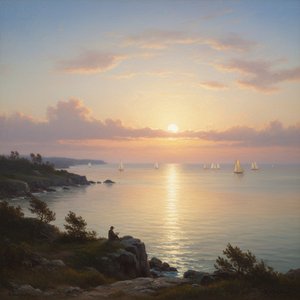
William Trost Richards: Luminism, Spirituality & the American Landscape Tradition
Explore the captivating landscapes of William Trost Richards, a master of Luminism associated with both the Hudson River School & American Pre-Raphaelite movements. Discover his spiritual connection to nature and lasting influence on American art.

Evocations of Place: A Historical Journey Through Landscape Art
Explore the rich history of landscape art with ArtsDot. Discover renowned artists, movements like Impressionism & Romanticism, and expert guidance for collecting timeless pieces. Find your perfect serene escape today!