


 Esikatselu
 Jaa
Jaa Jaa
Jaa
 Tarkemmat tiedot

 Lataa
Lataa
 Samanlaisia
 Röntgenkuva
 Diaesitys
 Stats
StatsDepois do Centro
 Acrylic On Canvas
- WallArt
- Neo-Concretism
 1974
1974- Contemporary
 Banco do Brasil Cultural Center (Rio de Janeiro)
 Näytä lisää
Giclée-printit ja taideprintit
Museolaatuisia giclée- tai kankaitaulun tulosteita nopealla tuotannolla ja joustavilla viimeistelyvaihtoehdoilla. ( Osta käsintehty maalaus Switch to Digital Image)




P118B $10

P118H $10

P118W $10

P438Z $10

P508JH $12

P508YH $12

P805H $10

P805Z $10

P919BZ $10

P919G $10

P919XJ $10

P959ZH $10

P968JZ $12

W106C $8

W218G $10

W218JH $8

W218Y $10

W307PJ $10

W316G $10

W316PJ $8

W316Y $10

W398PJ $8

W4111J $10

W500HY $15

W500JH $15

W692G $12

W849H $8

W940BG $15

W953PJ $8




Valitse valmiista mitoistamme sellaiset, jotka vastaavat teoksen alkuperäisiä mittasuhteita.

Voit syöttää omat mitat sopiaksesi tiettyyn kehykseen tai tilaan. Jos valittu koko ei vastaa alkuperäisen kuvan mittasuhteita, rajaamme teosta tai laajennamme kuvaa peilatulla tai yhtenäisellä reunalla. Digitaalinen mallikuva lähetetään hyväksyttäväksi ennen tuotannon aloittamista.
Huomaathan, että näytöllä näkyvä esikatselu ei vastaa lopullista rajausta tai laajennusta. Vain mallikuva näyttää lopullisen sommittelun tarkasti.
Vaikka räätälöityjä kokoja on saatavilla, suosittelemme valitsemaan mitat valmiista listasta alkuperäisten mittasuhteiden säilyttämiseksi.
Toimitus maailmanlaajuisesti () kahdessa viikossa tavallisen 4–5 viikon sijaan. (8 syyskuu)

Ilmainen pikatoimitus ympäri maailman

Korkealaatuinen pellavakangas

Kattava kuljetusvakuutus

Tulliveron palautustakuu

Täydellinen värien vastaavuustakuu

100 päivän palautusoikeus (vain valmistusvirheet)

100% rahat takaisin -takuu

Määräalennus tarjous
 Lasivaihtoehto on saatavilla vain alle 110 cm kokoisina teoksina

Depois do Centro
Giclée-printit ja taideprintit
Replikaatin koko
-


Kokonaishinta
$ 62
Depois do Centro: A Minimalist Echo of Brazilian Identity
Anna Maria Maiolino’s “Depois do Centro” (After the Center) is not merely a painting; it's a carefully constructed dialogue between geometric form, stark color, and the complex history of Brazil. Created in 1974, during a period of intense political and social upheaval, this deceptively simple work embodies the spirit of Neo-Concretism – a Brazilian art movement that sought to strip away superfluous elements and focus on the essential qualities of form and materiality. The piece immediately commands attention with its stark contrast: a pristine white circle bisected by a bold, black triangle. This seemingly reductive composition belies a profound depth of meaning, inviting viewers to contemplate themes of duality, containment, and the search for equilibrium within a turbulent world.
Composition and Technique – A Study in Restraint
The painting’s power lies in its deliberate restraint. Maiolino employs a remarkably straightforward technique, applying solid blocks of color with visible brushstrokes to the white circle. This tactile quality subtly hints at the process of creation itself, grounding the abstract forms in a tangible reality. The black triangle, sharply defined and geometrically precise, acts as an anchor within the composition, providing a visual counterpoint to the softer curves of the circle. Notably, the circle’s line isn't perfectly smooth; it possesses a slight irregularity, suggesting a hand-drawn quality that imbues the work with a sense of immediacy and vulnerability. The subtle variations in tone within both colors – a hint of grey in the white, a darker shade in the black – add layers of visual interest without disrupting the overall balance.
Symbolism and Historical Context – Brazil’s Unsettled Soul
“Depois do Centro” is deeply rooted in the socio-political landscape of 1970s Brazil. The period was marked by a military dictatorship, widespread social inequality, and a growing sense of disillusionment. Maiolina's work reflects this atmosphere through its exploration of duality – the circle representing wholeness or unity, while the triangle suggests division, conflict, or perhaps even the limitations imposed by societal structures. The small circular hole within the larger circle can be interpreted as an aperture to vulnerability, a space for questioning and resistance. Drawing on her experiences as an Italian-born immigrant in Brazil, Maiolina’s art became a vehicle for expressing the complexities of identity, belonging, and the struggle against oppressive forces – mirroring the broader anxieties of a nation grappling with its own fractured past.
Emotional Resonance – A Quiet Contemplation
Despite its minimalist aesthetic, “Depois do Centro” evokes a powerful emotional response. The stark colors and geometric forms create a sense of quiet contemplation, inviting viewers to engage in a personal dialogue with the artwork. There’s an underlying tension between the two shapes – a feeling of contained energy, of striving for balance amidst uncertainty. The painting's enduring appeal lies in its ability to resonate with universal themes of duality, incompleteness, and the ongoing search for meaning in a complex world. It is a testament to Maiolina’s skill as an artist, her capacity to distill profound ideas into a remarkably simple and evocative form.
(Note: Further research suggests that reproductions of this artwork are available through ArtsDot.com.)
Samankaltaisia teoksia


Taiteilijan elämäkerta
A Journey of Displacement and Identity
The life of Anna Maria Maiolino is a profound tapestry woven from threads of migration, cultural intersection, and the search for selfhood. Born in 1942 in Scalea, Calabria, her early years were shaped by the dual heritage of an Italian father and an Ecuadorian mother. This sense of being between worlds followed her when, as a young child in 1954, she emigrated to Venezuela. It was here that her artistic sensibilities first began to take root, nurtured by the vibrant landscapes of South America before her family relocated to Rio de Janeiro in 1960. In the bustling heart of Brazil, Maiolino immersed herself in the rigorous training of the Escola Nacional de Belas Artes, mastering the tactile disciplines of painting and woodcut. These formative years were not merely about technical acquisition; they were a period of intense intellectual awakening, as she found herself at the epicenter of a transformative era in Latin American art history.
As she matured, Maiolino became a vital participant in the radical shifts defining the Brazilian avant-garde. During the 1960s and 1970s, she moved within circles of legendary figures such as Lygia Clark and Lygia Pape, contributing to movements like Neo-Concretism and the New Brazilian Objectivity. Her work during this period served as a silent yet potent form of resistance against the oppressive shadows of the Brazilian military regime and the widening chasm of urban inequality. Through her art, she sought to navigate the complexities of political tension and social upheaval, using the medium itself to challenge the status quo.
The Evolution of Form and Concept
In 1968, a pivotal shift occurred when Maiolino moved to New York, an experience that fundamentally recalibrated her artistic trajectory. Immersed in the international currents of Minimalism and Conceptualism, she began to explore the delicate, often charged interaction between the physical object and the perceiving viewer. This period was marked by a stripping away of the superfluous, focusing instead on the raw essence of material and the psychological space between art and audience. Her time in New York was further enriched by a scholarship at the International Graphic Center workshop at Pratt University, a recommendation earned through the support of the esteemed Luis Camnological.
Upon her return to Brazil in late 1971, Maiolino underwent a profound stylistic metamorphosis. She turned toward drawing as an intimate mode of self-expression, emphasizing the visceral gesture and the physical process of creation. This era saw the birth of works that blurred the lines between documentation and art, such as:
- Mental Maps (1971–74): Explorations of internal landscapes and cognitive structures.
- Book Objects (1971-76): Reimagining the printed word through sculptural and tactile interventions.
- Drawing Objects (1971-76): Where the act of mark-making becomes a physical presence in space.
Legacy and Materiality
The enduring significance of Anna Maria Maiolino lies in her ability to bridge the gap between the political and the personal, the cerebral and the tactile. Her mastery over diverse media—ranging from the delicate precision of drawing to the heavy, earthbound reality of clay sculpting—allows her to speak to the fundamental human condition. She treats materials not merely as tools, but as active participants in a dialogue about language, the body, and memory. In her hands, earth becomes a vessel for history, and the gesture becomes a political statement.
Today, Maiolino stands as a titan of contemporary art, a pioneer whose work continues to challenge how we perceive the boundaries of the self and the structures of power. Her legacy is found in every crack of her sculpted clay and every intentional stroke of her drawings, reminding us that art is an ongoing process of becoming, much like the migratory and metamorphic life she has so beautifully embodied.

anna maria maiolino
1942 - , Italy
Pikatiedot
- Artistic Movement Or Style: Neo-Concretism, Minimalism, Conceptualism
- Artists Who Influenced This Artist:
- Lygia Clark
- Lygia Pape
- Date Of Birth: 1942
- Full Name: Anna Maria Maiolino
- Nationality: Brazilian
- Notable Artworks:
- Mental Maps
- Book Objects
- Drawing Objects
- Place Of Birth: Scalea, Italy
Liittyvät artikkelit

Beyond Form & Color: Geometric Abstraction's Evolution in 20th/21st Century Art
Explore the evolution of geometric abstraction from Cubism to contemporary art. Discover key artists like Malevich & Mondrian, investment insights, and expert collecting advice at ArtsDot.

Wassily Kandinskin 25 mestariteosta: Värien ja muodon syvä maailma | ArtsDot
Tutustu Wassily Kandinskin 25 vaikuttavinta teosta! Uppoudu abstraktin taiteen maailmaan, värien symboliikkaan ja modernin ekspressionismin historiaan. Löydä inspiraatiota kodin sisustukseen ArtsDot.com:ista – laadukkaat taideprintit ja reproduktiot.

Geometrisen abstraktion mestariteokset: Taidetta kotiin ArtsDotilta
Tutustu geometrisen abstraktion 10 mestariteokseen! Piet Mondrian, Kandinsky ja muut taiteilijat muovasivat modernin taiteen historiaa. Löydä inspiraatiota kotiisi ArtsDotilta – laadukkaat taideprintit ja sisustusehdotukset odottavat. Tutki kokoelma verkossa!
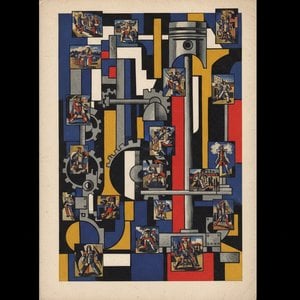
Fernand Légerin 25 mestariteosta: Modernismin ikoniset muodot seinillesi
Tutustu Fernand Légerin 25 ikonista mestariteosta – kubismin ja koneajan taiteen huiput. Taidehistoriaa, värikkäitä maalauksia ja inspiraatiota sisustukseen. Löydä upeimmat reproduktiot ArtsDot.com:sta!

Beyond Form & Color: Geometric Abstraction's Enduring Legacy in Art History
Explore the captivating world of geometric abstraction! Discover its origins, key artists like Malevich & Mondrian, and why this movement remains highly valued by art collectors today. Expert insights at ArtsDot.