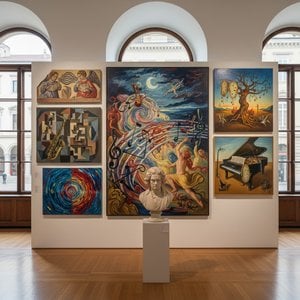
The Radiant Legacy of Ludovico Stern
In the sun-drenched, theatrical atmosphere of eighteenth-century Rome, a period defined by the graceful transitions of the Rococo and the lingering grandeur of the late Baroque, the name Ludovico Stern resonates with the elegance of a bygone era. Born on October 5, 1709, to a family deeply embedded in the artistic fabric of Europe, Stern was far more than a mere painter; he was a master of light and narrative who bridged the gap between sacred devotion and secular splendor. His lineage provided a rich tapestry of inspiration, as his father, the Bavarian-born painter Ignazio Stern, had already established a formidable presence in the Roman art scene. Growing up amidst the scent of oil paints and the quiet intensity of a studio, Ludovico was destined to inherit a profound understanding of visual storytelling, a gift that would later allow him to capture both the divine ecstasy of saints and the delicate stillness of nature.
The development of Stern’s artistry was a journey through some of the most prestigious institutions of his time. While his initial training was nurtured under the watchful eye of his father, he sought further refinement within the Academy of Parma and the esteemed Accademia di San Luca in Rome. This rigorous academic foundation instilled in him a meticulous command over anatomy and composition, yet it never stifled his ability to infuse his work with the emotive, swirling energy characteristic of the period. His talent was not merely recognized by peers but celebrated by the highest echelons of Roman society; his induction into the Congregazione dei Virtuosi del Pantheon in 1741 and his subsequent role as regent marked him as a pillar of the artistic community. Through these achievements, Stern moved beyond simple imitation, developing a style that could pivot seamlessly from the monumental scale of history painting to the intimate, whispered details of a portrait.
A Mastery of Sacred and Secular Narratives
The true brilliance of Ludovico Stern lies in his versatility, an ability to navigate the diverse demands of Roman patronage with unparalleled grace. His oeuvre is a breathtaking collection of works that range from the profoundly spiritual to the exquisitely decorative. In the realm of sacred art, Stern possessed a unique capacity to render the supernatural as something tangible and deeply felt. His canvases for the church of San Giovanni Evangelista in Guidonia Montecelio and his depictions of the Extasis and Meditation of San Carlo Borromeo serve as windows into the divine, utilizing dramatic lighting and fluid brushwork to evoke a sense of spiritual transcendence. These works do not merely depict religious events; they invite the viewer into a state of contemplation, making the miraculous feel intimately present.
Yet, Stern was equally adept at capturing the worldly elegance of his age. His contributions to the Palazzo Borghese, specifically the Stanza della Quattro Parti del Mondo, demonstrate his mastery of large-scale decorative cycles. In this room, he wove together mythological and geographical themes—depicting Europe, America, Asia, and Africa alongside figures like Juno and Iris—creating a visual encyclopedia of the known world that was both educational and aesthetically dazzling. This penchant for the grand and the allegorical was balanced by his celebrated skill in still lifes and portraits. In these smaller, more intimate formats, Stern’s technical precision shone, capturing the textures of fabric, the luster of fruit, and the nuanced character of his subjects with a clarity that remains captivating centuries later.
Historical Significance and Artistic Lineage
The historical significance of Ludovico Stern extends far beyond the borders of his individual canvases. He represented a vital link in a chain of artistic excellence that connected the Bavarian traditions of his father to the heart of Italian classicism. His life was a testament to the cosmopolitan nature of the eighteenth-century art world, where talent and heritage merged to create something uniquely Roman. The influence of his family was vast; his brother also pursued the mastery of still lifes, while his daughter, Veronica, became a skilled portrait miniaturist, ensuring that the Stern name remained synonymous with visual refinement.
As the era of the Baroque gave way to the more structured Neoclassicism, Stern’s work stood as a glorious culmination of the late-Baroque spirit. His legacy was carried forward even into the next generation through his great-grandson, the prominent Neoclassical architect Raffaele Stern. When we look upon the works of Ludovico today, we see more than just paint on canvas; we see the pulse of Rome, the devotion of the faithful, and the enduring power of an artist who could find the extraordinary within the ordinary, leaving behind a luminous imprint on the history of European art.
Küsimused ja vastused
Kui palju Ludovico Stern teoseid on kataloogis vaatamiseks saadaval?
Lehelt Kõik teosed saab vaadata 1 teost teost kunstnikult Ludovico Stern.
Kui populaarsed on Ludovico Stern teosed?
Ludovico Stern kohta on olemas Statistika lehekülg, mis esitab see veebileht kunstniku teoste kohta statistika.
Mis on Ludovico Stern sünnipaik ja sünnahöstua?
Ludovico Stern sündis Rome linnas aastal 1709.