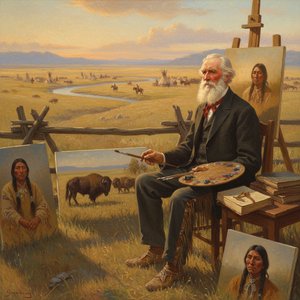
A Life of Discovery: The Artistic Odyssey of John Herbert Caddy
In the grand tapestry of nineteenth-century art, few figures embody the romantic intersection of scientific precision and creative wonder as profoundly as John Herbert Caddy. Born in Quebec City in 1801, Caddy was a man whose life refused to be confined by a single vocation. He was simultaneously a soldier, an engineer, an explorer, and a chronicler of the natural world. His journey began not with a brush, but with the rigorous discipline of military training at the Royal Military Academy, Woolwich. It was within these halls of engineering excellence that Caddy developed the meticulous eye for detail that would later define his watercolors. Influenced by the topographical sketching traditions of his contemporaries, such as George Heriot, he learned to view the landscape not merely as a scenic backdrop, but as a complex subject requiring both anatomical accuracy and atmospheric sensitivity.
Caddy’s career was propelled by the restless spirit of an adventurer, leading him across vast geographical expanses that served as his greatest muses. His military postings took him through the lush, vibrant landscapes of the West Indies—including Tobago, St. Lucia, and St. Vincent—where he captured the humid brilliance of tropical environments. These early travels culminated in a significant artistic achievement: the publication of a series of views depicting the Windward and Le Sobriety Islands. His ability to translate the heat, light, and verdant textures of these distant shores into hand-colored aquatints provided a window into a world that remained largely mysterious to the Victorian public, blending the role of the artist with that of the colonial documentarian.
The Explorer’s Eye: Archaeology and the Mayan Frontier
Perhaps the most breathtaking chapter of Caddy’s life occurred in 1839, when he led an expedition to the ancient Mayan city of Palenque. This period represented a sublime synthesis of his engineering intellect and his artistic soul. In the shadows of crumbling stone temples, Caddy acted as a pioneer of archaeological documentation. He did not merely observe; he recorded the intricate glyphs and monumental architecture with a level of scientific rigor that sought to preserve the past for future generations. His diaries and sketches from this expedition, though intended for a publication that would only see the light of day much later, serve as vital historical artifacts. Through his work, the grandeur of Mayan civilization was rendered tangible, bridging the gap between the raw discovery of the explorer and the refined interpretation of the artist.
As his travels brought him back to the Canadian frontier, Caddy’s focus shifted toward the rugged beauty of North America. Settling in London, Canada West, and later Hamilton, he transitioned from a man of war to a man of community and cultivation. As a civil engineer, he helped shape the very landscapes he painted, laying out plans for growing towns and contributing to the infrastructure of the Great Western Rail Road. This intimate connection to the land allowed his later works—ranging from maritime scenes to delicate studies of flowers and animals—to possess an authentic, lived-in quality. His art became a celebration of the Canadian wilderness, captured with the steady hand of someone who had literally helped build the world he depicted.
Legacy of a Multidimensional Visionary
The historical significance of John Herbert Caddy lies in his refusal to separate the analytical from the aesthetic. To him, a landscape was a puzzle of topography and light, an archaeological site was a narrative of human history, and a botanical specimen was a marvel of biological design. His contributions to the Canadian art scene were both instructional and inspirational; by opening his own studio and serving as an instructor, he helped nurture the next generation of artists in the Hamilton area.
Today, Caddy’s legacy is preserved in prestigious collections, such as that of Dundurn Castle, where his watercolors continue to evoke the spirit of a bygone era. His work remains a testament to a time when the boundaries between science and art were fluid, and when the act of painting was an essential tool for understanding the vast, unfolding mysteries of the globe. Through his eyes, we see a world of profound discovery, captured in the delicate, enduring medium of watercolor.
Küsimused ja vastused
Kust leida John Herbert Caddy teoseid väripaleti järgi grupeerituna?
John Herbert Caddy teoseid saab väripaleti järgi sirvida kunstniku Väripalettide järgi lehel.
Kust saan vaadata John Herbert Caddy teoste väriprofiili?
John Herbert Caddy värvikasutust teostes, mis on loetletud see veebileht lehel, saab uurida kunstniku Palettide genoom lehel.
Kas saan külastada John Herbert Caddy teoste virtuaalset muuseumi?
John Herbert Caddy teoseid saab vaadata 3D-galeriis tema 3D-galeria lehel.
Kas saan John Herbert Caddy teoseid värvispektri järgi uurida?
Lehekülg Värvitoonide indeks koondab John Herbert Caddy teosed värvide järgi.