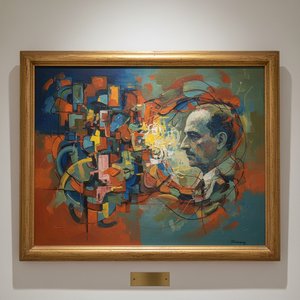
Joaquin Castañón: A Bolivian Vision of Rural Bolivia
Joaquin Castañón (born 1938) stands as a prominent figure in Bolivian Costumbrismo art, capturing the essence of rural Bolivian life and culture with remarkable sensitivity. His artistic journey began in Cochabamba, Bolivia, where he immersed himself in the traditions and landscapes that would profoundly shape his oeuvre. Influenced by Surrealism and Expressionism, Castañón developed a distinctive style characterized by vibrant colors, meticulous detail, and an evocative portrayal of everyday scenes—often depicting saints and biblical figures interwoven with pastoral imagery.
Early Years & Artistic Training: Castañón’s formative years were marked by exposure to European avant-garde movements, particularly Surrealism, which instilled in him a fascination for dreamlike imagery and symbolic representation. He honed his skills through formal artistic training at the Universidad Nacional Superior de Artes Aplicadas y Diseño (UNSAAD) in Cochabamba.
Costumbrismo Style: Castañón’s signature style is undeniably Costumbrismo—a Bolivian movement that sought to romanticize and celebrate the traditions, customs, and landscapes of Bolivia. He skillfully blended realism with fantasy, creating canvases brimming with color and texture that convey a deep appreciation for Bolivian rural life.
Notable Works: Among Castañón’s most celebrated paintings is “San Isidro Labrador,” a monumental depiction of Saint Isidore the Laborer—a revered Bolivian saint associated with agriculture and fertility—presented amidst a lush Andean hillside scene. This artwork exemplifies his masterful technique and profound understanding of Bolivian iconography.
Recognition & Legacy: Castañón’s artistic contributions have garnered considerable acclaim within Bolivia and internationally. He has been honored with numerous awards and exhibitions, cementing his place as one of Bolivia's foremost artists. His work continues to inspire admiration for its beauty and its ability to convey the spirit of Bolivian culture.
Technique & Artistic Influences
Castañón’s artistic approach was characterized by meticulous observation and a dedication to capturing subtle nuances of light and color. He employed oil paints on canvas with painstaking detail, layering textures and hues to create immersive visual experiences. Surrealist principles—particularly the exploration of subconscious imagery—influenced his compositions, adding an element of dreamlike wonder to his depictions of Bolivian landscapes and saints. Furthermore, he drew inspiration from Expressionism’s emphasis on emotional intensity and subjective perception.
Oil Painting Technique: Castañón favored oil paints for their ability to achieve rich colors and luminous effects—essential for conveying the vibrancy of Andean scenery.
Expressionist Expression: Castañón’s canvases resonate with emotional depth and convey a profound connection to the human experience—traits characteristic of Expressionist art.
San Isidro Labrador: Symbolism & Narrative Significance
“San Isidro Labrador” transcends mere visual representation; it embodies a complex tapestry of symbolism rooted in Bolivian Catholic tradition and Andean cosmology. Saint Isidore, depicted amidst rolling hills dotted with sheep—a quintessential symbol of Bolivian agriculture—represents the fecundity of the land and the importance of pastoral livelihoods. The saint’s serene gaze conveys spiritual contemplation and reinforces Castañón's overarching theme: a harmonious coexistence between humanity and nature—a core value within Costumbrismo art.
Conclusion
Joaquin Castañón’s artistic legacy extends far beyond his individual paintings. He championed Costumbrismo as a means of preserving Bolivian cultural heritage and fostering appreciation for the beauty of Andean landscapes. His enduring vision—expressed through masterful technique and imbued with profound symbolic resonance—continues to captivate audiences worldwide, securing his place as an icon of Bolivian art history.
Immerse yourself in the radiant world of Joaquín Sorolla. Explore 25 iconic masterpieces of Spanish Impressionism, from sun-drenched seascapes to luminous portraits. Find inspiration for museum-quality art reproductions and decor. Discover all masterpieces on ArtsDot.com.
Explore the captivating world of Jorge José Castillo Casalderrey, a leading Spanish Abstract Expressionist. Discover his unique style, market value & legacy. Expert insights for discerning collectors.
Journey through the shadows and light of Francisco Goya’s greatest works. From haunting Black Paintings to royal portraits, explore 25 iconic masterpieces and find museum-quality reproductions for your collection. Discover all masterpieces on ArtsDot.com.
Joaquin Castañón: A Bolivian Vision of Rural Bolivia
Joaquin Castañón (born 1938) stands as a prominent figure in Bolivian Costumbrismo art, capturing the essence of rural Bolivian life and culture with remarkable sensitivity. His artistic journey began in Cochabamba, Bolivia, where he immersed himself in the traditions and landscapes that would profoundly shape his oeuvre. Influenced by Surrealism and Expressionism, Castañón developed a distinctive style characterized by vibrant colors, meticu
Mis on teised nimed, mida Joaquín Castañón tuntud on?
Joaquin Castanon
Kui palju Joaquín Castañón maalid ArtsDot.com lehel on?
1
Millal ja kus Joaquín Castañón sündis?
Bolivia
Mis on ArtsDot.com platvormil Joaquín Castañón kõrgeima reitinguga maaldis?
San Isidro Labrador
Kas Joaquín Castañón teos on endiselt autoriõiguse all?
Jah, selle kunstniku teosed on endiselt autoriõiguse all kaitstud.
Kust Joaquín Castañón pärit on?
Bolivia
Kust saan näha Joaquín Castañón teoseid kronoloogilises järjekorras?