The Life and Art of Carl Arp
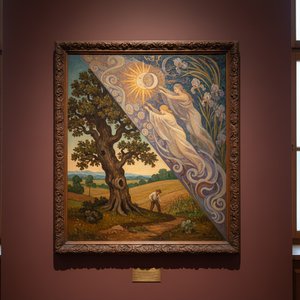
Carl Arp was a German landscape painter born in Kiel. He studied under Theodor Hagen and Leopold von Kalckreuth, later spending several years in Italy. As a representative of the Weimar Saxon-Grand Ducal Art School, he was a founding member of the Schleswig-Holsteinische Kunstgenossenschaft. His work often focused on motifs from Schleswig-Holstein, the Kieler Förde, southern Germany, and Italy, rendered primarily in oil or watercolor.
His technical approach was a source of significant controversy during exhibitions in the Kieler Kunsthalle and the Münchner Glaspalast. Rather than using traditional brushes, Arp utilized spatulas to manipulate paint, applying it in thick, pasted layers that some critics described as appearing "almost like a relief." This avant-garde technique led to the removal of some of his paintings from the permanent exhibition in Weimar by order of the grand duke.
Exhibitions and Legacy
Throughout his career, Arp exhibited his work in various cities, including Munich, Berlin, Kiel, Jena, and Düsseldorf. He was known as a main representative of the "en plein air" style of landscape painting. His artistic journey included a period in Venice and Taormina after his marriage to Marta Rethwisch. In 1906, he presented works alongside Fritz Overbeck and Käthe Kollwitz in Jena.
His notable works include:
Küsimused ja vastused
Kust leida Carl Arp teoseid värvide järgi sorteerituna?
Carl Arp Värvitoonide indeks on leht, kus kunstniku teosed on sorteeritud nende värvide järgi.
Millises ajaloolises perioodis töötas Carl Arp?
Carl Arp töötas 19th Century perioodil. See ajastu aitab määratleda kunstniku tegevust ajaloolises kontekstis.
Millest riigist on pärit Carl Arp?
Carl Arp sündis riigis Germany.