


Teos järgib teie valikuid: , .
Kogumisobjekti kirjeldus
Ujuv rõõm 'Sinakes' Kandinski poolt! See elav abstraktsest kunstist koosnev meistriteos ühendab dünaamilisi kujundeid ja värve, et tekitada emotsiooni ning areneb modernse kunsti pioneeri. Avastage selle väljendusrikas stiil juba täna!
 Loe lähemalt
Kunstniku elulugu
"Vassily Kandinsky oli abstrakti kunstiliikumise suur nimi ja maailma esimene värvikas ekspressjonist! Tema täielikud maalilõpptööd, nagu "Murnau koos pruuniga" ja "Tempered Elan", on maailma suurimas kunstigaleriis."
Käsitsi valmistatud õlimaalireproduktsioon
Meie kunstnike poolt tellimusel valmistatud käsitsi maalitud õli-kainaste teos teie soovitud suuruses ja raamis. ( Lülita trükkitoodetele Lülita digitaalse pildi juurde)
Lisateavet selle maali kohta
 Eelvaade
 Saada
Saada Jaga
Jaga
 Teave teose kohta
 Juhend

 Laadi alla
 Sarnased teosed
 Röntgenuuring
 Slaidietendus
 KÜSIMUSED JA VASTUSID
 Statistika
Tellige oma maali neljas lihtsas sammus
Ärge kiirustage. Saate igal hetkel vastuseid muuta; tellimuskarril kuvatav hind muutub vastavalt tehtud valikutele.
1 Esimene samm neljast
Millist suurust soovite?
Need suurused säilitavad originaalteose proportsioonid. Joonis näitab teie valikut seina küljel, kaheMeetise diivani kohal.
Või sisesta oma mõõdud
Vali meie eelmääratud suurused, mis vastavad teose algupärastele proportsioonidele.

Sisestage vajalik laius ja kõrgus, et teos sobiks teie raamile või seinale. Kuna tegu on käsipainatud teosega, siis erineva kujuga suuruse korral võib kunstnik jätta pildi ümber veidi rohkem marginaali või lõigata osa ära — valik on teie. Enne maali alustamist saadame teile kinnitamiseks digitaalse näidisprojektsiooni. Sellel lehel näidatud pilt ei kajasta tegelikku tulemust — seda näitab ainult näidisprojektsioon.
2 Teine samm neljast
Kuidas see peaks valmistatud olema: rullitud, pingutatud või raamitud?
Alljadevad hinnad kehtivad esimeses sammus valitud suuruse kohta.
Vali pingutatud kanga servade stiil
Vali oma raam

Valge serv €1

häguse servaga lõppviimistlus €1

Laiendatud €1

P118B €10

P118H €10

P118W €10

P438Z €10

P508JH €12

P508YH €12

P805H €10

P805Z €10

P919BZ €10

P919G €10

P919XJ €10

P959ZH €10

P968JZ €12

W106C €8

W218G €10

W218JH €8

W218Y €10

W307PJ €10

W316G €10

W316PJ €8

W316Y €10

W398PJ €8

W4111J €10

W500HY €15

W500JH €15

W692G €12

W849H €8

W940BG €15

W953PJ €8

H24-GOLD €30

H24-SILVER €30

H36-GOLD €45

H36-SILVER €45
Raamitud
Kujund: . Kogumõõt koos raamiga: .
3 Kolmandas sammis neljast
Kas soovite maalis midagi muuta?
Enamik inimesi vastab ei. Kuna iga maali on käsitsi valmistatud, saab meie kunstnik seda ka teie soovidega kohandada.
Pärast tellimust saadetab ArtsDot.com meeskond klientile e-posti juhised ning esitab ette tasandatud eelvaate
4 Neljas samm neljast
Mõned lõppviimistlusvõimalused
Kõik need on valimiste korral vabatahtlikud. Juba valitud vastustele ei rakendu täiendav kulu.
Kes selle maalis?
Maailmline tarne 3–4 nädala jooksul tavalise 5 nädala asemel. (8 november). Kvaliteedis kompromisse ei tehta.
Nimetelis, nagu muuseumis?
Graveeritud pronksplaadi üksikasjad
This elegant plaque features the artist's name and the title of the artwork, finely engraved for a timeless presentation.
It is made from bronze with a refined, elegant finish. The text is precisely laser-engraved for a sharp and permanent result. Measuring 9x2 cm, the plaque is compact yet easy to read. It's built to be durable and scratch-resistant, offering a professional, museum-quality look. Mounting is simple thanks to the included adhesive backing.
Läbipaistva akrüülplaadi üksikasjad
The plaque includes essential engraved details such as the artist's name, the title of the artwork, the date it was created, the type of media used-like oil on canvas or watercolor-a brief description of the piece, and a QR code that links to the complete artwork information.
It is crafted from clear acrylic, offering a sleek, modern appearance. The text is UV-engraved in black to ensure strong visual contrast. With a size of 10x15 cm, it ensures optimal readability. It comes equipped with two metal hooks for secure wall mounting. The plaque is designed to be weather-resistant, making it suitable for various environments, and it includes interactive features that work seamlessly with smartphone scanning.
Musta akrüülplaadiรายละเอียด (Note: The user provided "Musta akrüülplaadi detailid" as the current translation and asked for an improved version. Since "Musta akrüülplaadi
This elegant plaque includes engraved information such as the artist's name, the title of the artwork, the date it was created, the type of media used (like oil on canvas or watercolor), a short description of the artwork, and a QR code for quick access to more information.
The plaque itself is made from refined black acrylic with a premium finish. The text is laser-engraved in white for high contrast and readability. Its size is 10x15 cm, designed to be easy to read. It comes with two metal hooks for professional mounting. The design is sleek and fits any interior style. It is also weather-resistant and durable, with built-in digital integration for mobile compatibility.
Kaitsev lakikih?
Millal te seda vajate?
✓ Kontrolli ja telli
Teie maalid vastavalt tellimusele

Sinakes
Reproduktsiooni tehnika
Reproduktsiooni suurus
-

Eelistatud tippkunstnik
Rohkem detaile, peenust ja lisatootmisaega
-

Reproduktsiooni raamivalikud
-
-
Kunstiteoste või reproduktsioonide puhul, mille üks külg on üle 105 cm (umbikmolt 41 tolli), saadetakse raam kirjal asendis, la Dismantlitud komplektina. See meetod tagab ohutuse kohaletoimetamisel ja väldib transpordil tekkivaid kahjustusi.
Vajalik professionaalne kokkupanek – see ei ole isetegevusega valmistamiseks mõeldud toode.
Komplekt tuleb kokku panna ja lõvet pingutada kogemusega professionaalse raamija, kasutades puiduliim (ei kuulu komplekti), lõvetpingi ja klempe, et hoida raami kande mustad õigena liimi kuivamisaja jooksul. Vale kokkupanek või ebaühtlane lõvetping võib kunstiteost püsivalt kahjustada ning seda
 Kunstiteoste või reproduktsioonide puhul, mille üks külg on üle 105 cm (umbikmolt 41 tolli), saadetakse raam kirjal asendis, la Dismantlitud komplektina. See meetod tagab ohutuse kohaletoimetamisel ja väldib transpordil tekkivaid kahjustusi.
Kaasatud on kõik tahked puidust liistud, täpselt lõigatud vastavaks suuruseks.
Kokku panemiseks kasutatakse lisatud kruvisid ning nurkade liimamiseks vajalikku puuliima, mida ei ole komplektis ja mida peab raamivalmistaja ise hankima.
Vajalik on kasutada professionaalseid tööriistu, mis ei kuulu komplekti: lõvetelapide pingist (pingutaja) ja klambreid, et hoida raami puidu nurgas õigena liimi kuivamisaja jooksul.
Oluline:
Nurgaliimamiseks on vaja puiduliim, liimimine peab toimuma klempide all kuni liim on täielikult kuivanud ning kokku monteeritud raami kanga pingutamiseks on vajalik kanga pingutustang. Kumbki neist ei kuulu komplekti. Palun veenduge enne selle suuruse tellimist, et teil on saadaval kogenud professionaalne raamistaja.

Nimesildikiri
-
-

Kaitsevärnitsus
Läikiv lakk (muudab värvid elavamaks ning kaitseb valgust ja niiskust eest)
-

Kohanda oma teost
Näiteid muudatuste kohta: Asenda nägu kliendi fotoga; Lisa lemmikloom (nt asenda kass koeraga); Lisa taustale peidetud sõnum; Muuda tausta maastikku või elemente.
-

Kiire tarne
Ülemaailmne tarne riiki 3–4 nädalaga tavalise 5 nädala asemel. (8 november). Kvaliteedis kompromisse ei tehta.
-
Kiirsaatmine
Ülemaailmne tarne () 5 nädala jooksul. (15 november).
Sisse kuuluv
Koguhind
€ 235
Klaasivalik on saadaval ainult kuni 110 cm suuruses teostes
Säli iga tellimusega
- Tasuta ekspresssaatmine üle maailma
- Kõrgekvaliteediline lina-kangas
- Täielik transpordikindlustus
- Tollimaksude tagastamise garantii
- Värvitoime täpsuse garantii
- 100 päeva tagastusõigus (ainult valmistusdefektide korral)
- 100% raha tagasi garantii
- Hulgusoodustus


A Symphony in Blue: Unveiling Kandinsky’s “In the Blue”
Wassily Kandinsky's "In the Blue" isn’t merely a painting; it’s an immersion, a journey into the very heart of abstract emotion. Completed around 1908-1913 during a pivotal period in his artistic development, this oil on canvas transcends representational imagery to become a profound exploration of color and form as conduits for feeling. The work immediately captivates with its overwhelming expanse of blue – not a single shade, but a complex layering of cerulean, cobalt, and indigo that seems to shift and breathe before the viewer’s eyes. Yet, within this seemingly boundless azure, a carefully orchestrated dance of shapes emerges: geometric forms intertwine with organic curves, creating a dynamic tension that speaks volumes about Kandinsky's evolving artistic philosophy. This wasn’t simply an aesthetic exercise; it was a deliberate attempt to unlock the expressive potential of pure color and shape, a cornerstone of his later development of abstract art. The painting reflects the burgeoning interest in spirituality and inner experience that characterized early 20th-century thought, mirroring a desire to move beyond the limitations of depicting the external world and tap into realms of subjective feeling.The Language of Form: Geometry and Emotion
Kandinsky’s approach to composition is revolutionary for its time. He abandoned traditional perspective and realistic representation in favor of a system where shapes were not merely decorative elements but possessed inherent symbolic meaning. Within “In the Blue,” we encounter circles, triangles, and lines – each imbued with a specific emotional resonance according to Kandinsky's developing theory. Circles, often associated with wholeness and unity, dominate the composition, suggesting an underlying sense of harmony and spiritual connection. Triangles, conversely, introduce a sharper, more dynamic energy, hinting at conflict or striving. The interplay between these geometric forms creates a visual dialogue, a conversation between opposing forces that ultimately resolves into a unified whole. Notice how the lines aren’t straight; they curve and flow, mirroring the rhythms of breath and movement – a subtle indication of Kandinsky's belief in art as a means of accessing primal emotions. The painting is not about *seeing* blue; it’s about *feeling* blue—a profound statement on the power of color to evoke internal states.Expressionism and the Inner Eye
Classifying “In the Blue” within the Expressionist movement offers a crucial lens through which to understand its emotional intensity. While Kandinsky distanced himself from strict categorization later in his career, he was deeply influenced by the movement’s emphasis on subjective experience and the exploration of inner psychological states. However, "In the Blue" transcends simple Expressionism; it anticipates the core tenets of abstract art – prioritizing feeling over representation. The painting is less concerned with depicting a specific scene or object than with conveying an atmosphere, a mood, a state of being. Kandinsky’s intention was to stimulate the “inner eye,” encouraging viewers to engage in a direct, intuitive relationship with the artwork rather than relying on rational interpretation. This aligns with his belief that art should bypass conscious thought and speak directly to the soul. The painting's vibrant colors and dynamic composition are designed to evoke a visceral response, prompting contemplation and emotional resonance.A Legacy of Color: Symbolism and Spiritual Resonance
The choice of blue itself is laden with symbolic significance. Throughout history, blue has been associated with spirituality, the heavens, and the infinite. In Kandinsky’s work, it represents a realm beyond the material world—a space for contemplation and spiritual awakening. The layering of blues suggests depth and complexity, mirroring the multifaceted nature of human experience. Furthermore, the painting's creation coincided with Kandinsky’s growing interest in Russian Orthodox spirituality, which profoundly influenced his artistic vision. He sought to create art that could facilitate a mystical connection between the individual and the divine—a goal reflected in the painting’s evocative atmosphere and its emphasis on pure feeling. “In the Blue” stands as a testament to Kandinsky's pioneering role in shaping modern art, demonstrating how color and form can be harnessed to express profound emotional and spiritual truths.Resources for Further Exploration
- View ‘In the Blue’ by Wassily Kandinsky on ArtsDot: /art/list/?Filter=8EWL4J/$File/Wassily-Kandinsky-In-the-Blue.jpg
- List of paintings by Wassily Kandinsky on Wikipedia: https://en.wikipedia.org/wiki/List_of_paintings_by_Wassily_Kandinsky
- Jüngster Tag (The Day of the Last Judgement) by Wassily Kandinsky on ArtsDot: /art/list/?Filter=D42GK8-Wassily-Wassilyevich-Kandinsky-Jungster-Tag-(The-Day-of-the-Last-Judgement)
- Wassily Kandinsky on Wikipedia: https://en.wikipedia.org/wiki/Wassily_Kandinsky
Photo Description: The painting is a colorful abstract piece by Wassily Kandinsky, featuring various shapes and colors that create a dynamic composition. The main focus of the painting appears to be on the blue background, which serves as a canvas for the artist's creative expression. In addition to the blue background, there are several other colors present in the painting, including red, yellow, orange, and white. These colors create a vibrant atmosphere that adds depth and interest to the artwork. The shapes within the painting vary from simple geometric forms to more complex designs, further enhancing the visual appeal of the piece. The overall composition of the painting is quite intricate, with various elements interacting and intertwining throughout the canvas. This complexity showcases Kandinsky's skill as an artist and his ability to create a captivating visual experience for viewers.
Korduvad küsimused
Millast ajastu kuulub teos "Sinakes"?
Teose „Sinakes“, autor Vasili Vassiljevich Kandinski ajalooline periood on Modernism. See klassifikatsioon aitab teost kunstiloostikus paikata.
Millest teos "Sinakes" on valmistatud ja millises stiilis?
„Sinakes“, autor Vasili Vassiljevich Kandinski ühendab endas Õlimaal kangaruumil tehnikat ja Expressionism stiili. Tehnika ja suundumus kirjeldavad teose valmistusviisi ja esteetikat.
Kas teose "Sinakes" kõrgekvaliteediline allalaadimine on saadaval?
Teose „Sinakes“, autor Vasili Vassiljevich Kandinski digitaalse faili saamiseks tellige kõrge resolutsiooniga digitaalse pildi allalaadimine selle Digitaalne kunstiteos lehel.
Sarnased teosed


Vasili Vassiljevich Kandinski
1866 - 1944, Venemaa
Kunstniku elulugu
A Life Immersed in Color and Spirit
Wassily Wassilyevich Kandinsky, born in Moscow in 1866, was a revolutionary figure who irrevocably altered the course of modern art. His journey wasn’t one of immediate artistic calling; initially destined for a career in law and economics at the University of Moscow, it was a profound encounter with Impressionist painting – specifically Claude Monet's “Haystacks” – and a deeply moving experience witnessing Wagner’s opera "Lohengrin" that ignited within him an irrepressible desire to pursue art. This pivotal moment, occurring around age thirty, marked not merely a career change but a complete transformation of perspective, setting him on a path toward pioneering abstraction.
Early influences included Russian folk art, gleaned from an ethnographic expedition to the Vologda region in 1889, which instilled a fascination with vibrant color palettes and symbolic imagery. This foundation would prove crucial as he began to develop his unique artistic language. These early explorations weren’t simply about aesthetic preference; they were rooted in a deep cultural connection and a burgeoning understanding of how art could communicate beyond the literal.
The Dawn of Abstraction: From Expressionism to Inner Necessity
Kandinsky’s early works reveal a strong expressionistic bent, characterized by bold colors and emotional intensity – pieces like “Papeln (Poplars)” from 1902 exemplify this period. However, he wasn't content with merely representing the external world; he sought to express inner realities, spiritual truths that transcended mere visual depiction. This quest led him gradually away from representational art and toward a revolutionary exploration of color, form, and their emotional resonance.
He began to believe that colors possessed inherent psychological effects, capable of evoking specific feelings and sensations in the viewer. This conviction was deeply intertwined with his burgeoning interest in Theosophy, a spiritual movement emphasizing esoteric knowledge and universal brotherhood. As he delved deeper into these ideas, Kandinsky’s paintings became increasingly non-objective, shedding recognizable forms in favor of abstract compositions driven by an “inner necessity.” This wasn't simply about abandoning representation; it was about discovering a new visual language capable of expressing the intangible realms of emotion and spirituality.
Geometric Harmony and Spiritual Resonance
The period following his involvement with the influential artist group Der Blaue Reiter (The Blue Rider), which he co-founded in Munich in 1911, saw a further evolution in Kandinsky’s style. While earlier works often featured fluid, organic shapes, he began to explore geometric abstraction, focusing on the interplay of circles, triangles, and squares. “Several Circles” (140 x 140 cm) stands as a prime example of this phase – a dynamic composition where color and form interact in a harmonious yet energetic dance.
This wasn't cold or sterile geometry; rather, it was imbued with spiritual significance. Kandinsky believed that geometric shapes possessed inherent symbolic meaning, and their arrangement within the canvas could evoke specific emotional responses. His theoretical writings, most notably “Concerning the Spiritual in Art” (1911), articulated these beliefs, laying the groundwork for a new understanding of abstract art as a vehicle for expressing profound spiritual truths. He argued that art should not aim to imitate nature but rather to reveal the artist’s inner world and connect with the viewer on a deeper, more intuitive level.
Bauhaus Influence and Lasting Legacy
The outbreak of World War I forced Kandinsky's return to Russia in 1914, but following the Russian Revolution, he found himself increasingly at odds with the prevailing artistic climate. In 1920, he accepted a teaching position at the Bauhaus school in Germany, where he profoundly influenced generations of artists with his theories on color, form, and abstraction. The Bauhaus provided an ideal environment for Kandinsky to further develop his ideas and explore new creative avenues.
He continued to experiment with geometric forms and vibrant colors, often incorporating layered impasto techniques to create textured surfaces that added depth and complexity to his compositions – as seen in later works like “An Intimate Party” (1942). After the closure of the Bauhaus by the Nazi regime in 1933, Kandinsky moved to France, where he remained for the rest of his life. His impact on modern art is immeasurable; he is widely recognized as a pioneer of abstract expressionism and a key figure in the development of non-representational painting. His works are held in major museums worldwide, including the Tretyakov Gallery in Moscow, which houses his monumental “Composition VII,” a testament to his artistic vision and enduring legacy.
Kandinsky’s exploration of color, form, and spirituality continues to inspire artists today, solidifying his place as one of the most important figures in 20th-century art history. He didn't just paint pictures; he painted emotions, ideas, and the very essence of the human spirit.


Sarnased artiklid

Geomeetrilise Abstraktsiooni 10 Meisterteost: Kunst ja Kodukaunistus ArtsDot.com-is
Avastage geomeetrilise abstraktsiooni 10 suurteost – Kandinsky, Mondrian ja teised. Lugege kunstiteoste lugusid ning leidke inspiratsiooni kodukaunistuseks ArtsDot.com-is! Kunstikollektsioon ja reprodutsioonid.
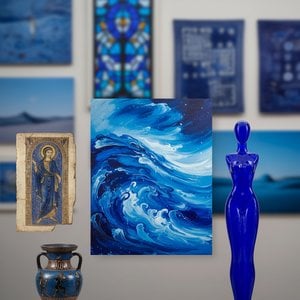
The Allure of Azure: Exploring the Symbolic & Aesthetic Depths of Blue in Art History
Explore the rich history of blue in art! Discover its symbolism, from ancient pigments to modern masterpieces by Kandinsky & Seurat. Uncover the psychological impact and cultural meanings behind this captivating hue.

Mastering Abstraction: The 25 Most Iconic Works by Wassily Kandinsky
Explore 25 iconic Kandinsky masterpieces and the birth of abstraction. Discover the full collection online at ArtsDot.com.