


 Vaata sisu
 Jaga teost
 Jaga
Jaga
 Detailid
 Õppekate juhend

 Laadi alla
 Sarnased teosed
 Röntgenuuring
 Slaidietendus
 Statistika
Classical Landscape


 Loe lähemalt
Giclée / Kunstiprint
Muuseumikvaliteediga giclée- või kangasprint kiire tootmisega ja paindlikud viimistlusvõimalused. ( Telli käsitsi maalitud reproduktsioon Ülemineku digitaalse pildi müügi kanalisse)




P118B €10

P118H €10

P118W €10

P438Z €10

P508JH €12

P508YH €12

P805H €10

P805Z €10

P919BZ €10

P919G €10

P919XJ €10

P959ZH €10

P968JZ €12

W106C €8

W218G €10

W218JH €8

W218Y €10

W307PJ €10

W316G €10

W316PJ €8

W316Y €10

W398PJ €8

W4111J €10

W500HY €15

W500JH €15

W692G €12

W849H €8

W940BG €15

W953PJ €8




Vali meie eelmääratud suurused, mis vastavad teose algupärastele proportsioonidele.

Sisestage vajalik laius ja kõrgus, et see sobiks teie raamile või seinale. Trükki saab ainult lõigata, seda ei saa kunagi pildist suuremaks teha, seega ka differentse vormiga suurus kaotab osa pildist. Enne trükkimist saadame teile kinnitamiseks digitaalse näidisprojektsiooni. Sellel lehel näidatud pilt ei kujuta reaalset lõiget — seda näitab ainult näidisprojekttsioon.
Ülemaailmne tarne () 2 nädala jooksul, tavalise 4/5 nädala asemel. (21 oktoober)

Tasuta ekspresssaatmine üle maailma

Kõrgekvaliteediline lina-kangastest muld

Täielik transpordikindlustus

Tollimaksude tagastamise garantii

Värvitoime täpsuse garantii

100 päeva tagastusõigus (ainult defektide korral)

100% raha tagasi garantii

Hulgusoodustus
 Klaasivalik on saadaval ainult kuni 110 cm suuruses teostes

Classical Landscape
Giclée / Kunstiprint
Reproduktsiooni mõõtmed
-


Lõppsumma
€ 54
Jean-Victor Bertin’s Classical Landscape: A Window Into Romantic Reverie
Jean-Victor Bertin (1767–1842) stands as a pivotal figure in the burgeoning landscape painting movement of late 18th and early 19th century France, bridging the gap between Neoclassicism’s rigid formalism and the emotive fervor of Romanticism. Unlike his contemporaries who primarily documented observable realities, Bertin embarked on a more ambitious endeavor: crafting immersive atmospheres steeped in classical allusion while simultaneously capturing the sublime beauty of the natural world.
His artistic journey began under the tutelage of Pierre-Henri de Valenciennes, a sculptor and landscape painter whose influence instilled in Bertin a meticulous approach to observation coupled with compositional rigor. Valenciennes championed the importance of accurately representing nature’s grandeur—a principle that would permeate Bertin's oeuvre throughout his prolific career.
Bertin’s training at the Académie royale de peinture et de sculpture solidified his understanding of artistic conventions, yet he swiftly diverged from established norms. He wasn’t merely replicating scenery; he was actively shaping it—transforming landscapes into canvases brimming with symbolic resonance and imbued with a palpable sense of emotion.
The Painting's Subject Matter: A Pastoral Ideal
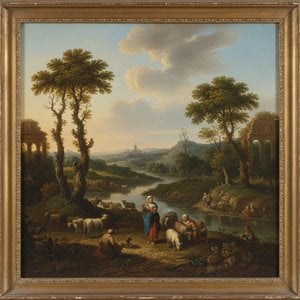
“Classical Landscape” depicts a serene Baroque/Romantic scene centered around ruins and lush vegetation. Bertin’s vision isn’t simply a depiction of a picturesque vista; it’s an imaginative interpretation of classical pastoral ideals—a genre deeply rooted in Renaissance humanist thought.
The composition unfolds with deliberate care, guiding the viewer's eye through a cleft in ancient trees, beyond which a carefully ordered succession of distinct planes culminates in distant mountains. This masterful use of atmospheric perspective softens the contours of the landscape, creating an ethereal quality that evokes feelings of tranquility and contemplation.
Technique and Style: Precision Meets Emotion
Bertin’s technique is characterized by painstaking detail—a hallmark of Neoclassical painting—yet it's tempered with Romantic sensibilities. He employed oil paints on canvas to achieve remarkable luminosity and tonal gradation, capturing the subtle nuances of light and shadow.
The scene unfolds in a clearing dominated by two young women who hold up garlands of flowers, symbolizing fertility and renewal. At the center right, shepherds offer an homage to Pan—the ancient Greek god of shepherds and flocks—further enriching the painting’s symbolic tapestry.
Historical Context: Bridging Eras
“Classical Landscape” emerged during a period of significant artistic transformation. Bertin's work reflects the broader shift from the austere grandeur of Neoclassicism to the expressive dynamism of Romanticism, mirroring the intellectual currents of his time. The painting’s depiction of ruins serves as a poignant reminder of the passage of time and the enduring influence of classical mythology.
Bertin's meticulous rendering—combined with his masterful use of atmospheric perspective—solidifies his place as one of the foremost landscape painters of his era, leaving behind a legacy of breathtaking beauty and profound artistic insight. It exemplifies the Romantic ideal of capturing sublime emotion within meticulously crafted natural settings.
Küsimused ja vastused
Kuidas kunstiliikumine ja ajastu tegemist on teoses „Classical Landscape“, autor Jean-Victor Bertin?
Teos „Classical Landscape“, autor Jean-Victor Bertin kuulub Classical Reverie suunasse ning on loodud autori Varajärgne modernne ajastu ajastul.
Kas teoses „Classical Landscape“, autor Jean-Victor Bertin kasutatakse tugevaid kontraste või pehmeid harronioid?
Teose „Classical Landscape“, autor Jean-Victor Bertin väruanalüüs on tuvastatud Statement kontrast ja Unified Palette harmoonia.
Kas teose "Classical Landscape" autoriõigused on kaitse all?')
Teos „Classical Landscape“, autor Jean-Victor Bertin kuulub lubaõigusliku staatuse avalikus õiguses – selle autoriõigud onหมดunud alla. See staatus reguleerib teose pildi reprodüseerimise võimalusi.
Sarnased teosed


Sarnased artiklid

John Constable: 25 Suurimat Teost Inglise Maastikumaali Tippu
Avastage John Constable'i 25 suurimat teost! Sukeldu inglise maastikumaali romantismisse, imetlege Dedham Vale ilu ja leia inspiratsiooni kodukaunistuseks. Kvaliteetsed kunstireprodutsioonid ArtsDot.com-is. Vaata kohe!
Nicolaes Berchem: Dutch Golden Age Pastoralism & the Evolution of Landscape Painting
Explore the captivating world of Nicolaes Berchem, a leading Dutch Golden Age painter. Discover his idyllic landscapes, masterful technique & lasting influence on art history. Learn more at ArtsDot.

Romantilise Maastikukunsti 10 Meisterteost: Kunstiteosed Koduks ArtsDot.com'ist
Avastage 10 romantilise maastikukunsti meistriteost! Tutvuge Caspar David Friedrichi, J.M.W. Turneri ja teiste suurte kunstnike loominguga ArtsDot.com-is. Leidke täiuslik õlimaal või reproduktsioon koduks – inspireeriv kollektsioon ootab!

Nicolas Poussin: Classicism, Allegory & Order in 17th-Century French Painting
Explore the life & work of Nicolas Poussin, a master of French Classicism. Discover his allegorical paintings, Roman influences, and enduring impact on art history. Expert analysis & insights.

Evocations of Place: A Historical Journey Through Landscape Art
Explore the rich history of landscape art with ArtsDot. Discover renowned artists, movements like Impressionism & Romanticism, and expert guidance for collecting timeless pieces. Find your perfect serene escape today!