


 Vaata sisu
 Jaga teost
 Jaga
Jaga
 Detailid
 Õppekate juhend

 Laadi alla
 Sarnased teosed
 Röntgenuuring
 Slaidietendus
 Statistika
A.158
 Acrylic On Canvas
- WallArt
- Abstract Expressionism
 100.0 x 100.0 cm
 MAGA - Museo Arte Gallarate
 Loe lähemalt
Sellel lehel kuvatav kunstiteos on kaitstud autoriõigusega, mis tähendab, et meil ei ole seaduslikku õigust luua või müüa identset reproduktsiooni. Seda kaitset rakendatakse rahvusvaheliste kokkulepete alusel, nagu näiteks Berne konventsioon ning riiklike seadustega, sealhulgas nendega, mida on sätestatud USA autoriõiguse seadus – 17. peatükk.
Austasena ja seaduslikuna alternatiivina pakume originaalist inspireeritud, käsitsi maalitud isikupärastatud teoseid. Meie osutavad ja professionalsed kunstnikud uurivad hoolikalt originaali stiili, meelemoi ja kunstilist olemust, et luua uus, ainulaadne teos, mis tekitab sama tunnet – olles samal ajal omaette originaalne looming.
See meetod järgib täielikult autoriõiguse reegleid, kuna see ei põhine kaitstud kunstiteose kopeerimisel või dupliteerimisel. Selle asemel on tegu loova reinterpreetatsiooniga – uue maaldisega, mis on algteosest inspireeritud, kuid ei ole sellest identiline.
Käsitsi valmistatud õlimaalireproduktsioon
Meie kunstnike poolt tellimusel valmistatud käsitsi maalitud õli-kainaste teos teie soovitud suuruses ja raamis. ( Lülita trükkitoodetele Ülemineku digitaalse pildi müügi kanalisse)




P118B €10

P118H €10

P118W €10

P438Z €10

P508JH €12

P508YH €12

P805H €10

P805Z €10

P919BZ €10

P919G €10

P919XJ €10

P959ZH €10

P968JZ €12

W106C €8

W218G €10

W218JH €8

W218Y €10

W307PJ €10

W316G €10

W316PJ €8

W316Y €10

W398PJ €8

W4111J €10

W500HY €15

W500JH €15

W692G €12

W849H €8

W940BG €15

W953PJ €8




Vali meie eelmääratud suurused, mis vastavad teose algupärastele proportsioonidele.

Sisestage vajalik laius ja kõrgus, et teos sobiks teie raamile või seinale. Kuna tegu on käsipainatud teosega, siis erineva kujuga suuruse korral võib kunstnik jätta pildi ümber veidi rohkem marginaali või lõigata osa ära — valik on teie. Enne maali alustamist saadame teile kinnitamiseks digitaalse näidisprojektsiooni. Sellel lehel näidatud pilt ei kajasta tegelikku tulemust — seda näitab ainult näidisprojekttsioon.
Pärast tellimust saadab ArtsDot.com meeskond kliendile e-posti juhised ning esitab eelvaate kavandi
Maailmline tarne 3–4 nädala jooksul tavalise 5 nädala asemel. (18 oktoober). Kvaliteedis kompromisse ei tehta.

Tasuta ekspresssaatmine üle maailma

Kõrgekvaliteediline lina-kangastest muld

Täielik transpordikindlustus

Tollimaksude tagastamise garantii

Värvitoime täpsuse garantii

100 päeva tagastusõigus (ainult defektide korral)

100% raha tagasi garantii

Hulgusoodustus
 Klaasivalik on saadaval ainult kuni 110 cm suuruses teostes

A.158
Reproduktsiooni materjal
Reproduktsiooni mõõtmed
-


Lõppsumma
€ 229
The Luminous Path: An Exploration of A.158
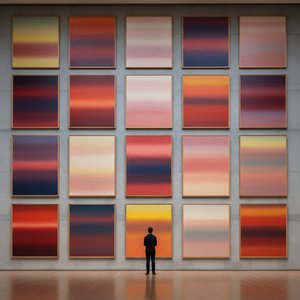
To stand before A.158 is to encounter a moment suspended between vibrant energy and serene contemplation. Claudio Verna’s canvas presents an immediate, arresting visual dialogue—a field of soft, enveloping pink bisected by a decisive, radiant yellow line. This is not merely decoration; it is a carefully orchestrated optical experience. The background itself seems imbued with the warmth of a blush-toned dawn, suggesting emotional resonance and gentle expanse. Yet, this softness is challenged, guided, and ultimately elevated by that singular streak of yellow. It draws the eye with an almost magnetic force, inviting the viewer into its luminous passage.
Technique and Compositional Flow
Verna’s mastery in this piece lies in his handling of acrylic on canvas. The application appears fluid yet controlled, allowing the pink ground to breathe while maintaining a palpable depth. The yellow line functions as more than just a compositional element; it is a vector, an invisible current guiding the viewer's gaze across the 100 x 100 cm square. While there is a subtle human presence anchored in the lower left corner, its relative quietude allows the abstract interplay of color and line to dominate the narrative. The technique speaks to a modern sensibility—one that values graphic clarity alongside atmospheric wash.
Symbolism of Color and Line
In art history, color choices are rarely accidental. Here, the pairing of soft pink with brilliant yellow evokes themes of optimism, transition, and illumination. Pink often symbolizes tenderness or nascent emotion, providing a receptive emotional field. Against this, the sharp, bright yellow acts as a conduit—a path toward understanding or breakthrough. The line itself suggests journey, connection, or perhaps even the passage of time viewed through an optimistic lens. It is the visible manifestation of an idea moving from one state to another.
Integrating Art into Living Space
For the discerning collector or interior designer, A.158 offers unparalleled versatility. Its abstract nature means it complements a vast array of décor styles, from minimalist modernism to richly textured bohemian spaces. Imagine this piece anchoring a room—the soft pink echoing blush textiles or pale wood tones, while the yellow line provides the necessary jolt of curated energy against deep jewel-toned furniture. It is a focal point that whispers rather than shouts, adding intellectual depth without overwhelming the domestic harmony.
The Enduring Resonance of Modern Abstraction
Claudio Verna’s work situates itself within a lineage of post-war Italian abstractionism, yet it possesses a distinctly contemporary lightness. It speaks to an era where academic rigor met emotional freedom. Owning this reproduction is acquiring a piece that honors the journey of modern art—a dialogue between structure and feeling. It invites daily contemplation, suggesting that even in the most structured environments, there remains room for a luminous, guiding path.
Küsimused ja vastused
Kes on teose "A.158" autor ja millises suunast see on?
Claudio Verna lõi teose "A.158" Abstract Expressionism suunaga.
Kust saan näha originaalteost „A.158“, autor Claudio Verna?
Originaalteost „A.158“, autor Claudio Verna hoiustatakse MAGA - Museo Arte Gallarate, Gallarate, Italy muuseumis. Reproduktsioon võimaldab teost koduses keskkonnas esitleda.
Kust saan alla laadida „A.158“, autor Claudio Verna?
Teose „A.158“, autor Claudio Verna digitaalset pilti saab alla laadida selle teose Laadi alla lehelt: kõrge resolutsiooniga digitaalse pildi allalaadimine.
Sarnased teosed


Kunstniku elulugu
Early Life and Artistic Foundations
Claudio Verna, born in the picturesque town of Guardiagrele, Italy, in 1937, embarked on an artistic journey that would establish him as a pivotal figure in Italian post-war painting. His early life, marked by a family relocation to Foligno in Umbria, instilled within him a deep appreciation for the region’s rich cultural heritage and landscape—elements that subtly permeate his later work despite its abstract nature. Verna's formal education began with studies in Umbria before he pursued a degree in political science at the University of Florence, graduating in 1961 with a thesis exploring the complex relationship between “Figurative Arts in Industrial Civilization.” This academic grounding proved crucial, providing him with a framework for understanding art’s evolving role within a rapidly changing society. It was during his time in Florence that Verna first engaged with the currents of classical abstractionism and began exhibiting his work, laying the initial foundations for a career defined by rigorous exploration and independent thought.The Birth of Pittura Analitica
Following his move to Rome in 1961, Verna deliberately withdrew from the public art scene for several years. This period wasn’t one of inactivity but rather intense self-examination—a crucial phase where he sought to define a unique artistic language and methodology. By 1967, when he re-emerged, it was with a clear vision that would give rise to *Pittura Analitica* (Analytical Painting). This movement, born from Verna’s conviction in the “ancient and indispensable reasons” of painting, represented a profound reflection on the very act of creation and its connection to artistic tradition. Pittura Analitica wasn't merely about what was depicted but *how* it was depicted—a focus on the fundamental elements of color, form, and surface. It became an Italian response to the prevailing minimalism, yet distinguished itself through a heightened sensitivity to chromatic intensity and emotional resonance.A Language of Color and Rigor
Verna’s paintings are characterized by their striking simplicity and essentiality. He strips away extraneous detail, focusing instead on the pure expressive power of color. His canvases become arenas where hues interact, vibrate, and define space—often employing vertical lines and muted tones that create a sense of contemplative calm. The artist doesn't simply apply color; he investigates its qualities, exploring saturation, light, and texture with meticulous precision. This pursuit isn’t cold or detached, however. Verna describes his work as existing “between the polarity of extreme rigor and intense emotional abandon,” suggesting a dynamic tension between intellectual control and visceral feeling. His works from the 1970s demonstrate this shift towards greater freedom of expression after an initial period of austerity linked to the principles of Analytical Painting, revealing a pulsating relationship between geometry and color.Exhibitions, Recognition, and Lasting Influence
Throughout his prolific career, Claudio Verna has held over one hundred solo exhibitions in Italy and abroad, cementing his reputation as a leading figure in contemporary Italian art. His work has been showcased at prestigious venues including the Venice Biennale (1970 and 1980), and retrospectives have graced museums in Gibellina, Spoleto, Ferrara, Conegliano, Treviso, L’Aquila, and Milan's Mudima Foundation. He has also participated in numerous group exhibitions across Europe and beyond—from Düsseldorf to London, Philadelphia to Moscow—further expanding his international reach. In 2008, Verna received the esteemed “Antonio Feltrinelli” Prize for painting from the National Academy of the Lincei, a testament to his significant contributions to the art world. His appointment as a National Academician of the Accademia di San Luca further solidified his position within Italy’s artistic establishment.A Legacy of Reflection and Innovation
Claudio Verna's enduring legacy lies in his unwavering commitment to exploring the fundamental principles of painting. He challenged conventional notions of representation, prompting viewers to engage with art on a deeper, more intellectual level. The publication of the Catalogue Raisonné of his work in 2010, curated by Volker W. Feierabend and Marco Meneguzzo, serves as a comprehensive testament to his artistic journey and its profound impact on contemporary art discourse. Verna’s influence extends beyond his own canvases; he inspired generations of artists to question the nature of their practice and to seek new ways of expressing themselves through color, form, and texture. He remains an active artist today, continuing to refine his unique vision and contribute to the ongoing evolution of abstract painting.
Claudio Verna
1937 - , Italy
Lühikest infot
- Full Name: Claudio Verna
- Nationality: Italian
- Date Of Birth: 1937
- Place Of Birth: Guardia Grele, Italy
- Notable Artworks:
- Pittura
- Deriva
- Costellazione
- Artistic Movement Or Style: Pittura Analitica, Minimalism
Sarnased artiklid

Geomeetrilise Abstraktsiooni 10 Meisterteost: Kunst ja Kodukaunistus ArtsDot.com-is
Avastage geomeetrilise abstraktsiooni 10 suurteost – Kandinsky, Mondrian ja teised. Lugege kunstiteoste lugusid ning leidke inspiratsiooni kodukaunistuseks ArtsDot.com-is! Kunstikollektsioon ja reprodutsioonid.

Kandinsky's Masterpieces: 25 Paintings That Define Abstract Art | ArtsDot
Journey through Wassily Kandinsky's 25 most iconic abstract paintings. Explore his revolutionary use of color, form & spiritual expressionism. Find museum-quality Kandinsky reproductions and elevate your home decor with ArtsDot.com. Discover all masterpieces on ArtsDot.com!

Abstract Ekspressionismi 10 Meisterteost: Kunsti ja Sisustamise Klassikat
Sukeldu abstraktse ekspressionismi maailma! Avasta 10 legendaarset kunstiteost – Pollock, Rothko jt. – ja nende loo. Leia inspiratsiooni interjööriks ning kaunista kodu ArtsDot.com kvaliteetsete reproduktsioonidega. Uuri kollektsiooni!
Mark Rothko 25 Parimat Teost: Emotsionaalsed Värvid ja Sügav Sisu | ArtsDot
Avastage Mark Rothko 25 parimat teost! Sukelduge ekspressionismi sügavustesse, emotsionaalsetesse värvimaalid ja kunstniku lugudesse. Leidke täiuslik seinakaunistus ArtsDot.com-ist – kvaliteetsed reproduktsioonid ja interjööride inspiratsioon.

Blush & Brilliance: 10 Iconic Paintings Dominated by Light Pink Tones |
Explore 10 iconic paintings bathed in captivating light pink tones! From Monet's Impressionism to Renoir’s romance, discover the stories behind these blush-hued masterpieces. Find museum-quality art reproductions & decor inspiration at .