

 Eelvaade
 Saada
Saada Jaga
Jaga
 Teave teose kohta
 Juhend

 Laadi alla
 Sarnased teosed
 Röntgenuuring
 Slaidietendus
 Q&A
Q&A Statistika
The Baptism

- 122.0 x 150.0 cm


 Loe lähemalt
Sellel lehel kuvatav kunstiteos on kaitstud autoriõigusega, mis tähendab, et meil ei ole seaduslikku õigust luua või müüa identset reproduktsiooni. Seda kaitset rakendatakse rahvusvaheliste kokkulepete alusel, nagu näiteks Berne konventsioon ning riiklike seadustega, sealhulgas nendega, mida on sätestatud USA autoriõiguse seadus – 17. peatükk.
See meetod järgib täielikult autoriõiguse reegleid, kuna see ei põhine kaitstud kunstiteose kopeerimisel või dupliteerimisel. Selle asemel on tegu loova reinterpreetatsiooniga – uue maaldisega, mis on algteosest inspireeritud, kuid ei ole sellest identiline.
Giclée / Kunstiprint
Muuseumikvaliteediga giclée- või kangasprint kiire tootmisega ja paindlikud viimistlusvõimalused. ( Osta käsitsi maalatud teos Lülita digitaalse pildi juurde)




P118B €10

P118H €10

P118W €10

P438Z €10

P508JH €12

P508YH €12

P805H €10

P805Z €10

P919BZ €10

P919G €10

P919XJ €10

P959ZH €10

P968JZ €12

W106C €8

W218G €10

W218JH €8

W218Y €10

W307PJ €10

W316G €10

W316PJ €8

W316Y €10

W398PJ €8

W4111J €10

W500HY €15

W500JH €15

W692G €12

W849H €8

W940BG €15

W953PJ €8




Vali meie eelmääratud suurused, mis vastavad teose algupärastele proportsioonidele.

Sisestage vajalik laius ja kõrgus, et see sobiks teie raamile või seinale. Trükki saab ainult lõigata, seda ei saa kunagi pildist suuremaks teha, seega ka erineva mustega suurus kaotab osa pildist. Enne trükkimist saadame teile kinnitamiseks digitaalse näidisprojektsiooni. Sellel lehel näidatud pilt ei kujuta reaalset lõiget — seda näitab ainult näidisprojektsioon.
Ülemaailmne tarne () 2 nädala jooksul, tavalise 4/5 nädala asemel. (2 november)

Tasuta ekspresssaatmine üle maailma

Kõrgekvaliteediline lina-kangas

Täielik transpordikindlustus

Tollimaksude tagastamise garantii

Värvitoime täpsuse garantii

100 päeva tagastusõigus (ainult valmistusdefektide korral)

100% raha tagasi garantii

Hulgusoodustus
 Klaasivalik on saadaval ainult kuni 110 cm suuruses teostes

The Baptism
Giclée / Kunstiprint
Reproduktsiooni suurus
-


Koguhind
€ 55
A Moment Frozen in Time
In The Baptism, Antonio Donghi achieves something truly extraordinary: he captures a fragment of middle-class life and suspends it in a state of eternal, quietude. The painting presents a family scene featuring three central figures, where a man in a suit and tie and a woman cradling a baby are set within a space that feels simultaneously real and profoundly abstract. There is a haunting quality to the composition; the individuals appear almost as immobile wax statues on a podium, their expressions neutral and strangely detached from the joyous occasion they are celebrating. This sense of emotional distance creates a tension between the sacred nature of the ritual and the stoic, almost frozen presence of the participants, as if they are waiting for a ritual photograph that will never quite capture their true essence.
< p>The atmosphere is charged with an unreal lack of familiarity, driven by an adamant painting style and a fixed, absorbed light that illuminates the scene with surgical precision. Donghi’s mastery lies in his ability to use light not just to reveal form, but to create a sense of mystery. The figures are set in a minimal environment that strips away the distractions of the modern world, leaving only the essential elements of the event. This deliberate reduction of detail allows the viewer to focus on the subtle interplay of texture and shadow, making the painting feel less like a mere depiction of an event and more like a dreamlike meditation on existence itself.The Artistry of Neoclassical Precision
Technically, The Baptism is a triumph of the Neoclassical movement, showcasing Donghi’s refined ability to marry meticulous detail with a powerful, structured composition. His attention to the clothing of the subjects—a skill perhaps inherited from his father, a fabric dealer—serves a deeper purpose than mere ornamentation; it functions as a way to socially characterize the roles of those portrayed. Every fold in the fabric and every sharp line in the attire contributes to the painting's sense of social order and permanence. The spatial clarity is remarkable, with each element occupying its place with absolute certainty, reminiscent of the architectural stability found in the works of Renaissance masters like Piero della Francesca.
For the discerning collector or interior designer, this work offers a unique aesthetic value. It possesses a Magical Realism that avoids the chaotic energy of much modern art, offering instead a sense of profound, meditative calm. The painting’s ability to evoke both the mundane and the monumental makes it a captivating centerpiece for any sophisticated space. Whether one is drawn to its smooth, polished surfaces or its enigmatic, quiet dignity, The Baptism stands as a testament to the power of stillness. It invites the observer to pause, to look closely, and to find beauty in the silent resonance of a single, captured moment.
Korduvad küsimused
Millast ajastu kuulub teos "The Baptism"?
Teos "The Baptism" kuulub Modern ajastu.
Kuidas teos "The Baptism" tasakaalustab valgust ja pimendust?
Teose „The Baptism“, autor Antonio Donghi eregus on shadow ja luminants on Dark.
Millist kontrasti näitab teos „The Baptism“, autor Antonio Donghi?
Teose „The Baptism“, autor Antonio Donghi kontrastivaimustus on Balanced.
Sarnased teosed


Kunstniku elulugu
The Silent Resonance of Antonio Donghi
In the quietude of an Italian afternoon, where light rests heavily upon a simple vase or a solitary figure, one finds the soul of Antonio Donghi. Born in Rome in 1897, Donghi emerged as a master of the unseen, a painter capable of transforming the most mundane scenes of popular life into moments of profound, almost sacred, stillness. His journey began within the disciplined walls of the Instituto di Belle Arti, where he cultivated a technical precision that would become his lifelong signature. However, it was the turbulence of World War I that served as a crucible for his artistic identity; emerging from military service, Donghi sought refuge not in the chaotic abstractions of the burgeoning avant-garde, but in the enduring clarity of classical tradition and the serene landscapes of the Italian spirit.
As he wandered through the intellectual corridors of Florence and Venice, Donghi absorbed the gravity of the Renaissance masters. He found a spiritual kinship with the monumental simplicity of Piero della Francesca, whose influence is visible in the architectural stability and rhythmic poise of Donghi’s figures. This was not merely an imitation of the past, but a deliberate reconstruction of reality. His work became a cornerstone of the Neoclassical movement and the Valori Plastici circle, where he championed a return to "plastic values"—a focus on form, volume, and a certain archaic stiffness that lent his subjects a timeless, almost statuesque quality. To look upon a Donghi painting is to witness a world stripped of modern frenzy, replaced by a deliberate, meditative calm.
A Mastery of Light and Stillness
The brilliance of Donghi’s technique lies in his ability to marry the meticulous with the emotive. Critics of his era often drew comparisons to Georges Seurat and Henri Rousseau, noting how he could imbue contemporary scenes with a subtle, dreamlike humor and a sense of detachment. His compositions are characterized by an extraordinary spatial clarity; every element, from a stray petal in a still life to the distant contour of a Tuscan hill, occupies its place with absolute certainty. There is no ambiguity in his brushwork, only a refined execution that captures the soft glow of light as it interacts with texture and shadow.
His subject matter often revolved around the beauty of the everyday:
- Still Lifes: Simple arrangements of flowers or fruit, rendered with a disarming symmetry reminiscent of naive art.
- Genre Scenes: Depictions of laundresses, jugglers, and cafe patrons, where figures possess a quiet dignity and a certain cool, enigmatic distance.
- Landscapes: Precise, detailed views of the Italian countryside, particularly in northern Lazio, Umbria, and Tuscany, captured with an almost photographic devotion to detail.
Legacy and the Rediscovery of a Master
Despite his meteoric rise in the 1920s—marked by international acclaim and successful exhibitions in New York—Donghi’s career faced the inevitable ebb of shifting artistic tides. As the art world moved toward more aggressive and experimental modes of expression, his commitment to figurative clarity was occasionally dismissed as old-fashioned or out of touch with the post-war zeitgeist. For several decades, his name receded from the primary critical discourse, a period of relative obscurity that lasted until a profound reassessment by art historians in the 1980s.
Today, Antonio Donghi is celebrated not as a relic of the past, but as a visionary who found strength in stability. His ability to evoke Magical Realism through the lens of Italian Neoclassicism has secured his place in the pantheon of 20th-century masters. His works now reside in the most prestigious collections, including the National Gallery of Modern Art in Rome and the Palazzo Pitti in Florence, serving as a permanent testament to his ability to find the eternal within the ephemeral. He remains the quiet master, reminding us that there is immense power in the pause, and profound beauty in the simple act of looking.

Antonio Donghi
1897 - 1963 , Italy
Lühikest infot
- Full Name: Antonio Donghi
- Nationality: Italian
- Date Of Birth: 1897
- Date Of Death: 1963
- Place Of Birth: Rome, Italy
- Notable Artworks:
- The Baptism
- Woman in a Cafe
- Artistic Movement Or Style: Neoclassical
- Artists Who Influenced This Artist:
- Henri Rousseau
- Georges Seurat
- Artists Or Movements Influenced By This Artist: ['Naive Art']
Sarnased artiklid

The Enduring Legacy of Family Portraiture: A Historical & Artistic Exploration
Explore the rich history of family portraiture with ArtsDot. Discover artistic styles, symbolism & collecting insights. Commission a custom oil painting or appraise your existing artwork today!

Raphaeli 25 parimat teost: Renessansi meistriteosed kodus – ArtsDot.com
Avastage Raphaeli 25 parimat teost! Sukeldu renessanssimaali ilu, luksuslikesse portreedesse ja atmosfäärilistesse freskode. Leia inspiratsiooni kodukaunistuseks ArtsDot.com-is – kvaliteetsed maalide reproduktsioonid ja kunstikollektsioonid.
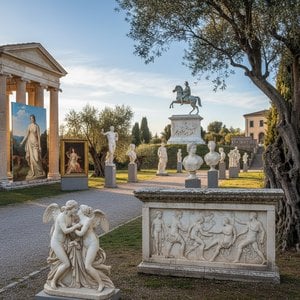
Neoklassitsismi 10 Meisterteost: Kunsti ja Disaini Klassikud
Avasta neoklassitsismi 10 silmapaistvat meistriteost! David, Canova jt legendid – kunstiajaloo klassikud. Tutvu lugudega, tehnikatega ja leid inspiratsiooni oma koduks. Kvaliteetsed kunstireproduktsioonid ArtsDot.com-ilt! Uuri täielik kollektsioon veebis.

Claude Monet: 25 Meisterteost Valgusest ja Värvidest | ArtsDot.com
Avastage Claude Monet 25 kõige ikoonilisemat teost! Sukelduge valgusest ja värvidest tulvil impressionismi maailma. Kunstiteosed, maalid ja seinakaunistused ArtsDot.com-is. Avasta täielik kollektsioon online!

Evolving Portraits: Personalized Art as a Chronicle of Family Life Across Generations
Create a timeless family legacy with custom portraits! ArtsDot connects you with skilled artists for heirloom-quality paintings & prints. Explore styles, commission your unique artwork today.