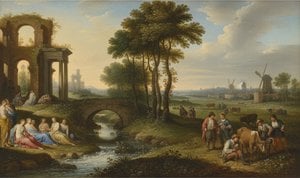
Remigius Adrianus Haanen: A Painter of Winter Landscapes
Remigius Adrianus Haanen (January 5, 1812, Oosterhout – August 13, 1894, Bad Aussee) was a Dutch landscape painter born in the northern Netherlands. He descended from a family of papercutters and was brother to several other artists—George Gillis Haanen, Elisabeth Alida Haanen, and Adriana Johanna Haanen—who shared his passion for capturing the beauty of nature. His artistic journey began with instruction at Utrecht Academy, where he honed his skills before embarking on a significant relocation in 1837 to Austria’s Vienna, establishing himself as a respected figure within the Viennese art scene.- Early Life and Training: Haanen's formative years were marked by familial tradition—his father practiced papercutting—and he received foundational artistic training at Utrecht Academy.
Vienna and Artistic Development
Haanen’s move to Vienna proved pivotal in shaping his artistic style. Surrounded by a vibrant intellectual environment, he embraced Impressionistic influences, particularly evident in his depictions of winter landscapes and river views. These scenes weren't merely representations of scenery; they conveyed a profound sense of atmosphere—the chill air, the glistening snow, the muted colors—reflecting a deep connection to the natural world. His technique involved layering brushstrokes to achieve luminous effects, capturing fleeting moments of light and shadow with remarkable precision.- Notable Works: Among Haanen’s most celebrated paintings are ‘Adrianus van unloading the catch,’ showcasing a bustling harbor scene bathed in winter sunlight; ‘Adrianus van a river landscape,’ presenting tranquil waters under a silvery moon; and ‘Remi van A Moonlit Winter Landscape,’ capturing the ethereal beauty of a snowy expanse.
Influences and Legacy
Haanen’s artistic vision drew inspiration from Eugène Delacroix and Frédéric Chopin, demonstrating his engagement with broader cultural currents. Like Delacroix, he sought to convey emotion through color and composition—a characteristic that distinguishes his landscapes from more purely descriptive works. Furthermore, Haanen's dedication to portraying winter scenes aligns with the Romantic movement’s fascination for sublime beauty and its exploration of human experience in relation to nature.- Museum Collections: Haanen’s paintings reside in prominent museums across Antwerp and Amsterdam, ensuring his artistic legacy continues to inspire admiration and scholarly study.
Concluding Thoughts
Remigius Adrianus Haanen remains a significant contributor to Dutch landscape painting of the 19th century. His masterful execution—characterized by luminous color palettes and evocative compositions—solidifies his place as an artist who successfully translated Romantic ideals into captivating visual narratives. He is remembered not only for his stunning depictions of winter landscapes but also for embodying the spirit of artistic innovation within a period defined by profound cultural transformation.Preguntas y respuestas
¿Qué colores utilizaba con más frecuencia Remigius Van Haanen?
El uso del color de Remigius Van Haanen en las obras listadas en este sitio web puede estudiarse en la página Genoma de la Paleta del artista.
¿En qué periodo histórico trabajó Remigius Van Haanen?
Remigius Van Haanen trabajó durante el periodo 19th Century. Este periodo sitúa la actividad del artista en la historia.
¿Qué tan populares son las obras de Remigius Van Haanen?
Existe una página de Estadísticas para Remigius Van Haanen, que presenta estadísticas sobre las obras del artista en este sitio web.