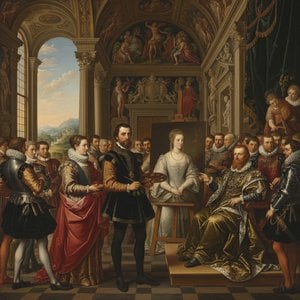
Hans von Aachen
Hans von Aachen (1552 – 4 March 1615) was a German painter who stood as one of the foremost representatives of Northern Mannerism, an artistic movement that flourished in the Low Countries and Germany during the late sixteenth century. Little is known about his early life; however, it’s believed he received his formative artistic training within the workshop of Leonardus Sievenhoven, a prominent Cologne painter whose influence undoubtedly shaped von Aachen's stylistic trajectory.Artistic Style and Influences
Von Aachen’s oeuvre is characterized by a distinctive Mannerist aesthetic—a style marked by bold colors, dramatic compositions, and an unsettling tension that resonated deeply with the sensibilities of his time. His paintings frequently employed elongated figures, meticulously rendered details, and a palpable sense of dynamism, mirroring the stylistic innovations championed by El Greco (domenikos theotokopoulos), whose monumental canvases captivated audiences across Europe. This connection to El Greco’s expressive grandeur is particularly evident in works like “The Crucifixion” (1585), where von Aachen masterfully utilized luminous hues and theatrical lighting to convey profound spiritual emotion. Similarly, "The Last Judgment" (1590) showcases his ability to orchestrate multiple figures within a single frame—a technique that exemplifies the Mannerist preoccupation with complex visual narratives. Furthermore, “Portrait of an Unknown Lady” (1595) demonstrates von Aachen’s exceptional skill in capturing subtle nuances of human expression, reflecting the humanist ideals prevalent during Rudolf II's reign.Notable Collections and Exhibitions
Von Aachen’s artistic legacy continues to inspire admiration and scholarly investigation. His paintings are housed in prestigious institutions across Germany, notably Gemäldegalerie Alte Meister in Dresden—which boasts an expansive collection of European art spanning from the fifteenth to the eighteenth centuries—and Museum Ostdeutsche Galerie in Regensburg, presenting a singular panorama of eastern German artistic heritage. Exploring these collections offers invaluable insight into the dissemination and reception of von Aachen’s groundbreaking vision.Historical Significance
Hans von Aachen's contribution to Northern Mannerism cemented his place as a pivotal figure within European art history. His innovative stylistic choices—particularly his masterful manipulation of color, form, and composition—challenged conventional artistic conventions and propelled the movement toward unprecedented expressive depth. He served as court painter for Emperor Rudolf II, fostering a vibrant cultural environment that nurtured artistic experimentation and celebrated humanist ideals. Today, von Aachen’s paintings stand as enduring symbols of Mannerist grandeur and continue to captivate viewers with their evocative beauty and profound psychological insight—a testament to his enduring influence on subsequent generations of artists.Preguntas y respuestas
¿Cuál es el lugar y el año de nacimiento de Hans Von Aachen?
Hans Von Aachen nació en Cologne en 1552.
¿Dónde se encuentran las obras de Hans Von Aachen organizadas por color?
La página Índice Espectral organiza las obras de Hans Von Aachen por color.
¿Cómo puedo seguir la obra de Hans Von Aachen año tras año?
La página de Cronología de obras del artista presenta las obras de Hans Von Aachen ordenadas por fecha, año tras año.
¿Existe un relato cronológico de Hans Von Aachen?
Un relato cronológico de la obra de Hans Von Aachen está disponible en la página Crónica del artista, donde las obras se presentan en orden de creación, capítulo a capítulo.
¿En qué ciudad y país nació Hans Von Aachen?
Hans Von Aachen nació en Cologne, en Alemania.
¿Dónde se encuentran las obras de Hans Von Aachen agrupadas por movimiento artístico?
Los movimientos en los que trabajó Hans Von Aachen pueden verse en la página de Todos los movimientos del artista, que agrupa las obras por movimiento.
¿Dónde se pueden explorar las obras de Hans Von Aachen clasificadas por tema?
Las obras de Hans Von Aachen pueden explorarse por tema en la página Atlas de temas del artista.
¿Puedo explorar las obras de Hans Von Aachen por estado de ánimo?
Las obras de Hans Von Aachen pueden explorarse por estado de ánimo en la página Galería de estados de ánimo del artista, donde las piezas se organizan según sus emociones registradas.