


The Quiet Interior: Defining Intimacy Beyond the Surface
 Intimacy
, Theo van Rysselberghe
Intimacy is rarely a matter of simple proximity. In the context of fine art, it functions as a quality of closeness, an inward sensation that exists beneath the visible layer of paint. To look at a canvas is to attempt to access a private interiority, a space where the viewer is not merely observing figures in a room, but is instead witnessing a moment of belongingness. This connection manifests through the most subtle hints—a whisper of a gesture or a shared gaze—or through the heavy, undeniable weight of a subject's emotional state. It is about the tension between what is revealed and what remains hidden in the shadows of the composition.
This modern search for the internal echo is mirrored in the works of Theo Van Rysselberghe. His 1890 crayon painting, Intimacy, presents a serene scene of two women engaged in quiet activities within a cozy room. Much like the contemporary desire to find meaning in the quiet corners of a home, his work captures an inward sensation that defies mere physical contact. The art provides the vocabulary for these unspoken attachments, allowing us to feel seen even as we observe a moment long passed.
Domestic Stillness: The Poetics of Everyday Life
 Guitar player
, Johannes Vermeer
There is a specific kind of peace found in the mundane, the repetitive actions that define a life lived in private. We see this in the way light falls across a room, or how a person becomes lost in a singular, repetitive task. These moments are not grand or dramatic; they are the quiet pulses of existence that build a sense of home. When an artist captures a person in a state of introspection, they invite us to slow our own pace and witness the dignity of the ordinary.
Johannes Vermeer’s Guitar player offers a profound example of this domestic tranquility. The painting captures a tender moment of musical serenity, featuring a young woman immersed in her instrument. Her delicate hands and serene expression evoke a sense of calm, turning a simple act of playing music into a private world of quiet elegance. This focus on the everyday life of a single individual reflects a long tradition of genre painting, where the beauty of the moment is found in its stillness rather than its spectacle.
The Human Form: From Sacred Symbolism to Raw Reality
The depiction of the naked body has always been a site of profound tension, shifting between the celebration of form and the weight of social expectation. Throughout history, the body has been used to communicate much more than mere aesthetics; it has been a vessel for strength, suffering, and divinity. From the small, 11 cm-tall Venus of Willendorf created between 28,000 and 25,000 B.C. to the athletic ideals of Ancient Greece, the way we represent the human form tells the story of what we value, what we fear, and what we worship.
This complexity is evident in the works of Giambono, whose painting Man of Sorrows depicts an emaciated Christ to symbolize the depth of human suffering. Here, nudity is not about beauty or desire, but about the raw, vulnerable reality of the human condition. This contrasts sharply with the more idealized or even suggestive depictions found in the Renaissance, such as Correggio’s Danaë, which shows soft-skinned angels and a suggestive pose. Whether through the lens of the sacred or the visceral, the body remains our most direct way of expressing the human experience.
Sensual Details: The Language of Objects and Adornment
 John Singer Sargent
. American expatriate portraitist of the Gilded Age, known for fluid brushwork and elegant depictions of high-society figures and landscapes.
Intimacy is often communicated through the things we touch and the objects we surround ourselves with. In the 19th century, sensuality was frequently expressed through the use of devotional objects, fine tableware, and intricate jewelry. These items act as extensions of the self, signaling status, desire, or piety. The texture of a fabric or the glint of a gemstone can speak volumes about the private life of the subject, adding layers of meaning to a scene without the need for explicit action.
This interplay of the material and the personal is a hallmark of 19th-century art, where artists like John Singer Sargent and Gustave Moreau explored the construction of sexuality and social identity. By focusing on the sensory details of adornment, these artists moved beyond the surface of the skin to explore how we present ourselves to the world—and how we retreat into our private selves when the jewelry is removed and the lights are dimmed.
Abstracted Emotion: Finding Connection in Modernity
 Untitled
, Jackson Pollock
As art moved into the modern era, the need to represent the physical world clearly began to give way to a desire to represent the feeling of a moment. Intimacy became less about the literal shape of a body and more about the energy of an encounter. This shift allowed artists to explore the chaotic, swirling, and often violent nature of human passion, moving away from the controlled lines of the past toward something far more visceral and immediate.
Jackson Pollock’s Untitled exemplifies this departure. Rather than depicting two figures in a realistic embrace, Pollock presents an impression of intimacy through a vortex of lines and fragmented shapes. The composition is dynamic, conveying a sense of passionate energy that exists within a flattened plane. There is no background to provide context; there is only the intensity of the interaction, proving that even in abstraction, the essence of human connection remains the central subject.
Immersive Presence: The Atmosphere of Shared Moments
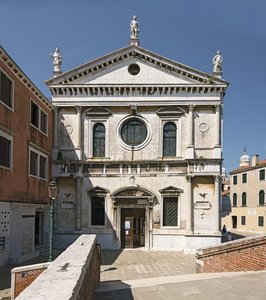 San Sebastiano
Discover San Sebastiano in Venice: A breathtaking church adorned with masterpieces by Paolo Veronese! Explore Venetian art history & architectural beauty in this unique, immersive space.
Sometimes, the power of an intimate work lies not in the subject itself, but in the atmosphere that surrounds it. The way light interacts with stone, the scent of incense, or the hushed reverence of a space can transform a viewing into an experience. When art is experienced in its original context, the boundary between the observer and the observed begins to blur, creating a sense of being present within the history of the work.
The San Sebastiano in Venice offers a profound sense of this immersion. Unlike the sterile, isolated environments of many modern museums, here the works are enveloped in their original context. The flickering candlelight and the subtle scent of incense create a sensory richness that allows a visitor to feel the spiritual significance of the art. It is a place where one does not just see art, but feels the enduring power of human creativity through the very air of the room.
Curating Connection: Integrating Intimacy into Your Living Space
Bringing art into a home is an act of defining one's own private world. Whether through a large-scale mural that transforms a ceiling or a small, contemplative portrait that sits on a desk, the art we choose acts as a mirror to our own inner lives. It allows us to surround ourselves with the emotions and stories that resonate with us, turning a house into a space of personal meaning and quiet reflection.
At ArtsDot.com, we believe that art should be accessible and deeply personal. We offer a variety of ways to bring these moments of connection into your home, from hand-painted oil reproductions that capture the tactile depth of a masterpiece to custom commissions that turn your own memories into art. Whether you are looking for a specific color palette to match your decor or a "remix" of a historical style to suit your modern taste, our experts are here to help you find the piece that speaks to your own unique story. Explore our collections and discover how art can transform your space into a sanctuary of beauty and intimacy.


