

Andrea del Sarto: Florentine Grace, Technical Mastery & Artistic Ambition
Índice
Early Life & Apprenticeship: Forging a Florentine Style
 Wikipedia: Italian Renaissance
The Italian Renaissance (Italian: Rinascimento [rinaʃʃiˈmento]) was a period in Italian history during the 15th and 16th centuries. The period and place are known for the initial development of the broader Renaissance culture that spread from Italy t...
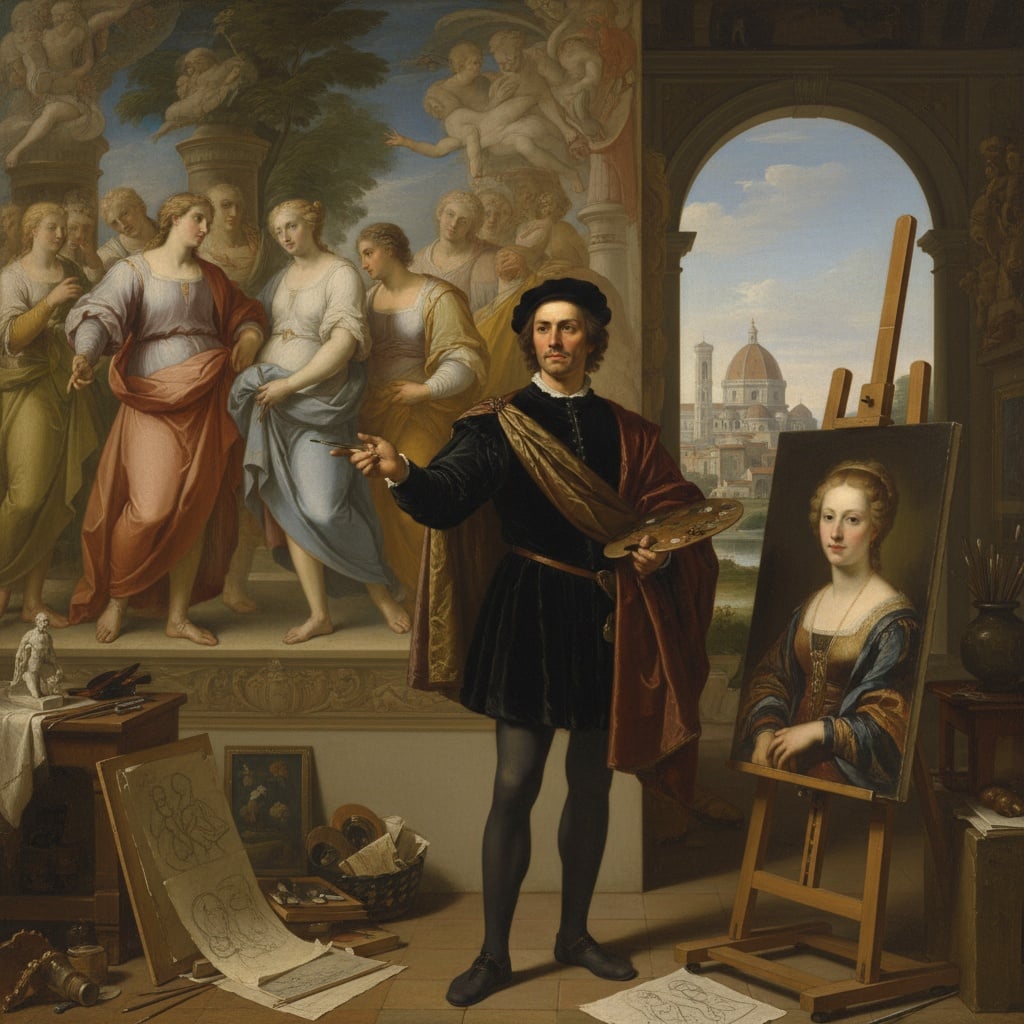
Andrea del Sarto, born Andrea d’Agnolo di Francesco di Luca in 1486 Florence, emerged from a milieu steeped in artistic tradition yet poised for innovation. His very nickname, “del Sarto” – meaning ‘of the tailor’ – speaks to his humble origins, a grounding that perhaps instilled a meticulous attention to detail evident throughout his oeuvre. While early apprenticeships with goldsmiths and woodcarvers provided foundational skills, it was his tutelage under Piero di Cosimo and Raffaellino del Garbo that truly ignited his artistic path. These formative years weren’t merely about mastering technique; they were about absorbing the spirit of Florence itself – a city pulsating with the legacy of Brunelleschi, Donatello, and Leonardo da Vinci. Unlike some contemporaries who sought radical departures, Del Sarto's early work reveals a deliberate synthesis of existing styles, a careful study of classical forms blended with an emerging personal voice. This wasn’t imitation, but rather a considered dialogue with the past, laying the groundwork for his distinctive harmonious compositions.
The Frescoes of Santissima Annunziata: A Showcase of Harmonious Composition
 Santissima Annunziata
Paintings for the Armadio degli Argenti (detail)
The Basilica della Santissima Annunziata became Del Sarto's most significant canvas during a prolific period between 1509 and 1514. Commissioned alongside Franciabigio and Andrea Feltrini, he embarked on a series of frescoes depicting the life of Saint Filippo Benizzi. These weren’t simply devotional images; they were narratives brought to life with an unprecedented sense of naturalism and emotional depth. Del Sarto's skill lay in his ability to orchestrate complex scenes – bustling crowds, dynamic gestures, and architectural settings – into cohesive wholes. The figures aren’t static icons but individuals caught in moments of genuine feeling, their interactions imbued with a quiet dignity. Notice the subtle interplay of light and shadow, the graceful curves of drapery, and the carefully considered color palettes that create an atmosphere of serene beauty. The *Procession of the Magi*, completed in 1511, is particularly striking; it’s not merely a religious procession but a vibrant snapshot of Florentine life, populated with recognizable contemporaries subtly woven into the scene – a testament to Del Sarto's keen observation and connection to his community.
Del Sarto’s Portraiture: Capturing Likeness and Psychological Depth
 Franciabigio
Franciabigio (1482-1525) was a Florentine Renaissance painter known for expressive portraits & frescoes. Influenced by Raphael & Andrea del Sarto, his work blends High Renaissance naturalism with proto-Mannerist elements. Discover his masterpieces!
While celebrated for his frescoes, Andrea del Sarto also excelled in portraiture. His portraits weren’t simply records of physical appearance; they were attempts to capture the inner life of his sitters. He moved beyond the rigid formality of earlier Renaissance portraiture, infusing his subjects with a sense of personality and psychological depth. His technique was masterful – soft sfumato creating subtle gradations of tone, delicate rendering of fabrics, and an acute attention to detail in facial features. But it’s the *expressiveness* that truly sets his portraits apart. A slight turn of the head, a nuanced expression in the eyes, a carefully posed hand—these details reveal not just who his sitters were, but also something of their character and temperament. He wasn't merely painting faces; he was capturing souls.
Technical Innovations: Color, Sfumato, and the Pursuit of Perfection
 Domenico Puligo
Domenico Puligo (1492-1527) was a Florentine Renaissance painter influenced by Ghirlandaio & del Sarto. Known for portraits, Madonnas, and soft sfumato techniques. Discover his works!
Del Sarto’s reputation as “Andrea senza errori” – Andrea without fault – stemmed from his unparalleled technical skill. He inherited Leonardo da Vinci’s sfumato technique—the subtle blending of tones to create a soft, atmospheric effect—but he refined it, introducing a warmer and more vibrant range of colors. This wasn't simply about achieving realism; it was about creating an emotional resonance through color itself. He meticulously studied the effects of light and shadow, using them to sculpt forms and create depth. His mastery of oil painting allowed him to achieve levels of detail and nuance previously unseen. He also demonstrated a remarkable understanding of anatomy, but unlike some contemporaries who emphasized muscularity and dramatic poses, Del Sarto favored grace and naturalism. His pursuit wasn’t about showcasing technical virtuosity; it was about achieving a harmonious balance between form, color, and emotion.
A Shadow of Doubt: Reputation, Rivalry & the Influence of Mannerism
Mannerism is a style in European art that emerged in the later years of the Italian High Renaissance around 1520, spreading by about 1530 and lasting until about the end of the 16th century in Italy, when the Baroque style largely replaced it. Northe...
Despite his widespread acclaim during his lifetime, Andrea del Sarto's reputation suffered an eclipse after his death. Overshadowed by the towering figures of Leonardo, Michelangelo, and Raphael, he was often dismissed as a skilled imitator rather than an original genius. This perception wasn’t entirely unfounded; Del Sarto *did* draw heavily on the styles of his predecessors. However, to view him solely as a copyist is to overlook his unique contributions – his harmonious compositions, his mastery of color, and his ability to infuse his works with emotional depth. Furthermore, his later work anticipates elements of Mannerism—the stylistic shift that followed the High Renaissance. While he didn’t fully embrace the exaggerated forms and compositional complexities of Mannerist artists like Pontormo and Rosso Fiorentino, his increasing emphasis on elegance and refinement paved the way for this new aesthetic movement. His 1518 journey to France, commissioned by François I, though ultimately fraught with personal turmoil (and a rather infamous failure to deliver promised paintings), exposed him to new artistic influences and further broadened his stylistic range.
Rediscovering Del Sarto: From Obscurity to Renaissance Master
For centuries, Andrea del Sarto remained a relatively obscure figure. It wasn’t until the mid-20th century that scholars like Sydney Freedberg and John Shearman began to reassess his work, revealing the depth and originality of his artistic vision. Freedberg's meticulous analysis of Del Sarto’s workshop practices demonstrated the scale of his influence on Florentine art, while Shearman highlighted the innovative qualities of his compositions and color palettes. Today, Andrea del Sarto is recognized as a pivotal figure in the transition from the High Renaissance to Mannerism—a master whose harmonious compositions, technical brilliance, and emotional depth deserve renewed appreciation. His frescoes at Santissima Annunziata, his captivating portraits, and his enduring legacy continue to inspire artists and art lovers alike. At ArtsDot.com, we are proud to offer high-quality reproductions of Del Sarto’s masterpieces, allowing you to experience the beauty and grace of this Florentine master in your own home.
Artículos relacionados

Reimaginando el Retrato Histórico Contemporáneo: Comisionar una Obra Maestra para la Identidad y el Legado Personal
Comisione un retrato histórico único y personalizado con artistas expertos. Preserve su legado familiar a través de una obra maestra atemporal. ¡Descubra el valor del arte hecho a medida!

The Gilded Cage & Beyond: Status Symbols in Art History – From Renaissance Portraiture to Contemporary Consumption
Explore the fascinating history of status symbols in art, from Renaissance masterpieces to modern expressions of wealth & identity. Discover how collecting art reflects and shapes legacy with expert insights.

The Enduring Gaze: Portraiture's Historical & Psychological Evolution
Explore the rich history of portraiture with expert analysis from ArtsDot. Discover iconic Renaissance masterpieces, symbolism & techniques that shaped identity. Find museum-quality art for your collection.

Filippo Lippi: Bridging Renaissance Devotion & Artistic Innovation
Explore the life & revolutionary art of Filippo Lippi, a pivotal Renaissance painter. Discover his masterpieces, influence on Botticelli, and investment potential. Expert analysis at ArtsDot.
Botticelli: Las 25 Obras Maestras del Renacimiento para Decorar con Arte y Elegancia
Descubre las 25 obras maestras de Sandro Botticelli, el genio del Renacimiento italiano. Explora 'El Nacimiento de Venus', 'Primavera' y más: historia, técnica y belleza clásica. Encuentra reproducciones de arte exclusivas en ArtsDot.com.

