

 Ver en contexto
 Enviar
 Compartir
 Detalles
 Guía
Guía

 Descargar
 Similares
 Radiografía
 Presentación de diapositivas
 Q&A
Q&A Estadísticas
Danaë

- 69.0 x 117.0 cm


 Ver más
Giclée / Impresión de arte
Impresiones giclée o en lienzo de calidad de museo con producción rápida y opciones de acabado flexibles. ( Comprar pintura hecha a mano Cambiar a imagen digital)




P118B €10

P118H €10

P118W €10

P438Z €10

P508JH €12

P508YH €12

P805H €10

P805Z €10

P919BZ €10

P919G €10

P919XJ €10

P959ZH €10

P968JZ €12

W106C €8

W218G €10

W218JH €8

W218Y €10

W307PJ €10

W316G €10

W316PJ €8

W316Y €10

W398PJ €8

W4111J €10

W500HY €15

W500JH €15

W692G €12

W849H €8

W940BG €15

W953PJ €8




Elija entre nuestros tamaños predefinidos que respetan las proporciones originales de la obra.

Introduzca el ancho y el alto que necesite para adaptarse a su marco o pared. Una impresión solo puede recortarse, nunca hacerse más grande que la imagen original, por lo que un tamaño con una forma distinta perderá parte de la obra. Le enviaremos una maqueta digital para su aprobación antes de realizar cualquier impresión. La imagen que se muestra en esta página no refleja el recorte real; solo la maqueta lo hace.
Envío a todo el mundo () en 2 semanas en lugar de las 4/5 semanas estándar. (2 noviembre)

Envío exprés gratuito a todo el mundo

Lienzo de lino de alta calidad

Seguro de envío total

Garantía de reembolso de aranceles aduaneros

Garantía de fidelidad cromática exacta

Política de devolución de 100 días (solo por defectos)

Garantía de devolución del 100% del dinero

Descuento por cantidad
 La opción de vidrio solo está disponible en tamaños inferiores a 110 cm.

Danaë
Giclée / Impresión de arte
Dimensiones de la reproducción
-


Precio total final
€ 55
The Serene Embrace of Myth: Exploring Titian's Danaë
To gaze upon Tiziano Vecellio’s Danaë is to step directly into the hushed, opulent chambers of the Venetian Renaissance. This masterpiece, painted in 1544, transcends mere portraiture; it is an immersion into a moment suspended between slumber and divine awakening. The composition immediately draws the eye to the central figure—the beautiful Danaë—reclining upon a magnificent bed that anchors the lower expanse of the canvas. Her repose is not merely physical but seems imbued with a profound, almost palpable serenity. Flanking her are two angelic presences, their forms suggesting guardianship and wonder, as if they have been tasked by heaven itself to witness this sacred slumber. The sheer elegance captured here speaks volumes about Titian’s unparalleled ability to render the human form with both breathtaking realism and ethereal grace.
Mastery in Color and Light: A Technical Marvel
Titian, the Venetian Titan, was renowned throughout his lifetime for his revolutionary handling of color. In Danaë, this mastery is on full display through the rich depth achievable only with oil on canvas. Observe how the light seems to emanate from within the scene itself, delicately illuminating Danaë’s skin and catching the folds of drapery. This sophisticated use of illumination, a hallmark of Venetian painting, allows for an almost tactile sense of texture—the softness of the bedding contrasting with the luminous quality of flesh. The interplay between shadow and light, or chiaroscuro, is not dramatic in the Baroque sense, but rather one of gentle modeling, giving the entire scene a warm, enveloping glow that speaks to Titian’s profound understanding of pigment and medium.
Symbolism and Mythological Resonance
The narrative underpinning this painting is steeped in classical mythology. Danaë herself, often associated with divine favor or impending destiny, lies at the heart of the symbolism. The presence of the angels elevates the scene from a simple depiction to an allegory—a meditation on beauty, protection, and the mysteries that surround life’s most vulnerable moments. The bed itself, grand and richly appointed, suggests status and opulence, grounding the divine encounter within a context of earthly grandeur. For the modern admirer, this confluence of mythic narrative and palpable human emotion offers endless avenues for contemplation, inviting us to consider what secrets lie just beneath the surface of perfect tranquility.
Bringing Renaissance Grandeur Home
For those who seek to infuse their interiors with the timeless poetry of Old Masters, a reproduction of Danaë is nothing short of acquiring a piece of history’s soul. The original scale of 69 x 117 cm commands attention, and reproductions allow this breathtaking vision to grace your walls without the monumental commitment. Owning or displaying an artwork inspired by Titian ensures that every glance catches the subtle brushwork, the rich chromatic harmony, and the enduring narrative power that made him one of art’s most celebrated colorists. It is a piece designed not just for viewing, but for feeling—a constant whisper of 16th-century Italian artistry.
Preguntas y respuestas
¿Dónde y para qué uso se recomienda "Danaë"?
Se recomienda "Danaë" de Tiziano para Pieza focal, idealmente en un/a Dormitorio. El uso y el espacio juntos ayudan a determinar dónde encaja mejor una reproducción.
¿Qué tan luminosa es "Danaë" en su conjunto?
La luminosidad percibida de "Danaë" de Tiziano es sombra profunda. Puede armonizarse con la luz del espacio destinado.
¿En qué técnica está ejecutada "Danaë" de Tiziano?
La técnica de "Danaë" de Tiziano es Óleo sobre lienzo. Las reproducciones pretenden recrear la apariencia de esta técnica.


Biografía del artista
Tiziano Vecellio: The Venetian Titan
Tiziano Vecellio, universally known as Titian, stands as a monumental figure of the Italian Renaissance—perhaps its most celebrated colorist and a master who redefined the possibilities of oil painting. Born around 1490 in Pieve di Cadore, nestled amidst the dramatic landscapes of the Venetian Alps, his journey from humble beginnings to international acclaim is a testament to prodigious talent and an unwavering dedication to artistic innovation. The exact date of Titian’s birth remains elusive, debated by scholars, but contemporary sources and his early stylistic development converge on estimates between 1488 and 1490.
His father, Gregorio Vecellio, was a military man—a profession that instilled in young Tiziano a disciplined spirit and an appreciation for observation. Lucia, his mother, nurtured him with affection and fostered his artistic inclinations. Recognizing their sons’ potential, the family arranged for Tiziano and Francesco to apprentice with Sebastiano Zuccato, a mosaicist—a decision that would irrevocably alter the course of art history. This formative experience exposed them to the meticulous craftsmanship required for creating intricate decorative panels, shaping their aesthetic sensibilities from an early age.
Titian’s artistic training continued under Giovanni Bellini, who was then Venice’s most prominent painter and a revered teacher. Bellini’s workshop fostered a tradition of Venetian painting characterized by lyrical beauty and subtle tonal harmonies—influences that would permeate Titian’s oeuvre throughout his life. Notably, he collaborated closely with Giorgione—a fellow Venetian artist whose groundbreaking style championed atmospheric perspective and psychological depth.
A Master's Early Style: Giorgione's Influence
The partnership between Titian and Giorgione proved pivotal in shaping Titian’s artistic vision. Their collaboration on the exterior frescoes for the Fondaco dei Tedeschi—a bustling trading post frequented by German merchants—established a stylistic precedent that would endure for decades. The paintings showcased a remarkable sensitivity to light and color, reflecting Giorgione’s pioneering exploration of atmospheric perspective—a technique that aimed to convey the illusion of depth and realism.
Titian’s early works embody this Giorgionesque aesthetic—characterized by hazy landscapes, muted palettes, and an emphasis on capturing mood rather than precise detail. Paintings like *A Man with a Quilted Sleeve* exemplify his burgeoning talent for portraiture, skillfully portraying not only the physical likeness of his subjects but also their inner character—a hallmark of Venetian Renaissance painting.
Expanding Horizons: Bellini's Legacy and Artistic Maturity
Following Giorgione’s untimely death in 1510, Titian continued his artistic development under Giovanni Bellini’s guidance—though Bellini himself was gradually withdrawing from active painting. This period witnessed a gradual shift toward bolder compositions and more assertive color palettes—reflecting Titian’s growing confidence as an independent artist.
His monumental altarpiece for Santa Maria Gloriosa dei Frari—commissioned in 1518—marked a watershed moment in Venetian painting history. The ambitious undertaking demanded mastery of technique, compositional innovation, and chromatic brilliance—qualities that Titian possessed in abundance. This masterpiece cemented his reputation as Venice’s foremost painter and established him as a pioneer of monumental fresco painting.
The Venetian School's Dominance
Titian’s influence extended far beyond his own lifetime, shaping the artistic landscape of Europe for centuries to come. He became a cornerstone of the Venetian school—a movement that championed coloristic realism and psychological depth—inspiring artists across generations. From Rubens and Rembrandt to Delacroix and Monet, Titian’s techniques—particularly his innovative layering of pigments and his masterful manipulation of light—became models for aspiring painters.
His legacy endures not only in the masterpieces he created but also in the enduring fascination with color and emotion that characterizes Venetian art. Tiziano Vecellio—Titian—remains an unparalleled figure in the history of painting, a testament to artistic genius and an embodiment of the Renaissance spirit.

Tiziano
1490 - 1576 , Italia
Datos clave
- Artistic Movement Or Style: Renacimiento Veneciano
- Artists Or Movements Influenced By This Artist:
- Rubens
- Delacroix
- Artists Who Influenced This Artist:
- Giovanni Bellini
- Giorgione
- Date Of Birth: c. 1490
- Date Of Death: 1576
- Full Name: Tiziano Vecellio
- Nationality: Italiano
- Notable Artworks:
- La Schiavona
- Venus de Urbino
- Place Of Birth: Pieve di Cadore, Italia
Artículos relacionados

El Regreso del Fresco: Murales de Lujo para un Diseño Exclusivo
Descubre el arte del fresco: guía completa sobre técnicas, diseño y aplicaciones de lujo. Expertos en murales personalizados para hoteles y espacios exclusivos. ¡Transforma tu espacio con !

Titian: Innovation, Technique & the Venetian Renaissance Portrait Tradition
Explore the revolutionary techniques & enduring legacy of Titian, the master of Venetian Renaissance portraiture. Discover insights for collectors & appreciate his impact on art history.

La Luz Dorada de la Innovación: Explorando el Renacimiento Veneciano (1430–1580)
Descubra la riqueza y el esplendor del Renacimiento veneciano con ArtsDot. Explore las obras maestras de Tiziano, Giorgione y Tintoretto. Análisis experto, historia detallada e información para coleccionistas.
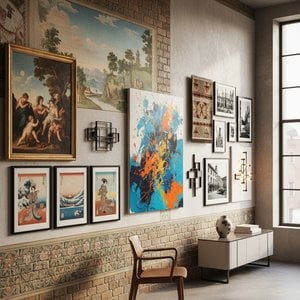
Transforming Spaces: A Comprehensive Exploration of Wall Decor Through Art History & Contemporary Practice
Explore the art of transforming spaces with our comprehensive guide to wall decor. From historical movements to contemporary trends, discover how to curate impactful interiors and commission bespoke artwork for a truly personalized aesthetic.

Maestro del Drama: Las 25 Mejores Obras de Jacopo Tintoretto
Explora las 25 obras maestras de Jacopo Tintoretto y su drama veneciano. ¡Descubre toda la colección en ArtsDot.com!


